

A diffuser breaks essential oil into particles light enough to drift on the air, so the scent fills the room instead of sitting in the bottle. This guide from Scentreat explains what a diffuser actually does, how each type works inside, and what decides whether you can smell it.
What Does an Essential Oil Diffuser Do?

It spreads scent through a room. Inside, it disperses essential oils as droplets or vapor that hang in the air. Air currents carry them around, and your nose picks them up as scent.
Without a diffuser, oil in an open bottle only scents the space right around it.
Some types do a little more. An ultrasonic diffuser releases a bit of moisture with its mist, and many have a soft light. A cold-air diffuser runs on pure essential oils, so it adds no moisture at all.
Timers, apps and night lights are handy extras; they do not change how the scent gets into the air.
What it does not do. A diffuser adds scent; it does not remove dust or germs from the air. For the details, see whether a diffuser actually cleans the air, and read about what a diffuser can add to your day.
How Does an Essential Oil Diffuser Work? The Basic Idea
Every diffuser does three things. It holds the oil, breaks it into tiny particles, and lets air carry those particles into the room. The types only differ in the middle step.
- Hold the oil: in a water tank, a glass bottle, a felt pad, a dish or a porous stone.
- Break it up: with vibration, fast-moving air, gentle heat or plain evaporation.
- Carry it out: as a mist or a vapor that drifts with the air in the room.
The method changes three things you notice: how strong the scent is, how fast the oil runs out, and how much care the diffuser needs. The next section walks through each type.
How Each Type of Diffuser Works

Six designs cover almost every diffuser you can buy. Three use power to make a fine mist, two use power to help oil evaporate, and passive diffusers need no power at all.
Ultrasonic Diffusers: Vibration, Water and Cool Mist

A tiny disc does the work. You fill the tank with water and add essential oils. Under the water sits a small ceramic disc that vibrates faster than you can hear. The vibration breaks the water and oil at the surface into a cool, fine mist.
A small fan then pushes the mist out through the top. Nothing is heated along the way.
What that means at home: the scent is soft because the oil is spread through water, the mist adds a little moisture, and the tank needs a regular rinse.
In our range: the Ceramic Diffuser works this way with a 180 ml tank, where 8 to 12 drops of essential oil give an everyday scent. Browse all our ultrasonic diffusers.
Cold-Air Diffusers: Air Pressure and Pure Oil

Air does the work instead of water. Inside, a tiny pump forces air through a pinhole nozzle. The fast stream sweeps past the top of a thin oil tube, pulls the oil up and shatters it into droplets so small they float.
Two-fluid atomization: that is the maker's name for it, since one fluid is air and the other is oil. Larger versions of the same design scent hotel lobbies and stores, and some connect straight to the air ducts.
What that means at home: the scent is stronger and closer to the smell in the bottle, there is no tank to wash, and the room gets no extra moisture. It does use more oil, so timers and pauses matter.
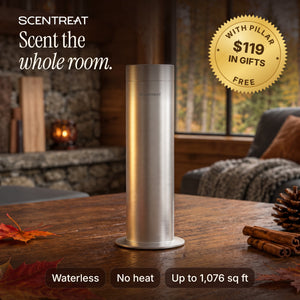
In our range: the Pillar Diffuser works this way from a 150 ml bottle and fills a room of up to 1,500 sq ft. Browse our cold-air diffuser collection.
Nebulizing Diffusers: A Glass Chamber and an Air Pump
The original waterless design. A nebulizer also relies on an air pump, but the oil climbs into an open glass chamber, where the air stream shatters it before it drifts out. Many models attach straight to the oil bottle.
What to expect: a strong scent, a soft hum from the pump on some models, and glass that needs a rinse now and then. For a side-by-side look, see ultrasonic vs nebulizing diffusers.
Heat Diffusers: Warmth Speeds Up Evaporation
Gentle heat helps essential oils evaporate. A heat diffuser warms oil in a small dish, either over a tealight or on an electric plate, and the scent rises into the room as the oil warms.
Simple and silent, a heat diffuser has two downsides: heat can change how some oils smell, and an open flame needs watching.
Evaporative Diffusers: A Fan and a Pad
Moving air lifts the scent off a pad. You put a few drops on a felt pad or filter, and a small fan blows air across it. The lightest parts of the oil leave first, so the scent can shift a little as the pad dries.
These diffusers are small and quiet, which suits a desk, a car or a bathroom shelf.
Passive Diffusers: Reeds, Clay and Terracotta
No power at all. Reed diffusers, clay stones and terracotta pendants soak up oil and let it evaporate slowly from their surface.
Made for small spots. The scent stays close to the diffuser, so they suit a shelf, a closet or a small corner rather than a whole room. Add a few fresh drops when the scent fades.
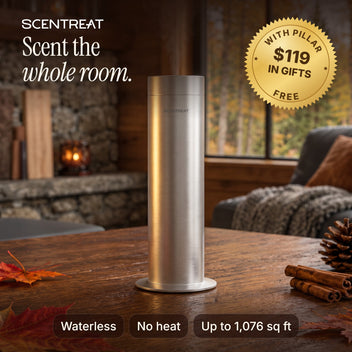
Waterless cold-air diffuser in aluminum: 150 ml oil bottle, covers up to 1,500 sq ft, under 30 dB, app time...
Do Diffusers Actually Work?

Yes, if the diffuser fits the space. Diffusing essential oils fills a room well when the machine matches it. A small diffuser in an open living room will feel weak, and a strong one in a small bedroom can feel like too much. Four things decide how much you smell:
- Room size and airflow: open plans, high ceilings and AC vents spread the scent thin.
- The oil: bright, thin oils like citrus and peppermint travel fast, while heavy base notes stay closer to the diffuser.
- Placement: about waist height, out in the open and away from vents works best.
- Pauses: your nose gets used to a scent after a while, so a diffuser that runs in on and off cycles often smells stronger than one that runs nonstop.
Scent still weak? Start with our step-by-step fixes for a weak diffuser.
Does a Diffuser Add Moisture to the Air?
Only a little, and only some types. An ultrasonic diffuser lets off a small amount of water with its mist. A cold-air diffuser adds none, because it never touches water.
A diffuser cannot replace a humidifier. That job needs a machine built to raise the moisture in a dry room. If dry air is the problem, use a humidifier; if scent is the goal, use a diffuser. Our diffuser vs humidifier guide covers the details.
Conclusion
A diffuser spreads scent by breaking oil into pieces small enough to float, and the type decides how: vibration and water, air pressure, warmth, a fan or slow evaporation. Once you know what happens inside, it is easy to see why some feel soft and others fill a whole room.
For a soft scent in a bedroom, an ultrasonic model like our Ceramic Diffuser is a good fit. For a large shared space like a living room, the Pillar Diffuser spreads pure oil with cold air. When you are ready to compare types side by side, read our guide to the types of diffusers and how to choose one.
Have a question about a specific model? Our team answers on Facebook and Instagram, and at support@scentreat.com.
Frequently Asked Questions
How long does it take to smell a diffuser?
A few minutes in a small room, longer in a large or open one. Cold-air models usually reach the far side of a room faster than ultrasonic ones, because the oil is not mixed with water.
Do diffusers use a lot of electricity?
No. Most draw only a few watts. The Pillar Diffuser runs at 1.5 W, and the Ceramic Diffuser uses a 12 W adapter.
Does every diffuser need water?
No. Only ultrasonic diffusers need water, and some tealight burners use a little in the dish. Cold-air, nebulizing, evaporative and passive diffusers all work with oil alone.
Are diffusers noisy?
Most are close to silent. In an independent lab test, the Ceramic Diffuser measured a quiet 27.3 dB(A) at a distance of 1 m, and the Pillar Diffuser stays under 30 dB on the manufacturer's test. Nebulizers with an air pump can give a soft hum.
Is it safe to run a diffuser around pets and kids?
Yes, with a little care. Run it in short sessions in a room they can leave, keep it out of reach, and go easy on strong oils like peppermint, eucalyptus and tea tree. Our list of kid-safe and pet-safe essential oils shows which oils to skip.

