

Key Takeaways
BEST BUY PICKS
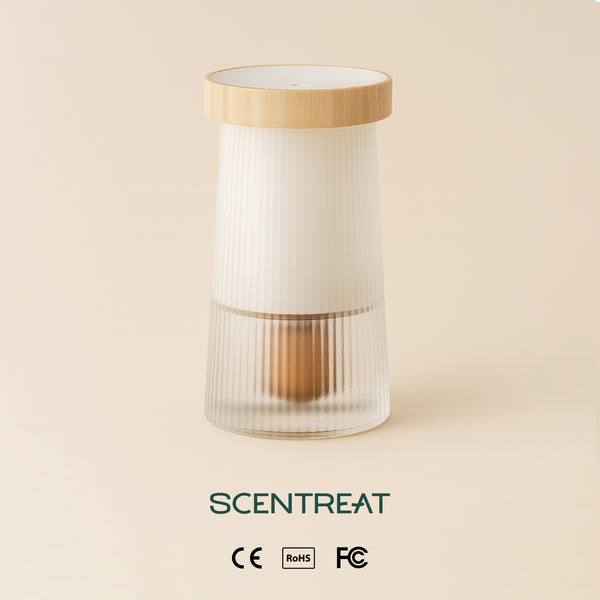
Short answer: A diffuser disperses essential oils for scent and atmosphere. A humidifier adds moisture to dry air. They are not interchangeable — each solves a different problem. If your room feels dry (below 30% relative humidity), you need a humidifier. If you want fragrance, calm, or aromatherapy benefits, a diffuser is the right tool.
Below, Scentreat walks through how each device works, when to use which, and how to know what your room actually needs — starting with your indoor humidity reading.
What Is a Diffuser?

A diffuser is designed to disperse essential oils into the air as a fine mist. It is used for scent, mood, and aromatherapy — not to raise room humidity. In the diffuser vs humidifier comparison, that distinction matters most.
Most modern diffusers use ultrasonic vibration: water and a few drops of essential oil are broken into microscopic particles and released as a cool, quiet mist. The oil molecules travel through the air and interact with the olfactory system, which connects directly to the limbic system — the brain region associated with emotion and memory. That's why scent can shift your mood or help you settle into sleep faster.
Because diffusers use diluted oil in a small water reservoir (typically 100–300 ml), moisture output is minimal. The goal is scent delivery, not humidity control.
Pros of a Diffuser
- Customizable atmosphere: Swap oils to change the mood — lavender for sleep, peppermint for focus, eucalyptus for a clean-air feeling
- Fine scent control: Adjust intensity by changing the number of drops (3–5 drops for a bedroom; up to 10 for a larger living area)
- Low moisture footprint: Won't over-humidify a room or cause condensation issues
- Quiet and simple: Ultrasonic models run nearly silently, requiring only a rinse between oils
Cons of a Diffuser
- Not designed to raise relative humidity — if your room is dry, a diffuser won't fix it
- Requires rinsing every 2–3 uses to prevent oil residue buildup
- Smaller reservoirs (100–200 ml) need refilling every few hours on continuous mode
What Is a Humidifier?

A humidifier increases the moisture level in the air. It is a functional device, not an aromatherapy tool. Most standard humidifiers are built specifically to push water vapor into a room and raise the relative humidity (RH) percentage.
Humidifiers come in several types: ultrasonic (cool mist), evaporative (fan-driven), warm-mist (steam), and impeller models. The common thread: they all output significantly more water vapor than a diffuser — often 200–500 ml/hour versus a diffuser's 20–40 ml/hour.
Critical note: most standard humidifiers are not designed for essential oils. Adding oils to a non-diffuser humidifier can corrode the internal tank, clog the wick, and void the warranty — and may disperse oil particles unevenly into the air in a way that irritates airways.
Pros of a Humidifier
- Meaningful humidity increase: Can bring a 20% RH room up to a comfortable 40–50% in hours
- Covers larger spaces: Designed for whole-room or whole-house use
- Relieves dry-air symptoms: Dry skin, static electricity, cracked lips, sore throat from dry indoor air
Cons of a Humidifier
- No scent experience; not designed for aromatherapy
- Requires more thorough cleaning (mineral scale and mold can build up in the tank within days)
- Can over-humidify a room above 60% RH — which encourages mold and dust mites; a hygrometer helps you avoid this
Diffuser vs Humidifier — Side-by-Side Comparison

| Feature | Diffuser | Humidifier |
|---|---|---|
| Primary purpose | Disperse essential oils for scent & aromatherapy | Add moisture to raise relative humidity |
| Water/moisture output | Low (~20–40 ml/hr); negligible RH change | High (~200–500 ml/hr); raises room RH noticeably |
| Essential oil compatible? | Yes — designed for it | No — most models not compatible; can cause damage |
| Humidity impact | Minimal; does not replace a humidifier | Significant; can shift room RH by 10–25% |
| Scent experience | Controlled, customizable, adjustable | None (or uncontrolled if oils are forced in) |
| Maintenance | Rinse every 2–3 uses; weekly deep clean | Frequent cleaning; mineral & mold risk in tank |
| Best room size | Small–medium (up to ~300 sq ft) | Medium–large; whole-room models available |
| When to use | Want scent, calm, sleep support, mood shift | Room RH below 30%; dry skin, throat, or airways |
| Risk of overuse | Oil buildup in tank if not cleaned | Over-humidification above 60% RH encourages mold |
Key takeaway: a diffuser is not a humidifier, and a humidifier is not a diffuser. Using one to do the other's job won't work — and with a humidifier, adding oils can damage it.
Key Differences Between Diffuser and Humidifier
The clearest way to think about it: diffusers are for how your room feels and smells; humidifiers are for how much moisture the air contains. They address different problems.
Primary Purpose
- Diffuser: Disperse essential oils into the air for scent, atmosphere, and aromatherapy benefits — linalool in lavender, 1,8-cineole in eucalyptus, limonene in citrus each have distinct sensory effects via the olfactory pathway
- Humidifier: Raise the relative humidity (RH%) of the air, addressing dryness caused by heating systems, air conditioning, or low-moisture climates
Moisture Output
- Diffuser: Releases roughly 20–40 ml of water per hour as a micro-mist — enough to carry the oil molecules into the air, not enough to change room RH meaningfully
- Humidifier: Outputs 200–500 ml/hour depending on model; designed to shift room RH by a measurable 10–25 percentage points
Scent Experience
- Diffuser: Provides full, controlled scent — you choose the oil, adjust the drops, pick the mist interval
- Humidifier: No aromatherapy function in standard models; adding oils risks damage and uneven dispersion
Maintenance
- Diffuser: Rinse the tank between oil changes; wipe the ultrasonic disc weekly; simple and quick
- Humidifier: Requires more thorough, frequent cleaning — mineral scale (white dust) and mold can build up in the water tank within days if neglected
How to Know Which You Need

Check your indoor humidity first. A basic hygrometer (under $15 at most hardware stores) gives you the answer in seconds. Then:
- Below 30% RH regularly: Your room is genuinely dry. A humidifier is what you need — a diffuser won't provide enough moisture to help. Use the humidifier to bring RH up to 40–50%, then consider a diffuser alongside it for scent.
- Between 30–50% RH: You're in the optimal range. There's no humidity problem to solve. A diffuser is the right choice for scent, atmosphere, and aromatherapy.
- Above 60% RH: Your room is already too humid. Don't add either device. Focus on ventilation first, and consider a dehumidifier. A humid room that smells stale often needs air circulation, not more moisture — see our guide on why your bedroom smells bad for the full checklist.
Related: if you already have a diffuser but your room feels humid, read using a diffuser in a humid bedroom — there are a few adjustments that help.
When to Use a Diffuser vs a Humidifier
When to Use a Diffuser
A diffuser is the right tool when the goal is atmosphere, not moisture. Use it when you want to:
- Add natural scent to a bedroom, workspace, or living area
- Create a calm environment for sleep or wind-down time
- Shift mood or focus during the day — citrus and peppermint for energy, lavender for settling the nervous system
- Enjoy aromatherapy as a daily ritual without adding humidity
Because a diffuser uses 3–10 drops in a small reservoir, it's well-suited for daily, everyday use. No humidity concern, no mold risk — just clean scent. For a deeper look at what diffusers can do, see our guide to essential oil diffuser benefits, types, and how to choose.
When to Use a Humidifier
A humidifier is right when the air is measurably dry and it's affecting your comfort or health. Use it when you:
- Have confirmed your room is below 30% RH
- Wake up with a dry throat, cracked lips, or nosebleeds from dry air
- Are heating the space intensively in winter (heated air loses moisture)
- Need humidity support for a larger room or open-plan space
If you're noticing a musty or stale odor after running a humidifier, check our cluster on why a room smells bad after diffuser or mist use — the same principles apply to humidifiers.
Does a Diffuser Add Humidity?
Negligibly, no. An ultrasonic diffuser releases a fine mist, but the moisture output is so low (~20–40 ml/hour from a 100–200 ml tank) that it cannot meaningfully raise relative humidity in a standard room. You might see a 1–2% RH bump directly next to the unit, but nothing that registers on a hygrometer across the room.
This also means a diffuser is generally fine to use in a room that's already at comfortable humidity (35–55% RH) — it won't push you into the over-humid zone. If you're worried about humidity and diffusers, read what happens if your bedroom stays humid for too long — the threshold to watch is 60%+ RH sustained over time.
Diffuser vs Humidifier: Which Is Better for You?

Neither is universally "better" — they solve different problems. The honest guide:
Choose a Diffuser If:
- You want to fill your space with natural scent and create an atmosphere
- Your room humidity is already in the 35–55% range
- You use essential oils regularly — lavender for sleep, eucalyptus when stuffy, citrus for a mood lift
- You prefer something quiet, low-maintenance, and safe for daily use
Choose a Humidifier If:
- Your hygrometer consistently reads below 30% RH
- You're dealing with dry skin, dry throat, static electricity, or bleeding from dry nasal passages
- You're in a dry climate or running heat all winter
- Moisture — not scent — is the main issue
Can You Use Both?
Yes — they're complementary, not competing. Run a humidifier to bring dry air up to 40–50% RH, then use a dedicated essential oil diffuser alongside it for scent. Don't add essential oils to your humidifier to try to combine both functions — you risk damaging the unit and getting an uncontrolled, uneven scent.
Why Scentreat Diffuser Works Well for Daily Use

If your humidity is in a good range and you're looking for scent and atmosphere, the Quiet Ceramic & Rubber Wood Ultrasonic Diffuser is designed exactly for that role.
Key specs:
- Ultrasonic technology — no heat, preserves the oil's natural compounds
- Quiet operation suited for sleep and focus sessions
- 200 ml reservoir for small to medium rooms (up to ~300 sq ft)
- Rubber wood and ceramic build — no plastic contact with your oils
- Easy-rinse tank for simple daily upkeep
- 90-day money-back guarantee
For scent pairing, the 100% pure essential oils work directly with ultrasonic diffusers — no carrier oil needed. Drop 3–5 for a bedroom, up to 8–10 for a larger living space.
Conclusion
Diffusers and humidifiers are different tools for different jobs. Check your room's RH with a hygrometer: below 30% means you genuinely need humidity; 30–50% means a diffuser is the right move for scent and comfort; above 60% means focus on ventilation first. A diffuser is not a humidifier — and adding essential oils to a standard humidifier can damage it.
For more ideas on scent and air quality at home, follow us on Facebook and Instagram. Questions about Scentreat's products? Reach us at support@scentreat.com — our team is available 24/7.
Frequently Asked Questions
Is a diffuser the same as a humidifier?
No. A diffuser disperses essential oils for scent and aromatherapy. A humidifier adds moisture to raise the relative humidity of the air. They are fundamentally different devices designed for different purposes.
Can a diffuser replace a humidifier?
No. A diffuser releases only a small amount of water vapor — roughly 20–40 ml per hour — which is not enough to raise room humidity in any meaningful way. If your room is genuinely dry (below 30% RH), you need a humidifier.
Can I put essential oils in a humidifier?
Generally no. Most standard humidifiers are not designed for essential oils. Adding oils can corrode the water tank, clog evaporative wicks, damage the ultrasonic membrane, and void the warranty. It can also disperse oil particles unevenly and may irritate airways. Use a dedicated diffuser for aromatherapy.
Does a diffuser increase room humidity?
Only negligibly. Ultrasonic diffusers release a fine mist, but the water output is far too low to raise room relative humidity noticeably. A hygrometer next to the unit might show a 1–2% bump, but across the room you won't see a difference. This also means a diffuser won't cause humidity problems in a normal room.
How do I know if I need a diffuser or a humidifier?
Check your indoor humidity with a hygrometer. Below 30% RH regularly = you need a humidifier for dry-air relief. Between 30–50% = optimal range, a diffuser is the right choice for scent and atmosphere. Above 60% = neither; focus on ventilation and consider a dehumidifier first.
Which is better for daily use: diffuser or humidifier?
For most people in normal humidity conditions, a diffuser is more practical for everyday use — it creates a comfortable, customizable scent experience without any humidity risk. A humidifier is the right tool only when the air is genuinely dry.
Is a diffuser good for sleep?
Many people find that diffusing calming essential oils — lavender (linalool), chamomile, or cedarwood — helps create a wind-down atmosphere that supports better sleep. Research suggests inhaled lavender may improve perceived sleep quality. For a closer look, read about using a quiet diffuser for better sleep.