

If your essential oil diffuser smells weaker than you expected, adding more oil is rarely the right first move. Scent strength depends on the diffuser type, the room size, where the unit sits, airflow, the output setting, and how well the device has been maintained. In this guide, Scentreat explains how to make your diffuser smell stronger — and get better coverage — without simply pouring in more oil.
Why Doesn't My Diffuser Smell Strong Enough?

A diffuser can be working perfectly and still produce a scent that feels too light.
Sometimes there genuinely is not enough oil for the volume of water in an ultrasonic tank. Just as often the unit is sitting in the wrong part of the room, running on a low-output setting, or being asked to fragrance a space far larger than it was built for.
The type of diffuser matters too. Ultrasonic models mix oil into water and release it as a fine mist. Waterless and cold-air models atomize neat oil, so scent strength is controlled completely differently. Before adding anything, work out what is actually limiting the fragrance.
Start With Settings, Not More Oil

1. Use the right amount of essential oil for your model
On an ultrasonic diffuser the oil-to-water ratio has a direct effect on how noticeable the scent feels. Too little produces a very light aroma, especially in a bigger room. But maxing out the oil is not the answer either, and there is no universal drop count — a 120 ml tank should not get the same amount as a 200 ml one.
Scentreat publishes a range for each model, so start in the middle and move up:
| Model | Tank | Light | Medium (everyday) | Strong |
|---|---|---|---|---|
| Ceramic Diffuser | 180 ml | 6–8 drops | 8–12 drops | 12–15 drops |
| Wood Diffuser | 200 ml | 7–9 drops | 9–13 drops | 13–17 drops |
| Night Light (liquid mode) | 120 ml | 4–5 drops | 5–8 drops | 8–10 drops |
If you are already at the strong end of the range and the scent still feels light, the problem is not the oil — it is one of the other factors below.
2. Try a stronger mist or intensity setting
Most diffusers offer more than one output mode, and this is the cheapest fix available.
On an ultrasonic model, continuous mist releases fragrance steadily and feels noticeably stronger than intermittent mode, which pauses between cycles to stretch the tank. On the Ceramic and Wood models, intermittent is exactly why one fill lasts 8–10 hours instead of 4–5 — that gentler scent is the trade.
On a waterless model, step the intensity up one level at a time. The CalmRide Car Diffuser has three mist levels; the Pillar has adjustable scent strength through its app.
Move up one level and give the scent time to circulate before changing anything else.
3. Check the water level on an ultrasonic diffuser
More water does not mean better performance. Overfilling dilutes the fragrance and interferes with normal mist production, so you lose twice. Always stay below the maximum fill line, and adjust the oil within the recommended range instead of topping up the tank.
Starting each session at the correct water level also makes the scent consistent from one use to the next, which makes it much easier to tell whether a change actually helped.
Placement and Room Size

4. Put the diffuser somewhere the scent can actually spread
Fragrance moves with the air. A diffuser beside an open window, an exterior door, a ceiling fan or an air-conditioning vent loses its scent before it ever reaches the room.
Good placement
- A table, dresser or open shelf
- Open space above the mist outlet
- Near where you actually sit
- Closer to the centre of a large room than to a corner
Poor placement
- Beside an open window or exterior door
- Under or near an HVAC vent
- Inside a cabinet or behind large furniture
- Directly beneath a running ceiling fan
5. Make sure the diffuser actually fits the room
This is the most common reason a diffuser feels weak, and no amount of extra oil will fix it. A compact ultrasonic unit that is lovely in a bedroom will struggle in an open-plan living area.
Layout matters as much as floor area. Scent disperses fastest in spaces with high ceilings, open staircases, connected kitchen-dining areas, wide doorways and constant airflow. In those rooms, adding oil makes the air near the diffuser stronger without improving coverage anywhere else.
| Model | Rated coverage | Built for |
|---|---|---|
| Ceramic Diffuser | 320 sq ft | Bedrooms and single rooms |
| Wood Diffuser | 375 sq ft | Bedrooms and living rooms |
| Night Light Diffuser | 325–430 sq ft | Nightstands, desks, small rooms |
| CalmRide | 108–215 sq ft | Cars, desks, travel |
| Pillar Cold-Air | 1,076 sq ft | Open-plan spaces and large rooms |
Matching the diffuser to the space is almost always more effective than steadily increasing the oil.

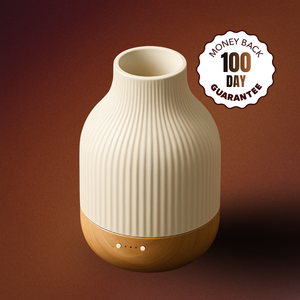
Handcrafted ceramic essential oil diffuser for bedroom and sleep: quieter than a whisper (27.3 dB, lab-test...
Maintenance and Oil Choice

6. Clean it before you add anything
If the diffuser used to smell stronger and has faded gradually, residue is the likely culprit. On an ultrasonic model, oil film and mineral scale build up around the reservoir and the ultrasonic plate, and less mist means less fragrance. A waterless model has the same problem at the atomizer.
Scentreat's published routine for its ultrasonic models is 10 drops of white vinegar in a half-full tank, run about 5 minutes, then clean the plate itself with a cotton swab dampened with vinegar or rubbing alcohol — once a week. Waterless models need a completely different method, so do not borrow one for the other. Full instructions are in How to Clean an Essential Oil Diffuser.
7. Use oils your diffuser can actually handle
Scentreat recommends 100% pure essential oils and advises against thick carrier oils, fragrance oils, and blends with additives that leave residue or interfere with the mechanism.
Viscosity matters most on waterless systems, where neat oil passes through a narrow atomizer. Thicker pure oils — sandalwood, vetiver, myrrh, patchouli — are fine to use, they just need more frequent cleaning. Carrier oils such as coconut, jojoba or sweet almond should never go in.
For waterless models, never add water to make the oil last longer. It does not work, and it creates a problem instead.
8. Pick an oil with more presence
Sometimes the diffuser is not the problem — the aroma itself is simply quiet.
Bright citrus, mint and herbal oils read as strong quickly: lemon, sweet orange, grapefruit, peppermint, eucalyptus, rosemary. Woody, resinous and some floral oils sit softer in the same room at the same drop count: sandalwood, cedarwood, vetiver, frankincense, chamomile.
So two blends with identical drop counts can feel completely different. If you want more presence, change the balance of the blend rather than the total volume — swapping one base note for a citrus top note often does more than three extra drops. Our full range of 100% pure oils is all one price, which makes experimenting cheap.
Two Things That Are Not the Diffuser's Fault

9. Give the scent time to fill the room
A diffuser does not fragrance a room instantly. The mist needs time to disperse, and how long depends on room size, air movement, ceiling height, output, placement and the oil itself.
Do not judge the strength in the first few minutes — and definitely do not add more oil then. Let it run, and assess once the scent has had time to move through the space. In a large room this matters a lot.
10. Consider whether you have simply stopped noticing it
If the scent is obvious when you walk in but seems to vanish later, it is probably still there. Your sense of smell adapts to a constant background aroma — this is called olfactory adaptation, and it is completely normal.
Two quick tests before you touch anything: leave the room for ten minutes and come back, or ask someone who has just arrived whether they can smell it. If they notice it immediately, your diffuser is already producing plenty of scent.
Making an Ultrasonic Diffuser Smell Stronger

Scent strength here is driven by both oil concentration and how much mist is released. In order:
- Check the oil amount against the range for your tank size, and move up gradually rather than all at once.
- Switch to continuous mist. It creates a noticeably stronger immediate scent than intermittent.
- Do not overfill. Fill only to the line — excess water dilutes the scent and hurts mist output.
- Clean the ultrasonic plate. Film and scale quietly reduce output over weeks.
- Improve the placement — away from windows, doors and vents.
Making a Waterless Diffuser Smell Stronger

No water is involved, so the levers are different: output, cycle length, placement and the state of the atomizer.
- Raise the intensity one step at a time, and let the scent spread before going further.
- Adjust the diffusion cycle. A longer active period makes the aroma more continuous — on the Pillar this is set in the Bluetooth app.
- Check the room size. If it is strong beside the unit and gone across the room, the space is bigger than the diffuser's rating.
- Clean the atomizer with the method for waterless mechanisms, never an ultrasonic routine.
- Do not add water. Ever, on an oil-only model.
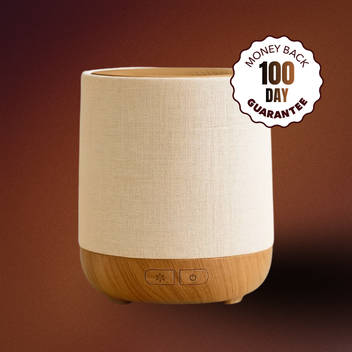
Wood essential oil diffuser that runs up to 10 hours on one 200 ml fill. Quieter than a whisper (27.3 dB, l...
Common Mistakes That Make a Diffuser Smell Weaker

| Mistake | What actually happens |
|---|---|
| Adding too much water | Dilutes the oil concentration and interferes with mist production |
| Putting it next to an open window | The aroma leaves the room as fast as it is released |
| Using intermittent mist when you want immediate scent | The pauses between cycles are the point — it is designed to be gentler |
| A small diffuser in a large open room | Noticeable next to the unit, absent everywhere else |
| Ignoring oil and mineral buildup | Mist or atomizer output drops gradually, so you never notice the decline |
| Just adding more oil | Cannot fix placement, output, room size or a dirty diffuser |
| Changing everything at once | You will never know which adjustment worked |
What Should You Adjust First?

| What you notice | What to try first |
|---|---|
| Scent feels slightly too light | Move up within the recommended oil range, or raise the intensity |
| Strong only near the diffuser | Improve the placement |
| Struggles in a large room | Check the coverage rating — the model may be undersized |
| Mist is weaker than it used to be | Clean the tank and the ultrasonic plate |
| Waterless diffuser has weak output | Check the intensity setting and the atomizer |
| Scent seems to fade after a while | Leave the room and come back — probably olfactory adaptation |
| More oil does not help | Placement, room size or maintenance is the real limit |
Should You Just Add More Essential Oil?

It helps — up to a point. If you are currently at the light end of your model's range, moving toward the strong end will make a real difference.
But once you are already using the right amount, more oil stops helping and starts costing you money. At that stage the limit is one of: mist output, placement, room size, cleanliness, oil choice, or diffusion mode. Work through those instead.
Choosing a Diffuser for the Scent Strength You Want

Want a softer, everyday scent
An ultrasonic diffuser disperses oil together with water, which naturally gives a gentler aroma. The Ceramic Diffuser pairs a 180 ml tank with continuous and intermittent modes — suited to bedrooms and single rooms up to 320 sq ft.
Want noticeably stronger coverage
A waterless cold-air diffuser atomizes neat oil with no dilution, so the scent is more concentrated. The Pillar Cold-Air Diffuser is rated for open spaces up to 1,076 sq ft.
Neither type is automatically better. It depends on the size of your space, how noticeable you want the fragrance, and whether you would rather manage a water tank or an oil bottle.
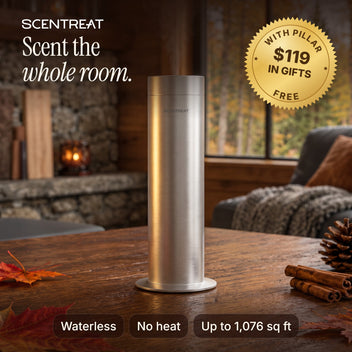
Waterless cold-air diffuser in aluminum: 100 ml oil bottle, covers up to 1,076 sq ft, under 30 dB, app time...
Conclusion
Making a diffuser smell stronger rarely means using more essential oil. Start with the oil amount for your model, the output setting, the placement and the room size — then check whether residue is quietly throttling performance.
For ultrasonic diffusers, focus on the oil-to-water balance, continuous mist mode, and a clean ultrasonic plate. For waterless diffusers, it comes down to intensity settings, cycle length, oil compatibility and atomizer maintenance.
A diffuser that genuinely matches your space should give you a noticeable, comfortable fragrance without running at maximum output all day.
For more essential oil and aromatherapy tips, follow Scentreat on Facebook, Instagram and Pinterest. Any questions about Scentreat products or promotions, email us at support@scentreat.com — our team is always happy to help.
Frequently Asked Questions
How can I make my essential oil diffuser smell stronger?
Use the right amount of oil for your model, switch to a stronger mist or intensity setting, improve the placement, keep it clean, and make sure the diffuser is rated for your room size. Change one thing at a time so you can tell what worked.
Does adding more essential oil make a diffuser smell stronger?
Up to a point. If you are at the light end of the recommended range, moving toward the strong end helps. If you are already using the right amount, check mist output, placement, room size and cleanliness before adding more.
How many drops of essential oil should I put in a diffuser?
It depends on the tank. Scentreat's Ceramic Diffuser (180 ml) uses 6–8 drops for a light scent, 8–12 for everyday and 12–15 for strong. The Wood Diffuser (200 ml) uses 7–9, 9–13 and 13–17. Follow the range for your own model rather than a universal number.
Is continuous mist stronger than intermittent mist?
Yes. Continuous releases fragrance steadily, so the scent builds faster and feels stronger. Intermittent pauses between cycles, which is why it stretches one tank from 4–5 hours to 8–10.
Where should I place my diffuser for a stronger smell?
In an open spot with normal room airflow, roughly where you spend your time, with clear space above the mist outlet. Keep it away from open windows, exterior doors, fans and HVAC vents, which carry the scent off before it spreads.
Why can I no longer smell my diffuser?
If it is still running normally, you have most likely adapted to the scent. Leave the room for ten minutes and come back, or ask someone who has just walked in. If they smell it straight away, nothing needs changing.
Can cleaning make my diffuser smell stronger?
Yes, and it is the most underrated fix. Oil film and mineral scale on the ultrasonic plate reduce mist output gradually enough that you never notice the decline — until you clean it and the scent comes back.
How do I make a waterless diffuser smell stronger?
Raise the intensity one step at a time, lengthen the active diffusion cycle, improve the placement, use a compatible pure oil, and keep the atomizer clean. Never add water.
Can a diffuser be too small for a room?
Yes, and it is the most common reason a diffuser feels weak. Check the coverage rating: 320 sq ft on the Ceramic, 375 on the Wood, 1,076 on the Pillar. If your room is larger than the rating, no amount of oil will close the gap.
Why does my diffuser smell strong close up but weak across the room?
That pattern is almost always placement, airflow or room size — not the oil. Move it toward the centre of the space, away from drafts, and compare the room's floor area against the model's rated coverage.
Will a stronger setting use up my oil faster?
Yes, on both types. Continuous mist and higher waterless intensity both consume oil more quickly. That is the real trade-off to weigh — often a correctly placed diffuser on a medium setting gives a better result than a badly placed one running flat out.

