

Musty odors have one root cause: moisture sitting somewhere it shouldn't — in fabric, wood, drywall, or the air itself. The most effective eliminators don't just mask the smell; they remove the moisture or break down the organic compounds producing it. Baking soda and activated charcoal absorb odors in tight spaces; dehumidifiers control room-level humidity; enzyme cleaners digest the organic compounds causing odors in fabrics; and essential oil diffusers work as a finishing layer once the moisture source is addressed.
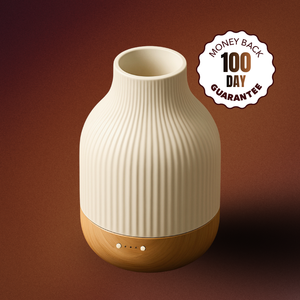
That finishing layer is optional and it is last on purpose: Scentreat's Ceramic & Rubber Wood Diffuser covers a 320 sq ft bedroom from a 180 ml tank at 27.3 dB(A), but it will not remove a musty smell on its own — it only makes a dried-out room pleasant again.
Where the Musty Smell Comes From — in Short

Musty smells come from excess moisture interacting with organic material — mold, mildew, bacteria, and decomposing matter all release volatile compounds that register as that familiar damp, earthy odor. The smell itself is often produced by microbial metabolites called microbial volatile organic compounds (MVOCs), which the EPA notes are associated with mold and dampness indoors.
The six usual sources — hidden mold and mildew, indoor humidity above 60% RH, leaks and damp corners, stagnant air, odor-trapping fabrics, and dirty HVAC filters — are worked through one by one in why your room smells bad. This page stays on the fix: which eliminator to reach for once you know the source, and what each one cannot do.
Musty Smell Eliminator Comparison: Which Method Is Right for Your Problem?

No single product solves every musty odor. Each method works at a different stage — absorption, neutralization, moisture control, or biological breakdown. Use the table below to match the method to your situation, then layer them where needed.
| Method | How It Works | Best For | When to Use It |
|---|---|---|---|
| Baking Soda | Absorbs odor molecules via pH neutralization | Carpets, shoes, refrigerators, small spaces | Light musty odor; sprinkle on fabric, let sit 15–30 min, vacuum |
| Activated Charcoal | Porous structure adsorbs odor particles and moisture | Closets, cabinets, shoes, cars | Ongoing odor prevention in enclosed, low-airflow spaces |
| White Vinegar | Acetic acid kills surface mold and neutralizes odor compounds | Hard surfaces, tile grout, washing machines | Visible mildew on non-porous surfaces; dilute 1:1 with water and wipe |
| Enzyme Cleaners | Beneficial bacteria produce enzymes that digest organic odor compounds | Fabrics, carpets, upholstery, pet areas | Deep fabric odors that baking soda won't shift; soak, don't blot |
| Dehumidifier | Pulls water vapor from the air, lowering ambient RH | Basements, bathrooms, whole-room moisture control | RH consistently above 60%; run until you hit 30–50% |
| HEPA + Activated Carbon Air Purifier | HEPA captures mold spores; activated carbon filter adsorbs gaseous odor compounds (VOCs) | Whole-room air quality after source is addressed | Residual airborne odor; run continuously in affected room |
| Essential Oil Diffuser | Disperses plant-based fragrance to refresh ambient air | Bedrooms, living rooms — freshness maintenance | After moisture and cleaning are done — as a finishing layer, not a fix |
How Does Baking Soda Remove Musty Odors?
Baking soda (sodium bicarbonate) neutralizes acidic odor molecules on contact, making it one of the simplest and cheapest options for fabric surfaces. It doesn't kill mold, but it absorbs the volatile compounds that smell.
Sprinkle a generous layer on a musty carpet or mattress, leave it for at least 15–30 minutes (longer is better), then vacuum thoroughly. For shoes and gym bags, a small open container works well as ongoing odor control. Baking soda is best for mild, surface-level musty smells — if the odor comes back quickly, the source is deeper and you'll need an enzyme cleaner or moisture fix.
When Should You Use Activated Charcoal?

Activated charcoal works best in enclosed, low-airflow spaces — closets, shoe cabinets, car interiors, and under-sink areas where stale odors concentrate. Its highly porous surface area adsorbs both odor molecules and moisture from surrounding air continuously, without adding any scent.
Unlike sprays that mask smells temporarily, charcoal bags keep working for weeks. Most can be refreshed by placing them in direct sunlight for an hour. This makes activated charcoal one of the most practical ongoing solutions for closets and storage spaces.
For a closer look at one of the most common use cases, read Cabinet Musty Smell: Causes and Quick Fixes.
Best Uses for Activated Charcoal
- Closets and linen storage
- Shoe cabinets and gym bags
- Under-sink areas and bathroom cabinets
- Small storage spaces with limited airflow
Does White Vinegar Really Kill Musty Smells?
Yes — on hard, non-porous surfaces. White vinegar's acetic acid kills surface mold and mildew and neutralizes the organic compounds causing the odor. It's effective on tile grout, bathroom fixtures, washing machine drums, and sealed countertops.
Dilute it 1:1 with water in a spray bottle, apply to the surface, let it sit for 10–15 minutes, then wipe clean. The vinegar smell dissipates as it dries. What vinegar cannot do is reach mold that has soaked into a porous material — untreated drywall, soft furnishings, or grout stained below the surface rather than just filmed over on top. Those need enzyme cleaners or professional remediation.
Don't mix vinegar with bleach. The combination produces chlorine gas. Use one or the other.

Handcrafted ceramic essential oil diffuser for bedroom and sleep: quieter than a whisper (27.3 dB, lab-test...
What Are Enzyme Cleaners and Why Do They Work on Fabric Odors?
Enzyme cleaners are the strongest tool for musty odors embedded in fabrics, carpets, and upholstery. They contain beneficial bacteria that produce enzymes — biological catalysts that break down the organic compounds (bacteria byproducts, mold metabolites) causing the smell at a molecular level, rather than masking them.
Standard cleaners and baking soda can't reach odor compounds deep in carpet fibers or mattress foam. Enzyme cleaners penetrate the material and digest those compounds. For best results: saturate the area (don't just blot the surface), cover with plastic wrap to slow drying, and let it work for several hours or overnight. The bacteria need time and moisture to do their job.
When to Reach for an Enzyme Cleaner
- Musty carpet that smells again hours after vacuuming
- Upholstered furniture with lingering damp odor
- Mattresses, cushions, and pet bedding
- Laundry that smells musty even after washing
Do You Need a Dehumidifier? The 30–50% RH Rule
If your indoor humidity consistently runs above 60% RH, a dehumidifier isn't optional — it's the fix. Musty odors caused by high ambient humidity will keep returning no matter how often you clean, because the conditions that create them haven't changed.
An inexpensive hygrometer (under $15 at most hardware stores) shows your room's current RH. Target 30–50% RH. Below 30% the air feels too dry; above 60% mold and dust mites thrive and musty odors develop. Run the dehumidifier until the reading holds in the 30–50% band, then switch to a maintenance cycle.
Basements are the most common problem area — below-grade rooms absorb ground moisture and rarely have enough natural airflow to stay dry. A dehumidifier sized to the room's square footage is the most effective single purchase for a chronically musty basement.
Handcrafted ceramic essential oil diffuser for bedroom and sleep: quieter than a whisper (27.3 dB, lab-test...
Should You Add an Air Purifier with HEPA + Activated Carbon?
A HEPA + activated carbon air purifier addresses what a dehumidifier can't: airborne mold spores and gaseous odor compounds already circulating in the room. The HEPA filter captures particles ≥0.3 microns (including mold spores); the activated carbon layer adsorbs VOCs and odor-causing gases.
This is most useful after you've fixed the moisture source and cleaned the surfaces but still notice a lingering stale smell in the air. Running a purifier continuously in the affected room helps clear residual odor compounds and spores before they resettle. Look for models that combine true HEPA with a thick activated carbon filter — thin carbon pre-filters do very little for VOCs.
An air purifier is a complement to fixing the source, not a replacement for it. If the moisture or mold problem is still active, a purifier will run constantly without making a lasting dent.
Best Musty Smell Eliminator for Everyday Home Freshness: Essential Oil Diffusers

Essential oil diffusers work best as a finishing layer — use them after you've addressed the moisture source and cleaned odor-causing surfaces, not as a substitute for moisture control. Running a diffuser in a damp room doesn't fix the problem; it layers fragrance on top of it.
Once the underlying issue is resolved, ultrasonic diffusers are one of the most comfortable ways to maintain a fresher home environment. They disperse plant-based fragrance gradually without heat or heavy synthetic chemicals, making rooms feel calmer and cleaner over time.
Oils that pair well with a freshened environment:
- Eucalyptus — clean, open, slightly medicinal
- Lemon — bright, cuts through stale air
- Tea tree — antimicrobial character, less sweet
- Lavender — soft, calming, good for bedrooms
- Peppermint — invigorating, works well in living spaces
For bedrooms and everyday living spaces, diffusers are often preferred because they avoid the heavy synthetic base of most aerosol sprays.

The SCENTREAT Ceramic & Rubber Wood Diffuser is designed for exactly this maintenance role: 27.3 dB(A) at 1 m in independent laboratory testing, a 180 ml tank that runs 4–5 hours continuously or 8–10 hours on intermittent mode, and coverage for a room of up to 30 m² (320 sq ft) — quiet enough to leave running in a bedroom, and steady enough that the scent never arrives in bursts. Pair it with any of the fresh & clean essential oils for a noticeably lighter room atmosphere after your odor fix is complete.
You can also explore the full range of ceramic & wood ultrasonic diffusers or browse 100% pure aromatherapy oils to find what works for your space.
When Should You Call a Professional?
Most musty odors are DIY-fixable if the moisture source is accessible and the affected area is small. But some situations need professional help:
- Visible mold covering more than 10 square feet — the EPA recommends professional remediation at this scale.
- Mold inside HVAC ducts or air handlers — cleaning these incorrectly can spread spores throughout the entire home.
- Musty smell that returns within days despite cleaning — indicates an active moisture source you haven't found yet (hidden leak, rising damp, condensation in walls).
- Anyone in the home with asthma, allergies, or respiratory conditions — prolonged mold exposure can worsen symptoms; don't wait it out.
- Water damage from flooding or pipe bursts — surfaces need to be dried within 24–48 hours to prevent mold; professionals have the drying equipment to do this correctly.
The EPA's mold cleanup guidance is a reliable starting point for assessing whether a job is DIY-appropriate or needs a licensed remediation contractor.
How To Choose the Best Musty Smell Eliminator for Your Home
Start by identifying the source, then match the method:
- RH above 60%? → dehumidifier first
- Musty fabric or carpet? → enzyme cleaner
- Enclosed space (closet, cabinet)? → activated charcoal
- Hard surface mildew? → vinegar or commercial mold cleaner
- Lingering airborne odor after cleaning? → HEPA + activated carbon purifier
- Ongoing freshness maintenance? → baking soda for surfaces + essential oil diffuser for ambient air
For homes dealing with musty bedrooms specifically, our guide to common reasons your bedroom smells bad covers the most frequent causes and the right fix for each. If diffusers are part of your freshness routine, our overview of diffuser types and how to choose one helps you pick the right tool for your room size and needs.
Conclusion
The best musty smell eliminator is the one that targets the actual cause. Baking soda and activated charcoal absorb odors in enclosed spaces; vinegar clears surface mildew; enzyme cleaners break down organic odor compounds in fabrics; dehumidifiers solve high-humidity rooms; and HEPA + carbon air purifiers handle residual airborne VOCs. Essential oil diffusers work beautifully as a finishing layer once the moisture source is dealt with — keeping your home smelling genuinely clean rather than just covered up. The Scentreat Ceramic & Rubber Wood Essential Oil Diffuser – 180 ml is rated for a single enclosed room of up to 30 m² (320 sq ft) and measures 27.3 dB(A) at 1 m in independent laboratory testing; the Minimalist Wood Essential Oil Diffuser – 200 ml covers up to 35 m² (375 sq ft) if the room is larger. For more on musty rooms specifically, see Why Does Your Bedroom Never Smell Fresh?
Frequently Asked Questions
What causes musty smells in homes?
Musty smells are produced by microbial volatile organic compounds (MVOCs) released by mold, mildew, and bacteria that grow wherever excess moisture is present. The most common triggers are indoor humidity above 60% RH, hidden leaks, poor ventilation, and moisture trapped in fabrics or walls.
What is the best musty smell eliminator for bathrooms?
Moisture absorbers and a dehumidifier are the most effective starting points for damp bathrooms. If there's surface mildew on tile or grout, white vinegar diluted 1:1 with water kills it without harsh chemicals. Aim for the same 30–50% RH band as the rest of the home, and run the extractor fan during and after every shower so the room dries out instead of staying damp.
Does activated charcoal help remove musty odors?
Yes — activated charcoal is highly effective in enclosed spaces like closets, cabinets, and shoe storage. Its porous structure adsorbs both odor molecules and moisture continuously. Most charcoal bags can be refreshed monthly by placing them in direct sunlight for an hour.
What is an enzyme cleaner and when should I use it?
Enzyme cleaners contain beneficial bacteria that produce enzymes to break down the organic compounds causing musty odors in carpets, upholstery, and fabrics. Use them when baking soda doesn't fully eliminate a smell — saturate the area and allow several hours of dwell time for best results.
Are diffusers good for musty room smells?
Diffusers work best as a finishing layer after the moisture source and odor-causing surfaces are addressed. They refresh ambient air with plant-based fragrance, but they don't remove the conditions that create musty smells. Fix the humidity or mold issue first, then run the diffuser.
If a cat shares the room, keep the session short and the room open — a cat cannot process the phenols and monoterpenes in essential oils, so the dose it cannot avoid is the one that matters. Dogs cope better, but a dog should never be given oil to lick either, and diluted or not, it does not belong on fur.
How do I stop musty smells from coming back?
Keep indoor RH in the 30–50% range (use a hygrometer to check), improve ventilation in enclosed spaces, clean fabrics regularly with enzyme cleaners when needed, and address any leaks or damp areas promptly. Activated charcoal in closets and a dehumidifier in problem rooms are the most practical long-term tools.

