

Most essential oils are not safe for cats, and diffusing them is riskier than most owners expect. Cats cannot break down many compounds in these oils, so even small, repeated exposures can build up. This guide shows which oils to avoid, how different diffusers expose your cat, what poisoning looks like, and a calmer option that uses no essential oils at all.
For the wider picture that also covers dogs and children, start with our kid-safe and pet-safe essential oils guide.
Why Cats Can't Process Essential Oils

The problem sits in the liver. The Merck Veterinary Manual explains that cats are deficient in glucuronyl transferase, an enzyme most mammals use to clear phenols and similar compounds. Many essential oils are rich in exactly these compounds, so a cat clears them slowly and they can accumulate with each exposure.
Cats also take in oil by more routes than people realize. They breathe it in, it settles on their fur, and they swallow that residue when they groom. A dose that seems trivial to you can therefore reach a cat several times over in a single afternoon.
Is It Safe to Diffuse Essential Oils Around Cats?
It depends heavily on the type of diffuser. Veterinary sources split diffusers into two groups. Passive diffusers, such as reeds, only let scent evaporate, so the main risk is irritation of the airways. Active diffusers, which include ultrasonic and nebulizing models, push tiny droplets of oil into the air, and Merck notes that these droplets collect on hair, which makes them an extra risk for cats in particular.
| Diffuser type | How the oil gets out | What reaches your cat | Around cats |
|---|---|---|---|
| Reed or passive | Evaporates slowly | Scent in the air | Lower risk; keep out of reach |
| Ultrasonic (water-based) | Fine mist of water and oil droplets | Scent plus droplets that settle on fur | Only short sessions, door open |
| Nebulizing (waterless) | Undiluted oil droplets | Concentrated droplets on fur and surfaces | Avoid in cat rooms |
| Pheromone plug-in | Gently warmed vial, no essential oil | A calming pheromone signal | Made for rooms cats use |
How to read this table
Diffuser type names the kind of device. How the oil gets out describes what the device releases into the room. What reaches your cat is the part that matters for health, because droplets on fur are swallowed during grooming. Around cats is a practical summary, not a guarantee of safety. For example, the ultrasonic row explains why a water-based diffuser is gentler than a waterless one, yet still needs short sessions with the door left open, because its droplets can still land on your cat.
Can I Diffuse Lavender Around My Cat?

This is where advice online disagrees most. Oil sellers often call lavender cat-friendly, while veterinary publishers such as PetMD list it among the oils to keep away from cats. The honest answer is that no essential oil has been shown to be safe for cats, lavender included. It is simply lower in the phenols cats handle worst than oils like clove or tea tree.
If you still choose to diffuse lavender, treat it as an exposure you are managing rather than a safe scent: a very small amount, a short session, a room your cat does not sleep in, and an open door so your cat can leave. The Tisserand Institute gives the same core advice: ventilate, keep it brief, and never shut a cat in with a diffuser.
Essential Oils That Are Toxic to Cats

The Pet Poison Helpline names these oils as toxic to cats. Keep them out of any room your cat can enter, in a diffuser or in an open bottle:
- Tea tree (melaleuca)
- Eucalyptus
- Peppermint
- Citrus oils (lemon, orange, grapefruit, lime)
- Cinnamon
- Clove
- Pine
- Wintergreen and sweet birch
- Ylang ylang
- Pennyroyal
Wintergreen and sweet birch contain methyl salicylate, a close relative of aspirin, which cats are poorly equipped to clear. Pennyroyal can damage the liver. Tea tree can cause serious reactions even in small amounts, and should never be applied to a cat's skin.
Signs of Essential Oil Poisoning in Cats

Symptoms can appear within minutes or build over several hours. Watch for:
- Drooling, vomiting or pawing at the mouth
- Fast, labored or noisy breathing, coughing or wheezing
- Wobbliness, tremors or muscle twitching
- Unusual weakness, hiding or lethargy
- Yellowing of the gums, skin or eyes in severe cases
If you see any of these, switch the diffuser off, open a window, move your cat to fresh air and call for help straight away. The Pet Poison Helpline is on 855-764-7661 and the ASPCA Animal Poison Control Center is on 888-426-4435; both answer around the clock and may charge a consultation fee. Have the name of the oil ready, and follow up with your vet even if your cat seems to recover.
If You Still Diffuse: A Lower-Exposure Routine

Some households decide to keep diffusing. If that is you, these habits keep your cat's exposure as low as possible:
- Run short sessions of 15 to 30 minutes rather than leaving the diffuser on.
- Use a water-based diffuser and the smallest amount of oil that still gives you a light scent.
- Choose a large, ventilated room that is not where your cat eats, sleeps or uses the litter box.
- Keep the door open so your cat can always walk away.
- Skip diffusing altogether with kittens, senior cats and cats with asthma or liver disease.
- Never put essential oil on your cat's fur, paws or collar, and never add it to food, water or litter.
The ASPCA's poison control team puts it simply: a short session in an area your cat cannot reach is unlikely to cause a problem, while long sessions in shared rooms raise the risk. If you wonder how often is too often for any home, see is it bad to run a diffuser every day.
A Calmer Cat Without Essential Oils: Pheromone Diffusers
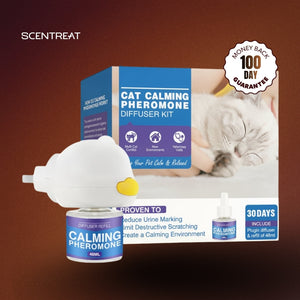
Many owners reach for a diffuser because their cat seems stressed, not because they want a scent. For that goal there is an option that leaves essential oils out of the room entirely. A pheromone diffuser plugs into the wall and gently warms a vial of a formula made to echo the calming signals cats leave when they rub their cheeks on familiar places. People cannot smell it, and your cat does not have to wear or eat anything.
The research is encouraging but not conclusive. A 2023 Veterinary Evidence review found that feline facial pheromone may reduce signs of stress, particularly around vet visits, and that it works best alongside other steps. The Scentreat Pet Calming Diffuser Kit uses a 48 ml vial that lasts about 30 days of continuous use and covers about 700 sq ft, roughly a large living room with an open kitchen, with a separate cat formula. Plug it in where your cat rests, leave it on, and give it two to four weeks alongside a steady routine, hiding places and daily play.
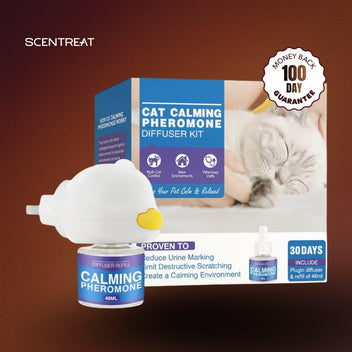
A plug-in pheromone diffuser for cats or dogs, with a 30-day vial in the box. It gently warms a vial of phe...
Homes With Both Cats and Dogs
When cats and dogs share a home, the cat rules win. Several oils that some sources list as tolerable for dogs, including citrus and peppermint, are on the cat toxic list, and cats are less able to clear what they absorb. Our guide to diffusing essential oils around dogs covers the dog side, but in a mixed home, diffuse only where your cat never goes. For calming, cat and dog pheromone formulas are different, so each pet needs its own diffuser in the rooms it uses most.
Essential Oils and Cats: The Bottom Line
No essential oil is proven safe for cats. Their livers clear these compounds slowly, droplets from active diffusers settle on their fur, and oils such as tea tree, eucalyptus, peppermint and citrus are firmly toxic. If you diffuse at all, keep sessions short, the room ventilated and the door open.
If your real goal is a calmer cat, the Pet Calming Diffuser Kit gets you there without essential oils: a cat pheromone formula in a plug-in vial that runs quietly for about 30 days.
Not sure what suits your home? Message us on Facebook or Instagram, or write to support@scentreat.com, and our team will help you choose.
Frequently Asked Questions
Are any essential oils safe for cats?
No essential oil has been shown to be completely safe for cats, because cats lack glucuronyl transferase, the liver enzyme that clears many of the compounds in these oils. Lavender, chamomile and frankincense are sometimes described as lower risk, but even these need a very small amount, a short session and a way for your cat to leave the room.
Are ultrasonic diffusers safe for cats?
Ultrasonic diffusers are active diffusers: they release a mist of fine droplets that can settle on your cat's fur and be swallowed during grooming. They are gentler than waterless nebulizing models because the oil is diluted in water, but around cats they should only run for 15 to 30 minutes at a time in a ventilated room with the door open.
Can I leave a diffuser on overnight with my cat?
No. Running an essential oil diffuser for hours, especially in a closed bedroom, lets the concentration build up and gives your cat no break from it. Turn it off before bed, or keep it in a room your cat cannot enter.
What should I do if my cat was exposed to essential oils?
Switch the diffuser off, open a window and move your cat to fresh air. Call the Pet Poison Helpline on 855-764-7661 or the ASPCA Animal Poison Control Center on 888-426-4435, have the oil name ready, and follow up with your vet even if the symptoms seem mild.
Do pheromone diffusers help calm cats?
Some studies suggest feline facial pheromone can reduce signs of stress in cats, especially around vet visits, although the evidence is mixed and it works best alongside a steady routine and places to hide. The Scentreat Pet Calming Diffuser Kit uses a cat formula in a 48 ml vial that lasts about 30 days and contains no essential oils.

