

Diffusing essential oils around dogs can be done, but only with the right oils, short sessions and a room your dog can leave. Dogs smell far more keenly than we do, and several popular oils are toxic to them. This guide sorts oils into safer, disputed and toxic, explains how each type of diffuser exposes your dog, and offers a calming option that uses no oil at all.
If you also have cats or young children at home, read our safe essential oils for pets and kids overview first.
In this article
Are Essential Oils Safe for Dogs?
Some are tolerated in small amounts, and some are not safe at any dose. The difference comes down to three things: which oil it is, how concentrated it is, and how your dog is exposed. Dogs can breathe oil in, absorb it through the skin, or swallow it after licking a spill or their own coat, and every route adds up.
A dog's nose is also far more sensitive than ours, so a scent that feels light to you can be intense for them. Puppies, senior dogs, small breeds and flat-faced breeds such as pugs and bulldogs tend to react more strongly, as do dogs with breathing problems, liver disease or a history of seizures.
Is It Safe to Diffuse Essential Oils Around Dogs?

The ASPCA's poison control team says a diffuser used for a short time in an area your dog cannot get into is not likely to be a problem, but dogs with breathing problems should not be around one at all. How much reaches your dog also depends on the device. The Merck Veterinary Manual separates passive diffusers, which mainly irritate the airways, from active ones that release droplets of oil into the air.
| Device | What it releases | Main risk for dogs | With a dog at home |
|---|---|---|---|
| Reed diffuser | Scent that evaporates | Airway irritation; spills if knocked over | Keep high and out of reach |
| Ultrasonic diffuser | Water mist carrying oil droplets | Breathing in droplets; residue on the coat | Short sessions, door open |
| Nebulising diffuser | Undiluted oil droplets | High airborne concentration | Not in rooms your dog uses |
| Pheromone plug-in | A calming signal from a warmed vial | No essential oil involved | Designed for the rooms dogs rest in |
How to read this table
Device is the type of diffuser. What it releases is what ends up in the air. Main risk for dogs names the way that output can harm a dog, and With a dog at home is the practical rule we suggest. Take the ultrasonic row: because the oil travels in water droplets it is gentler than a nebuliser, but the droplets can still settle on your dog's coat and be licked off later, so it belongs in short sessions with the door open.
Essential Oils for Dogs: Safer, Disputed and Toxic

Lists online contradict each other, mostly because oil sellers and veterinary sources start from different goals. This table sorts the common oils by how consistently trusted sources describe them.
| Group | Oils | What it means for diffusing |
|---|---|---|
| Generally better tolerated | Lavender, Roman chamomile, frankincense, ginger, myrrh | Low amounts, short sessions, good airflow |
| Disputed | Citrus oils including bergamot and lemon, cedarwood, rosemary | Sources disagree; skip them in shared rooms |
| Toxic, avoid | Tea tree, pennyroyal, wintergreen, sweet birch, pine, clove, cinnamon, peppermint, ylang ylang, eucalyptus | Never diffuse where your dog goes |
How to read this table
Group shows how trusted sources rate each oil. Oils lists the oils in that group. What it means for diffusing turns the rating into a rule for your home. For example, lavender sits in the first row because veterinary writers such as PetMD list it among the oils dogs tolerate best, yet that still means a few drops for a short session, not an all-day diffuser. Tea tree sits in the last row because the Pet Poison Helpline lists it among the oils most dangerous to dogs, and the ASPCA notes that concentrated tea tree oil can cause problems with only seven or eight drops.
Signs a Diffuser Is Bothering Your Dog

Your dog cannot tell you a scent is too strong, so watch for these signals during or after a session:
- Sneezing, coughing, watery eyes or laboured breathing
- Drooling, vomiting or pawing at the face
- Leaving the room, hiding, whining or pacing
- Tiredness, weakness or a wobbly walk
- Tremors, which call for urgent help
At the first sign, turn the diffuser off, open a window and let your dog move to fresh air. If symptoms continue or you see tremors or breathing trouble, call the Pet Poison Helpline on 855-764-7661 or the ASPCA Animal Poison Control Center on 888-426-4435, with the oil name to hand. Both may charge a consultation fee.
A Dog-Friendly Diffusing Routine

- Choose an oil from the first row of the table and start with one or two drops.
- Run 20 to 30 minutes, then switch off and air the room before the next session.
- Pick a larger room with a window or door open, never a small closed bedroom.
- Keep the diffuser away from your dog's bed, crate, food and water bowls.
- Always leave a way out, and never shut your dog in with a running diffuser.
- Store bottles out of reach, and never put essential oil on your dog's skin or coat.
Placement matters as much as timing; our guide on where to place a bedroom diffuser explains how height and airflow change what reaches the floor, where your dog breathes.
For an Anxious Dog: A Pheromone Diffuser Instead of Oils
If you are diffusing to settle a nervous dog during fireworks, storms, time alone or a move, a pheromone diffuser does that job without putting essential oil in the air. It plugs into the wall and gently warms a vial of a formula made to echo the reassuring signal nursing mothers give their puppies. Your dog does not need to wear anything, and people cannot smell it.
The evidence is still limited: a 2021 Veterinary Evidence review judged dog-appeasing pheromone unlikely to cause harm but its benefit unproven on its own, so it works best as part of a wider plan. The Scentreat Pet Calming Diffuser Kit has a dog formula in a 48 ml vial that lasts about 30 days and covers about 700 sq ft, about the size of an open-plan living area. Plug it in where your dog rests, start it a few days before a known event, and pair it with a quiet den, a steady routine and daily exercise.
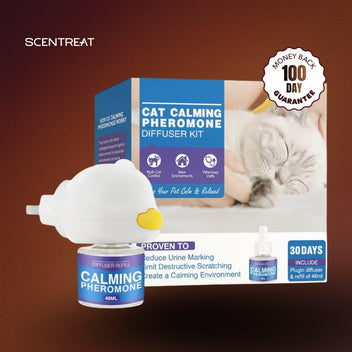
A plug-in pheromone diffuser for cats or dogs, with a 30-day vial in the box. It gently warms a vial of phe...
Homes With Dogs and Cats
Some oils that dogs tolerate are toxic to cats, and cats clear these compounds far more slowly. If both share your home, follow the stricter rules in our guide to essential oils safe for cats and only diffuse in rooms your cat never enters. Pheromone formulas are species-specific too, so each pet needs its own diffuser.
Diffusing Around Dogs: The Bottom Line
You can diffuse essential oils around dogs if you stick to the better-tolerated oils, keep sessions to 20 to 30 minutes, ventilate the room and always leave your dog a way out. Tea tree, pennyroyal, wintergreen, pine and the other oils in the toxic row do not belong anywhere your dog spends time.
If what you really want is a calmer dog, the Pet Calming Diffuser Kit gives you that without essential oils: a dog pheromone formula in a plug-in vial that runs for about 30 days.
Questions about your own dog or setup? Reach us on Facebook or Instagram, or email support@scentreat.com, and we will help you work it out.
Frequently Asked Questions
Which essential oils are safe to diffuse around dogs?
Lavender, Roman chamomile, frankincense, ginger and myrrh are the oils veterinary sources most often describe as better tolerated by dogs. Even these need one or two drops, a 20 to 30 minute session and a room your dog can leave.
Are essential oil diffusers bad for dogs?
They can be. Ultrasonic and nebulising diffusers release droplets of oil that dogs breathe in and that settle on their coat, and dogs with breathing problems should avoid them entirely. The ASPCA says a short session in an area your dog cannot access is unlikely to cause a problem.
How long can I run a diffuser around my dog?
Keep sessions to about 20 to 30 minutes, then switch off and air the room. Do not leave a diffuser running overnight in a closed room with your dog.
Can I use essential oils to calm my anxious dog?
It is safer not to rely on essential oils for anxiety. A pheromone diffuser such as the Scentreat Pet Calming Diffuser Kit uses a dog formula in a 48 ml vial that lasts about 30 days, with no essential oil, and works best alongside a quiet den and a steady routine.
What should I do if my dog reacts to a diffuser?
Turn the diffuser off, open a window and move your dog to fresh air. If symptoms continue, or you see tremors or breathing trouble, call the Pet Poison Helpline on 855-764-7661 or the ASPCA Animal Poison Control Center on 888-426-4435.

