

Portable diffuser vs traditional diffuser — which one actually fits the way you use essential oils? A portable diffuser is compact and easy to run in a car, at an office desk, or while traveling. A traditional diffuser is generally better suited to bedrooms, living rooms, and larger spaces. Both have real advantages; they simply solve different problems. In this guide, Scentreat compares the 10 differences that actually change which one you should buy.
Portable Diffuser vs Traditional Diffuser at a Glance
Before looking at each difference in detail, here is the short version.
| Feature | Portable Diffuser | Traditional Diffuser |
|---|---|---|
| Size | Compact and easy to carry | Usually larger and designed to stay in one place |
| Power source | Rechargeable battery, USB, or passive | Usually plug-in, or passive |
| Runtime | Limited by battery or a small reservoir | Often longer with continuous power |
| Coverage | Personal spaces and smaller rooms | Small rooms to large open spaces |
| Technology | Waterless, ultrasonic, or passive | Ultrasonic, waterless, nebulizing, heat, or reed |
| Scent output | Personal to moderate | Moderate to strong, depending on model |
| Best use | Car, travel, desk, bedside | Bedroom, living room, office, large rooms |
| Spill risk | Often lower on waterless models | Depends on the technology |
| Controls | Usually simple and compact | Often more settings and features |
| Cost | Varies with battery and technology | Varies widely with size and technology |
The biggest difference is not simply performance. It is where the diffuser is designed to be used.
What Is a Portable Diffuser?
A portable diffuser is a compact aromatherapy device designed to move easily between locations. It may run on a rechargeable battery, on USB power, or through a completely passive diffusion method.
Portable diffusers can be water-based or waterless. A portable ultrasonic diffuser mixes essential oil with water and creates a fine mist, while a waterless model atomizes essential oil directly without using a water tank.
Because they are smaller and easier to move, portable diffusers are commonly used in cars, hotel rooms, offices, on desks, or beside the bed.

Types of Portable Diffusers
Rechargeable waterless diffusers
Rechargeable waterless diffusers use essential oil directly, without mixing it with water. A built-in battery lets the diffuser run without staying connected to an outlet, which is especially useful in cars, on desks, in hotel rooms, and in other small spaces. Some models connect straight to a bottle of essential oil, so there is no separate water tank at all.
Car diffusers
Car diffusers are designed specifically for use inside a vehicle. Depending on the design they may sit in a cupholder, clip to an air vent, or run from USB power. Rechargeable waterless car diffusers are particularly convenient because there is no water reservoir to refill or carry around inside the car.
Mini USB ultrasonic diffusers
Mini USB diffusers use the same basic technology as larger ultrasonic diffusers. Water and essential oil go into a small reservoir, and ultrasonic vibration turns the mixture into a fine aromatic mist. The smaller tank makes them easy to put on a desk or pack for a trip, but it also means more frequent refilling than a full-size home diffuser.
Personal diffusers (aromatherapy jewelry)
Personal diffusers include aromatherapy necklaces, bracelets, and similar accessories. Instead of producing mist, they normally use an absorbent pad, a porous stone, or another material that slowly releases aroma close to the wearer. They need no electricity and no water, but the scent zone is intentionally very small.
What Is a Traditional Diffuser?

In this comparison, a traditional diffuser means a diffuser designed to stay in one place rather than travel with you. These models are the ones most people use in bedrooms, living rooms, offices, and other home spaces.
Traditional diffusers cover several technologies. Ultrasonic models combine water and essential oil to create a cool mist, while waterless and nebulizing diffusers disperse oil directly. Heat, evaporative, and reed diffusers use simpler methods to release fragrance into the surrounding air.
Because portability matters less, traditional models can offer larger reservoirs, continuous plug-in power, broader coverage, and more control over operating time and scent output.
Types of Traditional Diffusers
Tabletop ultrasonic diffusers
Tabletop ultrasonic diffusers are the most common essential oil diffusers for home use. They use high-frequency vibration to turn water and essential oil into a fine, cool mist. Many include adjustable mist modes, timers, lighting, and automatic shutoff when the water runs low.
Plug-in waterless and nebulizing diffusers
Waterless and nebulizing diffusers disperse essential oil without mixing it into a conventional water reservoir. Depending on the design they may use an atomizer, air pressure, or cold-air diffusion to create very small oil droplets. Larger plug-in versions are usually built for much greater scent coverage than compact portable models. If you want the detail, see our guide to ultrasonic vs nebulizing diffusers.
Heat and evaporative diffusers
Heat diffusers use gentle warmth to encourage fragrance to evaporate. Evaporative diffusers let aroma disperse naturally, or use airflow from a small fan to move scent into the space. Both are simpler than ultrasonic or cold-air systems.
Reed diffusers
Reed diffusers need no electricity at all. Reeds absorb fragrance liquid from a bottle and gradually release the scent into the air. They give continuous passive fragrance, but far less control over timing and intensity than an electronic diffuser.
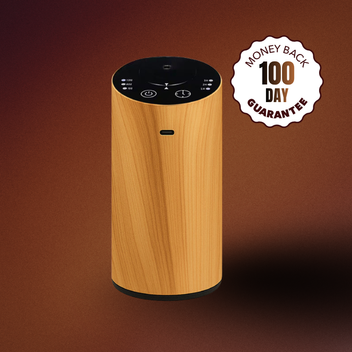
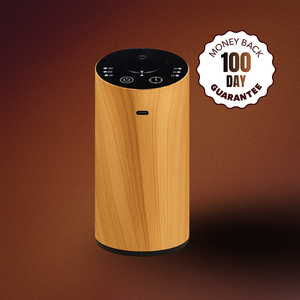
Waterless car diffuser that runs straight from a 10–20 ml oil bottle: no water, up to 60 hours per USB-C ch...
Portable Diffuser vs Traditional Diffuser: 10 Key Differences

When you compare a portable diffuser vs a traditional diffuser, the better choice depends on how you plan to use it. These are the 10 differences that matter most.
1. Size and portability
Size is the most obvious difference. Portable diffusers are built to be compact enough for a desk, a cupholder, a bedside table, or a suitcase. Traditional diffusers are generally larger because portability is not the priority — that extra space goes into a larger water tank or oil reservoir, a decorative housing, or more powerful diffusion components.
If you move your diffuser between places often, a portable design wins outright. If it will sit in the same room most of the time, a larger traditional model is usually more practical.
2. Power source: battery vs plug-in
Portable electronic diffusers commonly run on a rechargeable battery or USB power, so they work away from a wall outlet and you have far more freedom over placement.
Traditional electronic diffusers are more often plug-in devices. That limits where they can go, but they never have to stop to charge. For regular home use, continuous plug-in power is usually more convenient; for cars, travel, and flexible placement, rechargeable power makes more sense.
3. Runtime and battery life
Runtime works differently in the two categories. On a portable rechargeable diffuser, operating time depends on battery capacity, mist intensity, and how often the diffuser actually runs. A traditional plug-in diffuser has no battery limit — its runtime is set by the water tank, the oil reservoir, and the timer you choose.
For example, the Scentreat CalmRide Car Diffuser is rated for up to 60 hours of misting per USB-C charge, measured on its lowest mist level. The Scentreat Ceramic Diffuser, by comparison, runs roughly 4–5 hours continuously or 8–10 hours in intermittent mode from its 180 ml water tank — and it keeps doing that for as long as it stays plugged in.
4. Coverage area
Portable diffusers are designed for smaller scenting zones: cars, desks, small offices, hotel rooms, and bedside areas. Traditional diffusers cover a much wider range. A tabletop ultrasonic model suits a bedroom or office, while a larger cold-air system is built for an open-plan living area.
Scentreat's rated coverage makes the gap concrete: the CalmRide is rated for roughly 108–215 sq ft, the Ceramic Diffuser for an enclosed room up to about 320 sq ft, and the Pillar Cold-Air Diffuser for spaces up to 1,076 sq ft.
Choose by room size rather than by whichever diffuser looks like it makes the most mist. Our guide to the best diffusers for large rooms goes into this in more depth.

5. Diffusion technology: water-based vs waterless
Portable does not automatically mean waterless, and traditional does not automatically mean ultrasonic. Both categories use several technologies.
Ultrasonic diffusers combine water and essential oil before releasing a fine mist. Waterless diffusers atomize essential oil directly, with no conventional water tank. Portable models may also use passive evaporation, while traditional models add nebulizing, heat, evaporative, and reed systems.
6. Scent intensity and mist output
A portable diffuser can produce a clearly noticeable scent in a small space, especially a waterless one, because the oil is not diluted in water. What it is not designed to do is fill a large open room.
Traditional diffusers cover a wider range of intensity. An ultrasonic tabletop diffuser gives gentle everyday fragrance; a larger waterless cold-air diffuser delivers stronger coverage across open space.
The useful question is never which category makes more mist. It is whether the output matches the size of the room.
7. Where you can use it
Portable diffusers work best when your routine moves through the day — cars, office desks, hotel rooms, bedside tables, small personal spaces, and travel accommodation.
Traditional diffusers suit fixed locations: bedrooms, living rooms, home offices, entryways, studios, and large open rooms.
For many people the two complement each other rather than compete. A portable diffuser handles the commute and the office; a traditional diffuser stays at home.
8. Spill risk and travel safety
Water-based diffusers need care when they move. An ultrasonic diffuser should be emptied before you transport it, because water can reach parts of the device that are not meant to get wet.
That is exactly why waterless portable models are convenient for travel: with no conventional water tank, there is far less liquid moving around inside the unit. Essential oil still needs to be secured properly, and every diffuser should stay upright and follow the placement instructions for its model.
9. Features and controls
Traditional electronic diffusers have room for more controls and no battery to conserve. Features often include continuous and intermittent mist, multiple timers, adjustable lighting, automatic shutoff, larger reservoirs, and in some cases app or Bluetooth control.
Portable diffusers keep their controls simpler — which is not the same as having none. The CalmRide offers three mist levels and 1, 2, or 3-hour timers, so you still control scent output without a complicated interface.
10. Upfront cost vs ongoing cost
Portable diffusers are not automatically cheaper. Price depends on technology, battery, materials, controls, coverage, and construction — the Scentreat CalmRide is $79.95 and the tabletop Ceramic Diffuser is $99.95, but the gap would reverse with different models.
Ongoing cost varies too. Ultrasonic diffusers dilute essential oil in water, so a bottle lasts longer. Waterless systems use neat oil and go through it faster. Reed diffusers need replacement liquid and reeds. Rechargeable portable diffusers also contain batteries that lose capacity over the years.
Compare on how often you expect to use the diffuser, not on the sticker price alone. If you are still weighing up formats, our checklist on what to check before buying a diffuser is a good next read.
Pros and Cons of Portable Diffusers
Portable diffusers prioritize convenience, mobility, and a compact footprint.
Pros
- Easy to move between locations
- Convenient for travel
- Well suited to cars and desks
- Compact footprint
- Rechargeable models run without an outlet
- Waterless models need no water tank
- Easy to store
- Good for smaller personal spaces
Cons
- Designed for smaller coverage areas
- Rechargeable models need charging
- Battery capacity declines with age
- Mini water tanks need frequent refilling
- Less suitable for large open rooms
- Fewer controls than most full-size home diffusers
Pros and Cons of Traditional Diffusers
Traditional diffusers prioritize regular room use, longer sessions, and broader coverage.
Pros
- Wider range of room coverage
- Plug-in models never depend on battery life
- Larger water tanks or oil reservoirs
- Suitable for long home sessions
- More diffusion technologies to choose from
- Usually more timers and controls
- Large waterless systems handle open-plan spaces
- Many models are designed to suit home decor
Cons
- Less convenient for travel
- Usually need a permanent surface and an outlet
- Water-based models need filling and cleaning
- Larger models take up more space
- A filled ultrasonic diffuser should not be moved around
- High-output waterless systems use oil faster
Which Is Better for Travel, Cars, and Offices?
A portable diffuser is the better choice for travel and car use. It packs more easily, and a rechargeable model runs without needing a permanent outlet. Waterless portable diffusers are particularly convenient here, because there is no reservoir to fill before use or empty before you move the device.
For an office, the answer depends on the space. A portable diffuser works well on a private desk because it creates a smaller scenting zone. A traditional tabletop model is better for a private office where the diffuser stays put all day.

Handcrafted ceramic essential oil diffuser for bedroom and sleep: quieter than a whisper (27.3 dB, lab-test...
Which Is Better for Home and Large Spaces?
For regular home use, traditional diffusers generally have the advantage. A bedroom, living room, or home office does not need constant portability, so continuous power, a larger reservoir, and broader coverage become the things that actually matter.
A tabletop ultrasonic diffuser is the practical choice for bedrooms and everyday home spaces when you prefer a softer, water-based mist — see our picks for the best diffuser for a bedroom.
For larger or open-plan rooms, a plug-in waterless or cold-air diffuser covers far more ground than any compact portable device. Choose it on the manufacturer's rated coverage rather than running a smaller diffuser at maximum output and hoping.
Portable Diffuser vs Traditional Diffuser: Which Is Better for You?
Choose a portable diffuser if you
- Want essential oils in your car
- Travel regularly
- Move your diffuser between rooms
- Want something compact for a desk
- Prefer cordless operation
- Need fragrance in a smaller personal space
Choose a traditional diffuser if you
- Mainly diffuse at home
- Want broader room coverage
- Prefer continuous plug-in power
- Want a larger water or oil capacity
- Need longer diffusion sessions
- Want more control over timers, mist, and lighting
For plenty of routines the real answer is not one or the other. A traditional diffuser stays at home while a portable diffuser covers the car, the office, and travel.
Scentreat Essential Oil Diffusers: Aromatherapy at Home and On the Go
Scentreat makes different diffuser designs for different spaces, from ultrasonic home diffusers to compact waterless models for the car, the desk, and travel.
Why Scentreat? Rather than asking one diffuser to work everywhere, the range lets you pick the diffusion method, the coverage, and the format that match how you actually use essential oils. The current diffuser collection includes ultrasonic, portable waterless, and larger cold-air options.
The traditional option: Scentreat Ceramic Diffuser
The Scentreat Ceramic Essential Oil Diffuser ($99.95) is built for regular home use. A real porcelain cover and a natural rubber wood base sit over ultrasonic cool-mist technology — a classic tabletop option for bedrooms, offices, and everyday spaces.
| Diffusion type | Ultrasonic cool mist |
|---|---|
| Water tank | 180 ml |
| Runtime | About 4–5 hours continuous, or 8–10 hours intermittent |
| Coverage | Up to about 320 sq ft |
| Timer | 1, 3, or 8 hours, plus continuous mode |
| Noise | 27.3 dB(A) measured at 1 meter |
| Light | Warm light: bright, dimmed, breathing, or off |
| Automatic shutoff | Yes, when the water runs out |
| Power | Plug-in adapter |
Best for: bedrooms, home offices, small to medium rooms, bedside use, and anyone who prefers a softer water-based mist. If you want a warmer, all-wood look instead, the Wood Diffuser ($79.95) runs the same way with a 200 ml tank and about 375 sq ft of coverage.
The portable option: Scentreat CalmRide Car Diffuser

For portable use, the Scentreat CalmRide Car Diffuser ($79.95) is cordless and waterless. Instead of filling a tank, a compatible 10 or 20 ml bottle of 100% pure essential oil screws directly onto the diffuser. It is designed first for cars, but it moves just as easily to a desk, a nightstand, or a hotel room.
| Diffusion type | Waterless atomization |
|---|---|
| Oil compatibility | Compatible 10–20 ml bottles of 100% pure essential oil |
| Power | USB-C rechargeable |
| Battery runtime | Up to 60 hours per charge, on the lowest mist level |
| Charging time | About 4 hours |
| Coverage | About 108–215 sq ft |
| Mist levels | 3 |
| Timers | 1, 2, or 3 hours |
| Noise | Under 35 dB |
| Water tank | None |
Real-world battery life varies with mist level, how often it runs, battery condition, and temperature.
Best for: cars, commuting, office desks, small workspaces, hotel rooms, travel, nightstands, and anyone who prefers waterless, cordless diffusion.
If you need both: the Pillar Cold-Air Diffuser
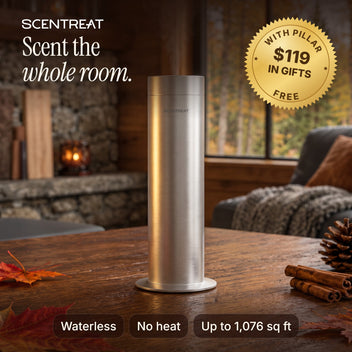
For an open-plan living room or a whole floor, the Pillar Cold-Air Diffuser ($169.95, from $199.95) is the traditional end of the range taken further. It is waterless like the CalmRide but rated for up to 1,076 sq ft, runs under 30 dB, holds a 100 ml oil bottle, and is controlled by Bluetooth app or one-touch.
Pair your diffuser with 100% pure essential oils
The diffuser decides how aroma reaches the room. The oil decides what the room smells like.
Scentreat's 100% pure single essential oils come in 10 ml amber glass bottles at $14.99, with no fillers, carrier oils, or synthetic fragrance. Current options run from Lavender and Peppermint to Frankincense, Sandalwood, Sweet Orange, and Bergamot.
For an ultrasonic diffuser, add oil to the water tank following the instructions for your model — our guide on how many drops to use in a diffuser has the numbers. For a waterless diffuser such as the CalmRide, the oil bottle connects directly and no water is involved.
Conclusion
When you compare a portable diffuser vs a traditional diffuser, the best choice comes down to where you plan to use it. Portable diffusers are ideal for cars, travel, desks, and smaller personal spaces. Traditional diffusers give you more flexibility in bedrooms, living rooms, and larger home environments. With both portable and home options in the range, Scentreat makes it easier to pick a setup that fits your daily routine — and for a lot of people, the honest answer is one of each.
For more essential oil and aromatherapy tips, follow Scentreat on Facebook and Instagram. If you have questions about Scentreat products or promotions, get in touch or email support@scentreat.com.
Waterless cold-air diffuser in aluminum: 100 ml oil bottle, covers up to 1,076 sq ft, under 30 dB, app time...
Frequently Asked Questions
Is a portable diffuser better than a traditional diffuser?
Neither is better overall. A portable diffuser is better for travel, cars, desks, and smaller spaces; a traditional diffuser is better for regular home use and broader room coverage. The right answer depends entirely on where you plan to use it.
Are portable essential oil diffusers waterless?
Some are, but not all. Portable diffusers can use waterless atomization, water-based ultrasonic technology, USB power, or passive evaporation. Check the product description before you buy, because it changes how you fill and clean the device.
Can I use a portable diffuser in my car?
Yes, if the diffuser is designed for vehicle use. Car diffusers are compact and may be rechargeable, USB-powered, or passive. A waterless model such as the Scentreat CalmRide is the easiest option in a car because there is no water to spill.
Which diffuser is better for a large room?
A traditional plug-in diffuser is generally better for large spaces, because larger units can offer far wider coverage and do not depend on a rechargeable battery. Always check the manufacturer's rated coverage for the specific model — the Scentreat Pillar, for instance, is rated for up to 1,076 sq ft.
Can I use the same essential oils in portable and traditional diffusers?
Usually, yes. Most ultrasonic and waterless diffusers are designed for 100% pure essential oils. The exception is thick or resinous oils and carrier-oil blends, which can clog a waterless atomizer. Always follow the instructions for your model.
Do portable diffusers smell weaker than traditional ones?
Not necessarily. A waterless portable diffuser atomizes neat oil, so within its rated area the scent can be more concentrated than an ultrasonic diffuser's diluted mist. What it cannot do is cover a large room. Perceived strength is really about matching output to room size.
How long does a portable diffuser battery last?
It depends on the model and the mist level. The Scentreat CalmRide is rated for up to 60 hours per USB-C charge on its lowest setting and takes about 4 hours to recharge. Running at the highest mist level will shorten that figure considerably.
Do I need to clean a waterless diffuser as often as an ultrasonic one?
Differently, rather than more or less often. An ultrasonic diffuser needs its tank emptied and wiped after use, because standing water is what causes residue and odor. A waterless diffuser has no tank, but the atomizer needs clearing when you switch oils or when output drops. See our diffuser cleaning guide.
Can I take an essential oil diffuser on a plane?
A diffuser itself is normally fine in carry-on luggage, but empty it completely first and check your airline's rules on lithium batteries for rechargeable models. Essential oil bottles are liquids and fall under the usual carry-on liquid limits.

