

Where you place a bedroom diffuser—and how quiet and dim it is—makes a real difference to how restful your room feels. This guide covers smart placement, the quiet and low-light features worth looking for, which oils work best in a bedroom, and simple mistakes to avoid.
For the buying checklist behind these recommendations, see what to look for in a sleep diffuser.
Quick answer: For a bedroom, a quiet ultrasonic diffuser with a 180–300 ml tank, adjustable (or fully off) LED light, and a low mist setting is what you want. A 180 ml tank runs 4–5 hours continuously, or 8–10 hours in intermittent mode—enough to cover a full night without a refill. Start with lavender or cedarwood oil: 2–3 drops per 100 ml water, soft light off or amber, diffuser placed at nightstand height a few feet from the bed.
If you diffuse most evenings and share the place with a cat, the door needs to stay ajar: cats metabolise essential oil compounds far more slowly than people do, so being able to leave the room is the real safeguard. Dogs rarely react the way cats do, but keep the bottles out of reach and never put oil straight onto a pet — licking it back off is what does the real harm.
In this guide, Scentreat covers everything from bedroom placement to LED light settings, so your diffuser quietly supports calmer nights—not disrupts them.
In this article
What Makes a Diffuser Ideal for the Bedroom?

A bedroom diffuser has different demands than one for a living room or office. It needs to be quiet enough to sleep through, dim enough not to interrupt darkness, and have a tank large enough to last until morning.
The wrong setup—too loud, too bright, too intense—can disrupt sleep rather than support it. Getting these three things right makes the diffuser feel invisible: part of your room, not a distraction.
Noise Level (Quiet Operation)
Noise becomes more noticeable in a quiet bedroom at night. The 30 dB threshold is the benchmark: sleep researchers generally consider sounds below 30 dB safe for sleep environments. Most quality ultrasonic diffusers operate in the 20–30 dB range—closer to a whisper than a fan. SCENTREAT's ultrasonic diffuser was measured at 27.3 dB(A) at 1 m in independent laboratory testing — comfortably under that threshold, and quiet enough to run through the night. Nebulizers and fan-based models tend to run louder; skip those for the bedroom.
Mist Output (Soft & Controlled Scent)
Strong bursts of aroma in an enclosed room can feel overwhelming. A softer, evenly distributed mist keeps the scent gentle and consistent. Low-mist mode is what most people actually want at night—it extends runtime and avoids over-saturating the air.
Tank Size & Runtime
A 180 ml tank typically runs 4–5 hours continuously, or 8–10 hours in intermittent mode—enough to cover a full night without manual refilling or worrying about auto shut-off waking you. Smaller 100–150 ml tanks suit a wind-down session more than all-night use. For bedrooms, 180–200 ml is the practical sweet spot.
Timer & Auto Shut-Off
A timer lets you set the diffuser to run for 1–3 hours as you fall asleep, then stop on its own. Auto shut-off when the water runs dry is a safety must. Together, these mean you can start the diffuser and forget it—no manual check needed in the middle of the night.
Light Features (Sleep-Friendly Design)
This is where bedroom diffusers differ most from other-room diffusers—and where most buyers underestimate the details. The ability to turn the LED off completely is non-negotiable for light-sensitive sleepers. See the full breakdown in the section below.

Handcrafted ceramic essential oil diffuser for bedroom and sleep: quieter than a whisper (27.3 dB, lab-test...
Quiet vs. Light Features: What Actually Matters at Night

Two things determine whether a diffuser works in a bedroom or just sits on the shelf: how it sounds after lights-out, and what its light does in a dark room. Neither is obvious from a product photo.
Quiet Operation — The Foundation of Sleep Comfort
Below 30 dB is the target for a bedroom. Most ultrasonic diffusers hit this range. In contrast, nebulizing diffusers use air pressure and often produce a low hum, while fan-based diffusers can generate noticeable airflow noise. If you're a light sleeper, test the diffuser before committing—or buy from a brand with a strong return policy.
Pros of a quiet diffuser:
- Keeps the sleep environment calm and undisturbed
- Can run all night without becoming intrusive
- The subtle water sound works as soft white noise for some people
Watch for:
- Budget models may still produce light bubbling sounds
- High-output mist settings usually run louder—use the low setting at night
Light Features — Helpful for Wind-Down, Distracting for Sleep
The LED lighting in most diffusers serves two modes: a soft color for ambiance before bed, and a liability once you're trying to sleep.
What to look for:
- Full off option: The light should switch off completely—not just dim. Any persistent glow in a dark room can register to your brain as a cue to stay alert.
- Warm / amber mode: If you want some light, warm amber is less disruptive to melatonin production than blue or white. Cool-white LEDs and blue-spectrum lights are the worst offenders at night.
- Color-cycling mode: Avoid leaving this on during sleep—changing light is more cognitively stimulating than a steady glow.
How to disable the LED on most diffusers: Look for a dedicated light button or a long-press on the power button. Some models cycle: tap once for low light, tap again for bright, tap a third time to turn off. Check your manual; if there's no off option, return it.
The bedroom-specific angle: Unlike a living room or office, a bedroom runs in near-complete darkness for 7–9 hours. A diffuser that's perfect in a living room can feel like a glowing nightlight in a bedroom. This post is specifically about getting this right—for a broader feature comparison, see our guide on best essential oil diffusers for bedroom sleep.
Finding the Right Balance
In a bedroom, the best diffuser is one that disappears. The framework is simple:
- Sound: below 30 dB, low mist mode
- Light: fully off (or amber, never blue/white) once you're asleep
- Tank: 180–300 ml for all-night coverage
Which Oils Work Best in a Bedroom?
This is the piece most diffuser guides skip. The oil matters as much as the diffuser itself.
For bedrooms, lavender and cedarwood are the most widely used sleep oils. Lavender's primary active compound, linalool, interacts with the limbic system—the brain's emotional and stress-regulation center—and research suggests inhaled lavender may help reduce perceived sleep latency and improve sleep quality. Cedarwood contains cedrol, which has a calming effect on the nervous system and pairs well with lavender in the evening.
According to the Sleep Foundation, systematic reviews suggest that inhaled lavender aromatherapy may improve perceived sleep quality, though research is ongoing.
Starting point: the light column. That is 6–8 drops in the 180 ml Ceramic & Rubber Wood tank and 9–12 in a 300 ml one. More isn't better—a lighter scent is easier to sleep through than a saturated one.
Other oils that work in a bedroom context: bergamot (calming but citrus-bright—better for wind-down than mid-sleep), chamomile (subtle and gentle), and frankincense (earthy, grounding). For a curated set built around evening use, the Deep Sleep Ritual™ set includes 6 oils matched to a nighttime routine. Setting up a new diffuser? Starting with one of the Ritual Kits built to pair with it lets you test several oils in the first weeks.
A note on safety: essential oils are not a substitute for medical treatment of sleep disorders. If you consistently struggle to fall asleep or stay asleep, consult your healthcare provider. Keep diffusers out of reach of children and pets, and check specific oil safety for your household before use.
 Pair it with 100% Pure Cedarwood Essential Oil
$14.99
Pair it with 100% Pure Cedarwood Essential Oil
$14.99
Our Bedroom Pick: SCENTREAT Ceramic & Rubber Wood Diffuser (180 ml)

The right diffuser for a bedroom isn't necessarily the most expensive—it's the one whose specs align with how a bedroom actually works.
Balanced Mist for Comfortable Sleep
The SCENTREAT Ceramic & Rubber Wood Diffuser uses ultrasonic technology to produce a soft, even mist—no heat, no flame. Its 180 ml tank runs 4–5 hours continuously, or 8–10 hours on intermittent mode: fill it before bed and wake up to a room that's been gently scented through the night, not oversaturated. On a nightstand the body material is as visible as it is functional; whether ceramic is worth it is a separate question we answered on its own.
The handcrafted ceramic cover and rubber wood body sit over a BPA-free ABS + PP reservoir, and because ultrasonic diffusion is cold, nothing in the mist path is ever heated—a meaningful detail when you're breathing in a closed room for 8 hours. It's the whisper-quiet ultrasonic diffuser we come back to for bedroom setups.
Of course, scent alone isn't the whole picture. If you're regularly lying awake despite feeling tired, our guide on Can't Fall Asleep Even When Tired? covers the most common reasons and practical fixes for your nighttime routine.
Quiet Operation for Night Use
This diffuser runs below the 30 dB sleep-safe threshold. On low mist, the only sound is a faint water movement—soft enough that most people don't notice it after the first few nights.
Simple Setup for Everyday Use
Easy controls, no app required. Fill the tank, add your drops, choose your light setting (or press to off), and let it run. The auto shut-off handles the rest.
Who It's Best For
- Bedrooms and personal spaces where quiet is non-negotiable
- Light sleepers who notice every sound and glow
- Anyone who wants all-night coverage without refilling
- Daily wind-down or morning wake-up rituals
To explore the full range, see all essential oil diffusers—or pair your bedroom pick with sleep & relaxation oils to complete the setup.
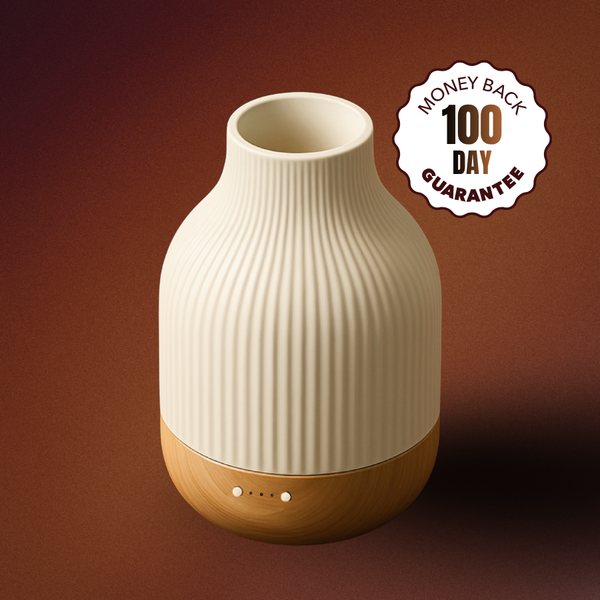
Whisper-quiet at 27.3 dB(A), made for sleep
Quiet Ceramic Essential Oil Diffuser for Bedroom & Sleep★★★★★ 4.92 (86 reviews)
Limited Offer — Free Lavender Oil View full product detailsPlacement Tips for Bedroom Diffusers

Placement is the underrated variable. The same diffuser can feel overwhelming or barely noticeable depending on where it sits. This is the angle that makes a bedroom diffuser genuinely different from a desk or living-room setup—and it's what this post focuses on that a generic "best diffuser for sleep" guide doesn't.
- Keep distance from the bed: 3–6 feet away from where you sleep. Too close concentrates the scent. You want the mist to disperse before it reaches you, not hit you directly.
- Place at nightstand or dresser height: Table height (around 24–30 inches off the floor) lets mist spread horizontally across the room. Floor placement traps scent low; ceiling shelves are too far.
- Avoid corners and enclosed nooks: Open placement allows the mist to circulate. Corners trap scent and can create an intense pocket of aroma.
- Slight ventilation helps: A partially open window or bedroom door prevents the scent from building up in a sealed space—especially useful for extended overnight sessions.
- Away from air vents: Vents will dilute the scent too quickly and blow moisture onto nearby surfaces.
With the right placement, the diffuser works naturally at low settings—no need to crank up the mist. For blend ideas that pair well with a bedroom setup, our Essential Oil Diffuser Recipes guide covers popular evening combinations.
Mistakes to Avoid When Using a Bedroom Diffuser

Even with the right diffuser, small habits can undercut the experience. These are the most common ones:
- Too many drops: The instinct is "more = stronger = better." In a bedroom, stronger scent is harder to sleep through. Stick to 2–3 drops per 100 ml—you can always adjust up slightly, but you can't easily undo an over-scented room.
- Running it continuously all night at high mist: Low mist for 6–8 hours is better than high mist for 3 hours. Lower output, longer runtime, more stable scent level.
- Ignoring the light setting: Even a soft blue glow in a dark bedroom is brighter than you think. Set the light to off before bed—not just dim.
- Placing it too close to the bed or pillow: Direct exposure can feel intense and dry out your nasal passages. Keep at least 3 feet of distance.
- Switching scents every night: Your body starts to associate a consistent scent with the bedroom routine. Changing it too often slows that association. Pick one or two oils and stick with them for a few weeks.
- Skipping the clean: Residue from one oil can go rancid and affect the next scent. A quick rinse and occasional deep clean keeps the mist clean and the oil smelling true. See our how to clean an essential oil diffuser guide for the simple routine.
Wrapping Up
The best diffuser for a bedroom isn't about maximum scent output—it's about specs that align with how a bedroom actually runs: a tank large enough for all night, a noise level below 30 dB, an LED that turns fully off, and placement that lets the mist disperse before it reaches your pillow. Add lavender or cedarwood at 2–3 drops per 100 ml, and you have a setup that quietly supports rest without calling attention to itself.
For the features worth comparing before you buy, our best essential oil diffusers round-up covers the full landscape—or go straight to our bedroom pick, the SCENTREAT Ceramic & Rubber Wood Diffuser. And once it's set up, a quick rinse between oils keeps the mist clean—our diffuser cleaning routine takes about five minutes.
Whisper-quiet at 27.3 dB(A), made for sleep
Quiet Ceramic Essential Oil Diffuser for Bedroom & Sleep★★★★★ 4.92 (86 reviews)
Limited Offer — Free Lavender Oil View full product detailsFrequently Asked Questions
What is the best diffuser for bedroom use?
A quiet ultrasonic diffuser with a 180–200 ml tank, adjustable or fully off LED light, and a low mist setting is the best fit for most bedrooms. A 180–200 ml tank runs 4–5 hours continuously, or 8–10 hours in intermittent mode—enough to cover a full night without a refill.
Should a bedroom diffuser be completely silent?
It doesn't need to be silent, but it should stay below 30 dB—roughly the sound level of a whisper. Most quality ultrasonic diffusers hit this range on their low mist setting.
Can I use a diffuser every night?
Yes, as long as you keep the oil ratio light (2–3 drops per 100 ml), run it on low mist, and clean it regularly to prevent residue buildup. A weekly rinse and monthly deep clean keeps it running well.
Is stronger scent better for sleep?
No. A lighter, consistent scent is easier to sleep through than a heavy one. Start at 2–3 drops per 100 ml and adjust from there. Stronger scent can feel stimulating rather than calming in an enclosed bedroom.
What size diffuser is best for a bedroom?
180–300 ml is the sweet spot for most bedrooms. A 180 ml tank on low mist already covers a full night. Smaller 100 ml tanks suit short sessions; larger 500 ml tanks are better for open living spaces.
Should I leave the LED on or off when sleeping?
Off is better for sleep. Even a soft glow in a dark bedroom can register as a light cue and interfere with melatonin. Most diffusers let you cycle through light settings with a single button press—tap until the light goes out.
What oils are best for a bedroom diffuser?
Lavender and cedarwood are the most widely used. Lavender (via linalool) has a calming effect on the nervous system; cedarwood (cedrol) is grounding and pairs well with it. Start with 2–3 drops per 100 ml. Bergamot and chamomile are good secondary options for the wind-down phase.

