

Most diffusers need 3 to 5 drops of essential oil for every 100 ml of water, so the right amount depends on the size of your tank. This guide gives you a simple chart by tank size, then shows how your room, your diffuser type and your choice of oil change that number, and how to tell when you have added too much.
In this article
Drops-by-Tank-Size Chart

The most reliable starting point is tank capacity, then the scent level you actually want. Larger tanks dilute oil more, so they need more drops to reach the same strength — but the relationship is not perfectly linear, and a bigger tank also runs longer, so the large sizes below are scaled back slightly rather than multiplied straight up.
Diffuser Drops Chart — by Tank Size and Scent Level
| Tank size | Light | Medium (most common) | Strong |
|---|---|---|---|
| 100 ml — personal desk, small bedroom | 3–4 drops | 4–7 drops | 7–8 drops |
| 120 ml — Waterless Ceramic Night Light, liquid mode | 4–5 drops | 5–8 drops | 8–10 drops |
| 180 ml — Ceramic & Rubber Wood, rooms up to 320 sq ft (30 m²) | 6–8 drops | 8–12 drops | 12–15 drops |
| 200 ml — Minimalist Wood, rooms up to 375 sq ft (35 m²) | 7–9 drops | 9–13 drops | 13–17 drops |
| 300 ml — standard bedroom, medium living space | 9–12 drops | 12–18 drops | 18–22 drops |
| 400 ml — living room, open bedroom | 12–15 drops | 15–22 drops | 22–28 drops |
| 500 ml — large or open-plan spaces | 14–18 drops | 18–26 drops | 26–32 drops |
What each column means
Tank size — How much water your diffuser holds. ml means millilitres. The figure is printed on the box or in the product listing.
Light — The drop count for a soft scent. This is the bedroom setting.
Medium (most common) — The everyday drop count, and where most people settle after a few uses. Almost every published recipe, ours included, is written at this strength.
Strong — The drop count for an open-plan room, or for when you want the scent noticed the moment someone walks in.
The three columns are not three products. They are three strengths for the same diffuser.
Example: the 180 ml Ceramic & Rubber Wood
Fill the tank with water first, then add the drops. Use 6 to 8 drops for a soft evening in a bedroom, 8 to 12 drops for the everyday setting most people settle on, or 12 to 15 drops when you want the scent to carry across a larger room. The tank and the water stay the same; only the drop count changes.
Medium is the default. Nearly every published recipe — ours included — is written at medium strength, and it is where most people settle once they have experimented. Treat light as the bedroom setting and strong as the one for an open-plan room or a party, and use medium for everything in between.
Picking your column: two things decide it. The first is the room — in a small, enclosed bedroom stay in the light column and run shorter cycles, because concentration in the air, not drops in the tank, is what tips an evening from pleasant to a headache. The second is the oil: lavender, sweet orange and cedarwood are forgiving and sit comfortably at medium, while peppermint, eucalyptus and ylang-ylang carry further than their drop count suggests, so treat light as their medium. One rule overrides the whole table — cinnamon, clove, oregano and thyme stay at 1 drop per 100 ml whichever column you picked, and are best diffused in short bursts.
How to Use This Chart
Start with the lower end of the range, especially if you're using a strong or sharp oil (peppermint, eucalyptus, clary sage). One caveat on that list: clary sage — and jasmine — are commonly advised against during pregnancy, particularly in the first trimester, so check with your midwife or doctor before diffusing either. You can add one or two more drops after 10–15 minutes if the scent feels too faint.
Adjusting up is easy. Adjusting down — once the room already smells heavy — takes time and ventilation.
How Many Drops by Diffuser Type
Different diffuser designs use oil in fundamentally different ways. Knowing this changes how you dose — not just how many drops, but whether drops are even the right unit.
1. Ultrasonic (Water) Diffusers

Ultrasonic diffusers create a fine mist by blending oil with water. The dilution means the scent builds gently, which makes it easier to fine-tune without going too far.
Recommended drops:
- 3–5 drops per 100 ml (see chart above)
- Adjust in 1–2 drop increments
Pros:
- Soft, even scent that stays comfortable over time
- Fine control — easy to land on the right intensity
- Efficient oil use
- Well-suited for daily and overnight use
Cons:
- Requires water refilling
- Needs regular cleaning — every 3–5 uses, which for daily users means about twice a week, to prevent oil residue buildup and keep the mist clean
For most people, ultrasonic is the easiest type to manage. If you're comparing diffuser technologies, our diffuser guide covers how each type works.
2. Nebulizing (Waterless) Diffusers

Nebulizing diffusers atomise pure oil directly — no water, no dilution. The scent is noticeably stronger and more immediate.
Recommended drops:
- No fixed drop count — oil is fed from a reservoir
- Control intensity by adjusting run time, not drops
Pros:
- Strong, immediate scent
- No water dilution needed
- Effective for larger spaces
Cons:
- Uses oil quickly — can feel overwhelming in small rooms
- Harder to control scent concentration
3. Evaporative (Pad) Diffusers

A pad or felt filter absorbs the oil; airflow carries the scent. Simple, passive, low-maintenance.
Recommended drops:
- About 5–15 drops directly on the pad
- Reapply when scent fades
Pros:
- No water, no power needed (depending on model)
- Simple setup and low maintenance
Cons:
- Scent fades as lighter molecules evaporate first
- Less even diffusion over time
4. Reed Diffusers

Reeds draw oil up by capillary action and release scent passively — no drops measured, no timing needed.
Scent control:
- Add or remove reeds to increase or reduce intensity
- Oil is poured by the ml, not counted in drops
Pros:
- Continuous ambient scent, no power required
- Decorative, very low maintenance
Cons:
- Limited intensity control; slower diffusion
How Room Size Changes the Equation

Tank size gets you in the ballpark. Room size moves you to the right end of the range. A 200 ml diffuser in a small bathroom needs fewer drops than the same diffuser in an open living room.
| Room Size | Approx. sq ft | Approx. m² | Suggested Drops | Notes |
|---|---|---|---|---|
| Small | Up to ~160 sq ft | Up to ~15 m² | 3–8 drops | Bedrooms, bathrooms, desks — scent builds fast |
| Medium | ~160–320 sq ft | ~15–30 m² | 8–15 drops | Living rooms, offices — well-balanced coverage |
| Large | >320 sq ft | >30 m² | 15–25 drops | Open-plan spaces — higher tank capacity recommended |
What each column means
Room Size — A plain label for how big the space is: small, medium, or large.
Approx. sq ft — The room size in square feet. Approx. means approximately, and sq ft means square feet.
Approx. m² — The same room size written in square metres. m² means square metres. The two columns describe one room, so read whichever unit you think in.
Suggested Drops — How many drops of essential oil to add to a full tank of water.
Notes — Where a room this size usually is in a home, and what to watch for.
A ~ in front of a number means "about". A > means "more than".
Example: a small room
A small room is anything up to about 160 square feet, which is the same room as about 15 square metres. In a space that size, the whole range is 3 to 8 drops in a full tank. Start at 3, because scent builds fast in a small room and you can always add one more drop.
1. Small Rooms (up to ~160 sq ft / 15 m²)
Scent concentrates quickly in small spaces. Start at 3–5 drops, let the diffuser run for 10 minutes, then decide if you want more.
This matters most in sleep environments. See our guide on choosing whether essential oil diffusers are safe for bedrooms and enclosed spaces.
2. Medium Rooms (~160–320 sq ft / 15–30 m²)
Ultrasonic diffusers with a 200–300 ml tank work well here. The water dilution helps scent distribute evenly across the room without concentrating in one corner.
9–18 drops is the comfortable working range for most medium spaces — but read it against the tank, not the floor area: about 9–13 drops if you are filling 200 ml, 12–18 if you are filling 300 ml. More water always needs more drops.
3. Large Rooms (>320 sq ft / >30 m²)
Scent needs time to travel and spread in large or open-plan spaces. Use a larger-tank diffuser (300–500 ml) and position it centrally rather than in a corner.
In a large open-plan space that works out to roughly 15–25 drops in a full 400–500 ml tank. Past that, adding more rarely improves coverage – it just raises the concentration near the diffuser while the far side of the room stays faint. Two diffusers placed apart do more for a large space than one dosed harder.
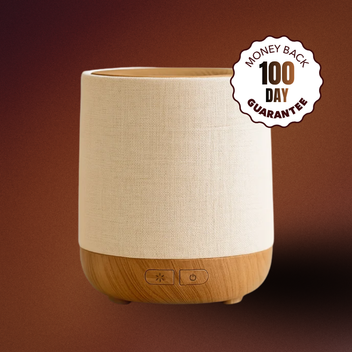
Wood essential oil diffuser that runs up to 10 hours on one 200 ml fill. Quieter than a whisper (27.3 dB, l...
Light, Medium, or Strong: Dialling in Scent Intensity

Beyond tank size and room, personal sensitivity matters. Essential oils are highly concentrated compounds — even one extra drop is noticeable. The safest approach is always to start lower than you think you need.
Light Scent
About 3–5 drops per 100 ml. Subtle, background-level — you notice it when you enter the room, but it doesn't follow you around.
- Best for: small or enclosed spaces, focus work, anyone sensitive to fragrance
- Good for long sessions (2–4 hours) without fatigue
Medium Scent
About 5–7 drops per 100 ml, one step up from the light starting dose. Most people end up here after a few sessions, once they know how a particular oil behaves in their room. The scent is easy to notice but still comfortable, and it feels natural rather than artificial.
- Best for: bedrooms, living rooms, daily aromatherapy
- Reach it by adding 1–2 drops at a time from the chart range, not by jumping straight to it
Strong Scent
About 7–9 drops per 100 ml. Use only in larger or well-ventilated spaces, or for very short sessions (30–45 minutes). Above about 9 drops per 100 ml, the experience often tips from pleasant to irritating — especially with sharp oils like peppermint or eucalyptus.
Signs You're Using Too Many Drops
More isn't better with essential oils. If any of these feel familiar, reduce by 2–3 drops:
- Scent hits hard the moment you turn the diffuser on
- Headache or dry throat after 30 minutes in the room
- The scent feels "thick" rather than fresh and clean
- Oily residue is building up inside the tank faster than usual
- The aroma becomes unpleasant rather than pleasant over time
If you're new to diffusing, 3–5 drops per 100 ml is always a safe starting point. Work up from there.
Blending Essential Oils: Keeping the Total in Range

Blending is one of the best ways to add complexity — a citrus note for brightness, a floral for balance, a woody base for depth. The key rule: the total drop count across all oils should stay within your normal range for that tank size. Which oils you reach for is a separate question — the best essential oils for a diffuser guide covers how each one smells and how far it carries.
A simple 3-oil blend for a 200 ml diffuser:
- 4 drops lavender (floral base)
- 3 drops sweet orange (citrus lift)
- 1 drop frankincense (woody depth)
- Total: 8 drops, inside the light range for a 200 ml tank, with room to add one or two more
For ready-made combinations, see our Essential Oil Diffuser Recipes guide — beginner-friendly blends for relaxation, focus, and everyday use.
 Pair it with 100% Pure Chamomile Essential Oil
$14.99
Pair it with 100% Pure Chamomile Essential Oil
$14.99
Using a Diffuser Around Children and Pets
This is worth knowing before you set up a diffuser in a shared bedroom or family living space.
Children under 3: For rooms where infants or young children are present, start at half the standard dose and keep the room ventilated. Many essential oils — including eucalyptus, peppermint, and camphor — are not recommended around very young children due to their respiratory effects. Consult your paediatrician before diffusing regularly in a baby's room. For guidance on safe oils and age ranges, the American Academy of Pediatrics (healthychildren.org) is a good first reference.
Pets: Cats and dogs are significantly more sensitive to aromatic compounds than humans. Oils to avoid around pets include tea tree, pennyroyal, cinnamon, and citrus oils. Keep diffuser sessions short, ensure the pet can leave the room, and consult your vet before diffusing around animals. The ASPCA Animal Poison Control maintains a list of toxic plants and oils.
For a broader look at diffuser safety — ventilation, materials, and duration guidelines — see our post on whether essential oil diffusers are safe.
Wood essential oil diffuser that runs up to 10 hours on one 200 ml fill. Quieter than a whisper (27.3 dB, l...
A Diffuser That Makes Dosing Easy

Dosing feels like guesswork when you cannot be sure how much water actually went in — the same drop count lands at a different concentration every fill, so the scent never quite repeats.
The SCENTREAT Ceramic & Rubber Wood Diffuser pairs a handcrafted ceramic cover with a 180 ml BPA-free ABS and PP reservoir, so you are always counting drops into the same, known volume. Fill the tank to 180 ml, count out your usual dose, and you get the same concentration run after run — you are not chasing a moving target.
Why It Works Better for Daily Dosing
- Handcrafted ceramic cover over a 180 ml BPA-free ABS and PP reservoir: a fixed, repeatable volume to measure into, so the same drop count means the same strength every time
- Ultrasonic + water dilution: the scent builds slowly, so adding one more drop mid-session is easier than airing out a room you overdosed
- Three published dose levels: 6–8 drops light, 8–12 medium (the default), 12–15 strong — so you pick a level instead of guessing a number
- 27.3 dB(A) at 1 m in independent laboratory testing: quiet enough to leave running long enough to judge a dose properly, in a bedroom or at a desk
- Easy to clean: simple disassembly helps you stick to the every-3–5-uses routine, and old residue is exactly what makes a familiar dose smell wrong
Browse the full essential oil diffuser collection to compare tank sizes and find the right fit for your space.
Conclusion
So, how many drops in a diffuser? Begin with 3 to 5 drops for every 100 ml of water, give the aroma about 10 minutes to build, and add one or two more only if the room still feels faint. From there, three things fine-tune the number: the size of your tank, the space you want to scent, and the oil itself. Gentle oils such as lavender and sweet orange can go a little higher, while sharp ones such as peppermint and eucalyptus belong at the low end.
Getting the same result every time is easiest when you always measure into the same amount of water. The Scentreat Ceramic & Rubber Wood Diffuser fills to a known 180 ml, so 6 to 8 drops gives a soft bedroom scent and 8 to 12 gives the everyday strength most homes prefer, fill after fill.
Still unsure what suits your space, or want a hand with a blend? Message us on Facebook or Instagram, or email support@scentreat.com, and our team will be glad to help.
Frequently Asked Questions
How many drops of essential oil should I use in a 100 ml diffuser?
Start with 3–5 drops for a 100 ml tank. That's the standard light-to-medium dose for a small room. Add 1–2 more drops if the scent feels too faint after 10–15 minutes.
What is the maximum number of drops I should ever use?
There is no single number, because the right amount scales with how much water is in the tank: 3–5 drops per 100 ml. That is 3–5 drops in a 100 ml tank and 15–25 in a 500 ml one. The real limit is the room, not the tank – in a small enclosed space stay at the bottom of the range and run shorter sessions, and save the top of the range for large, well-ventilated rooms.
Can I use more drops for a stronger scent?
Yes, but increase by 1–2 drops at a time and wait 10 minutes before adding more. The scent from an ultrasonic diffuser builds gradually — what feels faint at first often becomes comfortable after a few minutes of diffusion.
Do different diffuser types need different amounts?
Yes. Ultrasonic diffusers dilute oil in water, so drops are the right unit. Nebulizing diffusers use pure oil and are controlled by run time, not drops. Reed diffusers use ml, not drops.
Is it safe to diffuse essential oils around babies or pets?
Use caution. For children under 3, halve the standard dose and ensure ventilation; consult your paediatrician before regular use. For pets, keep sessions short and allow the animal to leave the room — some oils (tea tree, eucalyptus, citrus) can be toxic to cats and dogs. Check the ASPCA Animal Poison Control list for specifics.
What happens if I use too many drops?
The scent becomes heavy and potentially irritating rather than pleasant. You may notice headaches, a dry throat, or faster oil residue buildup inside the tank. If that happens, reduce by 2–3 drops and ventilate the room.
How often should I clean my diffuser?
Every 3–5 uses is the standard recommendation. If you diffuse daily that works out to roughly twice a week; letting residue build up past that is what starts to affect mist quality and scent accuracy.

