

The best diffuser settings for sleep: low mist, LED completely off, timer set to 30–45 minutes before bed, and intermittent mode on if your device supports it. Use 3–4 drops of a calming oil per 100 ml of water. That combination scents the room during your wind-down without running through the night — keeping the air light and your sleep undisturbed.
Many people focus on choosing the "right" essential oil — but overlook how their diffuser is actually set up. In reality, the way your diffuser operates often has a bigger impact on sleep than the scent itself. Settings aside, oil choice is covered in Essential Oil Diffuser for Sleep.
Settings only go so far if the hardware is wrong — what to look for in a sleep diffuser covers the buying side.
In this guide, Scentreat explains the best diffuser settings for sleep, why low mist and stable conditions matter more than intensity, and how to create a simple nighttime setup that supports deeper, more consistent rest.In this article
Why Diffuser Settings Matter More Than Oil Choice?

Many people focus on selecting the "right" essential oil while overlooking how their diffuser is actually operating. We cover this further in 5 Best Essential Oil Diffusers for Bedroom Sleep 2026 Buyer Guide.
In reality, device configuration often influences relaxation more than scent selection.
Sleep readiness depends on environmental stability. The Sleep Foundation notes that consistent, undisrupted bedroom conditions are among the most reliable supports for sleep continuity — while sensory shifts can increase micro-arousals during lighter sleep stages.
What this means in practice:
- Stability promotes rest.
- Fluctuation increases subtle alertness.
- Intensity matters less than consistency.
A beautifully selected oil helps. A thoughtfully configured environment helps more.
Recommended Sleep Diffuser Settings (Quick Reference)
Before getting into the reasoning, here's the complete setup at a glance. Screenshot this and keep it on your phone.
| Setting | Recommended | Why |
|---|---|---|
| Mist Level | Low (lowest available) | Keeps scent subtle; prevents olfactory fatigue and air heaviness during sleep |
| Timer | 30–45 min before sleep | Scents the room during wind-down; shuts off before deep sleep begins |
| LED Light | Off or lowest | Even dim light suppresses melatonin; full dark mode is best |
| Intermittent Mode | On if available (30 min on / 30 min off) | Maintains light background scent without saturation over longer sessions |
Oil dose for sleep use: 3–4 drops per 100 ml of water on a low mist setting. This is intentionally less than daytime use, which reduces the risk of scent saturation during the hours you're most sensitive.
What Is the Philosophy of Night Diffusion?
Peaceful sleep environments share one defining quality: restraint.
The most calming hotel rooms do not overwhelm the senses. They soften them.
Your diffuser should follow the same principle.
At night:
- Scent should feel distant, not immersive.
- Air should feel light, not dense.
- Light should be absent, not decorative.
- Sound should be minimal.
If you are aware of your diffuser while trying to fall asleep, it is likely doing too much.
Nighttime diffusion is not about adding more sensation. It is about refining what is already there.
What are the 3 Core Settings That Actually Affect Sleep?

Instead of adjusting every feature your device offers, focus on three foundational variables:
- Mist strength
- Light settings
- Timing
When these are optimized, most sleep discomfort disappears.
Mist Level: Lower Is Usually Better
It is tempting to assume that more mist equals more relaxation. At night, the opposite is often true.
High mist output can:
- Increase scent awareness
- Make the air feel heavy
- Trigger subconscious evaluation
- Cause olfactory fatigue
- Lead to mild throat or sinus irritation
A low, steady mist allows aroma to blend into the background.
For sleep use: 3–4 drops of oil per 100 ml of water at low mist. This is intentionally on the lighter side — less intense than daytime diffusion — which further reduces the risk of scent saturation during sleep.
How to Optimize Mist Level:
- Start with the lowest setting available.
- After 10–15 minutes, assess whether the scent feels subtle or dominant.
- If you clearly notice the diffuser, reduce intensity.
General Calibration by Room Size:
- Small room (<150 sq ft) → Lowest mist
- Medium room (150–300 sq ft) → Low mist
- Large room (>300 sq ft) → Low to brief moderate mist
Calibration works better than amplification.
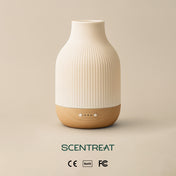
Ceramic ultrasonic diffuser for the bedside: ~30 dB, 180 ml tank, auto shut-off and a soft glow you can tur...
Light Settings: Darkness Is Non-Negotiable
Light exposure plays a powerful role in circadian rhythm regulation.
Research published through the National Institutes of Health (NIH) shows that even relatively low light exposure at night can suppress melatonin and shift biological timing.
Harvard Medical School also explains that blue-enriched light at night can delay melatonin release and increase alertness.
For sleep optimization:
- Turn off all diffuser LEDs
- Disable color-changing features
- Avoid blinking indicators
Even subtle light can maintain low-level alertness. A refined nighttime ritual prioritizes darkness.
Timing: Support the Transition, Not the Entire Night
Diffusion works best as a transition tool — not as an overnight intervention.
Deep sleep does not require active scent stimulation. In fact, consistency becomes more important than continued input.
Ideal Timing Structure
- Activate diffuser 30–45 minutes before bed
- Use low mist
- Allow automatic shut-off
Continuous overnight diffusion may cause scent buildup or mild sensory awareness during lighter sleep stages.
Short, intentional use creates an atmospheric bridge into rest. After that, stability is more valuable than presence.
Beyond mist, light, and timing, the surrounding environment also shapes how diffusion feels at night.
How Do Airflow and Humidity Affect Night Diffusion?

Mist intensity never works alone. It interacts quietly with the room itself — the size of the space, how air moves, and how humid the environment feels.
Even perfectly calibrated settings can feel overwhelming if air is stagnant, because scent cannot disperse evenly and gradually accumulates.
Over time:
- The room begins to feel dense
- Aroma becomes more noticeable
- You may wake slightly aware of the scent
The goal at night is always dispersion, not concentration.
How to Optimize Airflow:
You don't need strong ventilation. You need gentle movement.
- Avoid placing the diffuser in tight corners where mist can pool
- Maintain soft passive airflow (a slightly open door or natural circulation is enough)
- Avoid positioning directly under strong air vents that forcefully push scent
Air should move softly — never aggressively. Subtle circulation allows aroma to remain in the background rather than becoming the focus.
Humidity also changes how mist behaves.
| Air Condition | How Mist Behaves | How Scent Feels | Potential Impact |
|---|---|---|---|
| Dry air | Mist disperses faster | Scent feels lighter and fades more quickly | May require slightly longer pre-sleep diffusion |
| Humid air | Mist lingers longer | Aroma feels heavier | Overexposure can occur more easily |
If the room feels heavy, adjust mist intensity first before adding more oil. Most nighttime discomfort comes from environmental buildup, not insufficient fragrance.
Luxury sleep environments are rarely intense. They are balanced.
 Pair it with Lavender Essential Oil - 100% Pure
$14.99
Pair it with Lavender Essential Oil - 100% Pure
$14.99
What Is the Best Runtime Strategy for Stable Sleep? Mode, Timing & Night Stability?
Diffusion works best as a transition ritual — not as an overnight presence.
Think of it as a gentle signal that the day is ending. Once sleep begins, stability matters more than continued scent output.
Intermittent vs Continuous Mode
Different runtime modes create different atmospheric rhythms:
| Mode | Effect at Night |
|---|---|
| Continuous high | Often leads to over-saturation |
| Continuous low | Suitable for short pre-sleep sessions |
| 30 sec on / 30 sec off | Balanced, steady presence |
| 1 min on / 2 min off | Extended but subtle diffusion |
If running longer than 40 minutes, intermittent mode typically reduces scent buildup and keeps the room feeling lighter.
What If My Diffuser Doesn't Have Intermittent Mode?
Not all diffusers offer a built-in intermittent setting — and that's fine. The same result is easy to achieve manually.
Set the diffuser to low mist, start it 30 minutes before bed, and turn it off as you get in. Alternatively, set a phone timer to remind you to switch it off. The goal is to scent the room during your wind-down, not to run the diffuser through the night. The room holds the scent for a while after it stops — you don't need continuous output to feel the benefit.
More important than mode, however, is avoiding late-night disruption.
Unexpected mist bursts, LED flickers, or small motor sounds introduce change into the environment. Even subtle shifts can increase alertness during lighter sleep stages.
For better night stability:
- Do not restart the diffuser after getting into bed
- Disable automatic reactivation features
- Use a timer instead of manual shutoff
Once the ritual begins, the environment should remain unchanged.
How to Adjust Diffuser Settings for Sensitivity?

Not everyone processes scent in the same way. Sensory thresholds differ — and your ideal setting should reflect that.
Sensory Sensitivity Guide
| Sensory Sensitivity Level | Recommended Mist Level | Suggested Runtime | Placement Guidance | Important Note |
|---|---|---|---|---|
| Highly sensitive | Lowest mist | 20–30 minutes | Place diffuser farther from the bed | Avoid overnight exposure |
| Moderate sensitivity | Low mist | 30–40 minutes | Standard room placement | Avoid continuous overnight mode |
| Lower sensitivity | Low to brief moderate mist | 30–40 minutes (max) | Standard placement | Still avoid overnight continuous exposure |
A simple rule applies:
If you wake aware of scent, reduce intensity.
If you forget it is there, your setting is working.
After calibrating mist level, keep the configuration unchanged for 1–2 weeks. Consistency strengthens sleep association.
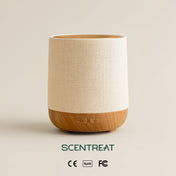
Minimalist wood ultrasonic diffuser with our largest tank: 200 ml of quiet cool mist, enough to run through...
How to Create a Simple, Consistent Night Preset
Once your mist level feels right, the next step is reducing complexity. Sleep preparation should reduce mental load — not add to it.
If your diffuser requires nightly adjustments, changes color unexpectedly, or draws attention to its operation, it quietly increases engagement at the wrong time of day.
Before sleep, the nervous system benefits from predictability.
The most supportive nighttime configuration is almost invisible. You should not think about it. You should simply feel the atmosphere soften.
Instead of optimizing every evening, create one refined preset and repeat it.
A calm luxury night mode can be as simple as:
- Lowest mist with 3–4 drops of calming essential oils
- Lights completely off
- 30–45 minute timer
- Same scent nightly
- Same activation time
Keep this configuration unchanged for 7–14 days.
Repetition builds association. When your brain encounters the same sensory pattern each evening, it begins to recognize it as a cue for rest. Over time, the diffuser becomes part of the atmosphere rather than an active presence.
A well-set diffuser should require no attention at all.
For a deeper look at placement and setup strategy alongside your settings, see our guide on Diffuser in Bedroom: Placement, Airflow & Setup Tips.
When to Adjust — and What to Look for in a Sleep-Friendly Diffuser

Not every sensation requires correction. Stability supports sleep more effectively than constant fine-tuning.
Adjustment should be intentional, not reactive.
Adjust if:
- Scent lingers long after shut-off
- Mild irritation appears
- You wake feeling slightly stimulated
Do not adjust if:
- You feel neutral about the scent
- You are tempted to increase intensity for faster results
- You find yourself monitoring nightly performance
Sleep thrives in steady environments.
This is also why device selection matters. Simplicity becomes effortless when your diffuser supports it.
Look for:
- Adjustable low mist settings
- Quiet operation
- True dark mode (no residual LED glow)
- A simple, reliable timer
You do not need more features. You need predictable control.
If you want a diffuser built specifically for this kind of quiet, low-light operation, the Ceramic & Rubber Wood Diffuser — $89.95, with a 100-day money-back guarantee — was designed with exactly these priorities in mind. You can also explore how it compares to cheaper alternatives if you're weighing your options.
Effortless systems create effortless sleep.
Conclusion
The best diffuser settings for sleep prioritize reduction: lower mist (3–4 drops per 100 ml), minimal light, a 30–45 minute timer, intermittent mode when available, and a consistent routine.
Sleep improves when sensory input softens. Configured thoughtfully, your diffuser becomes part of a refined evening ritual — present but unobtrusive, supportive yet invisible.
At night, subtlety is strength. Low mist, darkness, and predictable timing remain the foundation of effective nighttime diffusion. Settings aside, the dose stays fixed at 3–5 drops per 100 ml — so 6–9 drops for the 180 ml tank on Scentreat's Ceramic & Rubber Wood Diffuser.
Frequently Asked Questions
What is the best mist level for sleep?
The best mist level for sleep is the lowest setting available. Nighttime diffusion should feel subtle and blend into the background rather than create noticeable fragrance intensity.
How long should I run my diffuser before bed?
Running the diffuser for 30–45 minutes before sleep is typically sufficient to create a calming transition without oversaturating the room. Turn it off as you get into bed, or use a built-in timer so it shuts off automatically.
Is intermittent mode better than continuous?
For short pre-sleep sessions, low continuous mist works well. If running longer than 30–40 minutes, intermittent mode helps prevent air saturation and keeps the atmosphere balanced. If your diffuser lacks intermittent mode, simply set it to low mist and turn it off manually as you get into bed.
How many drops of oil should I use for sleep diffusion?
For sleep, 3–4 drops per 100 ml of water on a low mist setting is the right range. This is lighter than daytime use and reduces the risk of scent saturation while you sleep.
How do I adjust diffuser settings based on room size?
In smaller rooms, always begin with the lowest mist level. Medium rooms can tolerate low settings for slightly longer duration. Larger rooms may require brief moderate mist, but intensity should still feel light and stable.
How does airflow affect diffuser performance?
Poor airflow can cause scent buildup, even at low mist levels. Avoid placing the diffuser in corners or fully sealed rooms. Gentle air circulation helps disperse aroma evenly and prevents heaviness.
Should I run my diffuser all night?
In most cases, no. Short, controlled diffusion during your evening routine is typically more effective than continuous overnight operation. The room retains scent after the diffuser stops — you don't need it running all night to feel the benefit.

