

Key Takeaways
BEST BUY PICKS
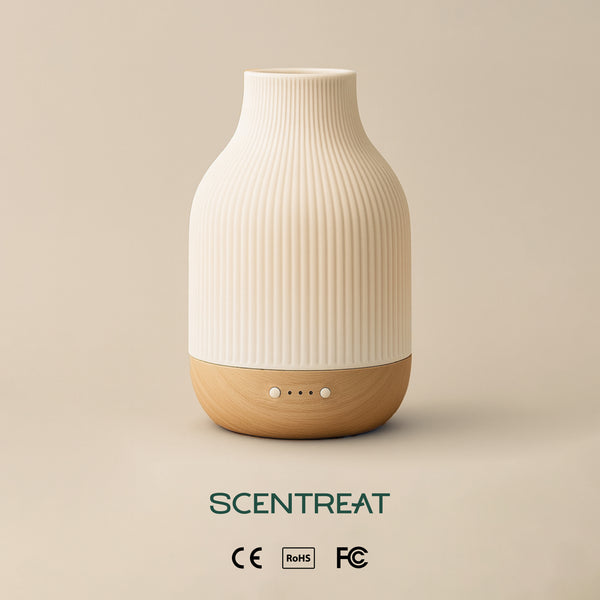
Many people turn to an essential oil diffuser for sleep hoping for a quick fix—but the effect is often more subtle than expected. It doesn't make you fall asleep instantly, yet it can still influence how your body transitions into rest.
Quick answer: A diffuser for sleep works by creating a low-level aromatic cue that may reduce nighttime arousal and help the nervous system shift from alertness into rest. It is not a sleep treatment — it's an environmental signal. For most people, 3–5 drops per 100 ml of water, run 30–60 minutes before bed, is a good starting point.
For the complete guide, see Best Essential Oils for Sleep and Relaxation 2026 Guide.
In this guide, Scentreat explains how an essential oil diffuser for sleep actually works, when it can support relaxation, and how to use it in a way that feels natural instead of overstimulating.
Introduction: Why Sleep and Scent Are Connected

Sleep does not occur in isolation.
The brain continuously monitors:
- Air composition
- Temperature
- Light exposure
- Subtle environmental changes
An essential oil diffuser for sleep changes one of these variables: ambient scent presence. We cover this further in Best Diffuser for Bedroom.
Unlike roll-ons or direct inhalation, diffusion creates:
- Spatial scent distribution
- Low-level atmospheric exposure
- Gradual perceptual blending
The bedroom becomes a subtly modified environment rather than a scented "event."
Research referenced by the National Sleep Foundation suggests that environmental cues — including scent — can influence how safe and relaxed a space feels before bed. The Sleep Foundation notes that inhaled lavender, in particular, may support perceived sleep quality, though it is not a substitute for medical sleep care.
Scent does not cause sleep.
But perceived safety influences relaxation — and relaxation supports sleep onset.
Wondering whether a diffuser really works at all? For the full evidence overview, read Do Essential Oil Diffusers Really Help You Sleep?
Can an Essential Oil Diffuser Improve Sleep and Insomnia Symptoms?

An essential oil diffuser does not cure insomnia. However, it can improve several factors that influence how the nervous system experiences nighttime.
Rather than changing sleep biology, it affects environment, perception, and emotional tone.
Below are the primary areas where support may occur.
1. Insomnia-Related Tension
If insomnia is driven by emotional tension or racing thoughts, a consistent diffuser cue may reduce nighttime arousal.
Improvement may look like:
- Less resistance at bedtime
- Fewer stress spikes before sleep
- A calmer response to lying awake
It does not induce sedation. It supports regulation.
Important: Aromatherapy via diffuser is not a medical treatment for insomnia. If you're experiencing persistent difficulty sleeping — most nights for three months or longer — speak with a healthcare provider. A diffuser can be a supportive part of a wind-down routine, not a standalone remedy. The American Academy of Sleep Medicine recommends cognitive behavioral therapy for insomnia (CBT-I) as the first-line treatment for chronic insomnia.
2. Bedroom Atmosphere
A diffuser can subtly soften the sensory environment.
Instead of a room feeling sterile or overly quiet, scent may create a stable, neutral tone. That environmental shift can lower vigilance and make rest feel safer.
This is about perception, not medication.
3. Bedtime Transition
Many people struggle not with sleep itself, but with transition.
When used consistently, a diffuser becomes a signal that the day is ending. Over time, this cue may shorten the "wired but tired" phase and support smoother wind-down periods.
4. Emotional Settling at Night
Night often amplifies stress.
A predictable scent may reduce emotional intensity before bed and during brief awakenings. The effect is subtle, but familiarity can help the nervous system stop scanning for stimulation.
5. What It Cannot Improve
An essential oil diffuser cannot:
- Correct circadian rhythm disruption
- Replace medical or behavioral insomnia treatment
- Force sleep when sleep pressure is low
It improves context — not sleep mechanics. For a deeper look at how scent actually signals the brain during sleep preparation, see Aromatherapy for Sleep: How Scent Affects the Brain.
How an Essential Oil Diffuser Influences Sensory Processing

The brain treats scent differently from sight or sound.
When diffusion is subtle:
- Olfactory receptors adapt
- Novelty detection decreases
- Monitoring behavior reduces
When diffusion is intense:
- Novelty remains high
- Vigilance increases
- Cognitive monitoring continues
An effective diffuser should become less noticeable within minutes.
If the scent demands attention, the nervous system remains engaged.
The goal is background presence — not foreground stimulation.
How Diffusion Intensity Affects Sleep
1. Diffusion Intensity and Sleep Response

Many people assume that a stronger scent creates deeper relaxation. In sleep environments, the opposite is often true.
The brain responds more strongly to changes in sensory intensity than to steady background stimuli. This is linked to the orienting reflex — a built-in neurological mechanism that prioritizes environmental shifts over constant input. When diffuser output is too strong or fluctuates noticeably, the nervous system increases monitoring rather than reducing vigilance.
Here's how air saturation levels typically influence sleep readiness:
| Air Saturation Level | Brain Response | Likely Sleep Impact |
|---|---|---|
| Barely detectable | Rapid sensory adaptation | Neutral to supportive |
| Light, stable background | Reduced vigilance | Potentially calming |
| Noticeable and fluctuating | Increased monitoring | Mild alertness |
| Strong and persistent | Sensory activation | Disruptive |
For diffuser oil for sleep, the ideal range is a low, stable diffusion intensity — not maximum output.
Sleep physiology favors consistency over saturation. A subtle aromatic background is more likely to support relaxation than a heavy scent filling the room.
2. Continuous Diffusion and Sensory Adaptation
The issue is rarely the essential oil itself — it is the exposure pattern.
When a diffuser runs continuously throughout the night, the nervous system adapts to the constant stimulus. Sensory adaptation reduces responsiveness over time. Once this happens:
-
The scent loses signaling value
-
The relaxation association weakens
-
Environmental contrast disappears
Without contrast, the brain stops assigning meaning to the aroma. What initially feels calming becomes neutral background input. In some cases, persistent saturation may even maintain low-level sensory activation.
For this reason, running a sleep diffuser all night often provides diminishing returns.
Diffusion works best as a cue — not as continuous stimulation.
3. Optimal Diffusion Pattern for Sleep
To support pre-sleep relaxation effectively:
-
Turn on the diffuser 30–60 minutes before bedtime
-
Use 3–5 drops of essential oil per 100 ml of water — a commonly used starting point for a light, stable background scent
-
Turn it off before sleep, or switch to intermittent mode
Short, intentional diffusion preserves sensory contrast. Over time, the brain begins associating that light, stable scent with the transition to rest.
This conditioning effect strengthens the wind-down phase — where diffuser oil for sleep has the greatest impact — rather than attempting to influence deep sleep directly.
In sleep environments, subtlety signals safety.
Excess intensity signals stimulation.
Common Mistakes That Reduce Effectiveness
Using an essential oil diffuser for sleep incorrectly often explains poor results. Oil choice can also influence perception, but intensity and maintenance matter more than specific blends. While calming options such as lavender, chamomile, sandalwood, or light bergamot are commonly associated with relaxation, even these can feel stimulating if overused. Research indexed on PubMed has explored how lavender aroma may support relaxation markers in some individuals, yet diffusion strength remains the dominant factor in nighttime comfort.
Common errors include:
- Overfilling water reservoir
- Using too many oil drops
- Placing diffuser directly beside pillow
- Using energizing oils unintentionally
- Allowing oil residue buildup
Mechanical stability influences scent quality.
Oil oxidation inside poorly cleaned devices can alter the aromatic profile, making scent sharper over time. Maintenance matters as much as oil selection.
Nighttime Diffusion Safety and Best Practices
When using essential oils before bed, the method of delivery matters just as much as the oil itself. While both diffusion and direct inhalation deliver aroma, their exposure patterns differ significantly — and so does their impact on sleep readiness.

| Air Saturation Level | Brain Response | Likely Sleep Impact |
|---|---|---|
| Barely detectable | Rapid sensory adaptation | Neutral to supportive |
| Light, stable background | Reduced vigilance | Potentially calming |
| Noticeable and fluctuating | Increased monitoring | Mild alertness |
| Strong and persistent | Sensory activation | Disruptive |
Direct inhalation creates a noticeable sensory event. It is concentrated and immediate, drawing attention to the scent itself. Diffusion, in contrast, creates environmental context. Instead of stimulating perception, it subtly reshapes the room's atmosphere.
At night, gradual ambient dispersion is generally more supportive of relaxation than sharp, concentrated exposure. The goal is to soften the sensory background — not trigger alertness.
However, because diffusion disperses aroma throughout the entire bedroom, safety considerations become especially important. Exposure is broader, often longer in duration, and influenced by room ventilation.
To maintain a safe and balanced sleep environment:
- Avoid diffusing in sealed, unventilated rooms
- Use clean water daily
- Limit oil drops to 3–5 per 100 ml of water per session
- Avoid synthetic fragrance oils
- Keep the device out of children's reach
Pet owners should also review essential oil safety guidance from organizations such as the American Society for the Prevention of Cruelty to Animals, as certain oils may not be suitable in enclosed spaces with animals.
When diffusion remains brief and low in intensity, safety concerns decrease significantly. Controlled, moderate use preserves both relaxation benefits and environmental comfort.
In nighttime settings, diffusion works best when it is subtle, intentional, and responsibly managed.
When a Diffuser for Sleep Is Most Appropriate
This method may be most useful when:
- The bedroom feels mentally "active"
- Stress lingers into bedtime
- Environmental tone feels sharp or sterile
- Transition from activity to rest feels abrupt
In these contexts, an essential oil diffuser for sleep may soften environmental perception without requiring behavioral overhaul.
It is less impactful when sleep disruption is strictly circadian or medical. If you're working on resetting your sleep schedule more broadly, How to Sleep Better at Night covers the full picture.
Environmental Layering: Diffuser + Room Conditions

A bedroom aromatherapy diffuser does not override environmental inconsistency. It functions within:
- Lighting conditions
- Air temperature
- Noise levels
- Visual clutter
If bright screens remain active, scent alone cannot reduce alertness.
Below is a structural interaction comparison:
| Environmental Factor | With Stable Environment | With Stimulating Environment |
|---|---|---|
| Low light | Scent integrates | Scent competes |
| Quiet room | Scent fades into background | Scent adds complexity |
| Cool temperature | Reinforces calm | Minimal effect |
| Active screens | Partial benefit | Reduced benefit |
The diffuser amplifies existing signals. It does not replace them.
Product Quality and Diffuser Design

Not all diffusers operate the same way.
- Ultrasonic models use water and vibration to produce a fine mist and are generally preferred for bedrooms due to their quiet, stable output.
- Nebulizing diffusers release more concentrated aroma without water, which can feel too intense at night.
- Heat-based diffusers rely on evaporation and may produce less consistent dispersion.
If you're choosing a diffuser for sleep, look for a model that produces a steady, gentle mist instead of strong pulses. Ultrasonic diffusers are often preferred for bedrooms because they tend to run more quietly and distribute scent more evenly throughout the room.
Features that matter most at night include:
- Consistent mist output
- A timer or automatic shut-off
- Intermittent mode instead of continuous mist
- A quiet motor
The goal isn't to fill the room with fragrance. It's to create a light, stable background presence that fades into the environment.
A good diffuser should support calm — not compete with it. If you'd like a quiet diffuser built for bedrooms, this whisper-quiet ultrasonic diffuser runs on intermittent mode and uses no plastic — which keeps the mist clean and the scent true to the oil.
How to Use an Essential Oil Diffuser Without Overthinking It

Many people overcomplicate using an essential oil diffuser for sleep.
You don't need perfect timing, a complex blend, or constant adjustments. What matters most is calm consistency.
A simple structure works well:
- Turn on the diffuser 30–60 minutes before bed
- Add 3–5 drops of a calming oil per 100 ml of water
- Dim lights
- Turn it off before falling asleep or set a timer so it shuts off automatically
That's it.
An essential oil diffuser for sleep should feel effortless. If you find yourself adjusting strength, switching oils nightly, or analyzing results every evening, the nervous system stays in evaluation mode. For a closer look, read about Essential Oils for Sleep Diffuser.
Calm happens when the diffuser becomes background — not a project.
Simplicity supports regulation. Overcontrol increases alertness.
Conclusion
An essential oil diffuser for sleep supports relaxation when used with intention, not intensity. It does not force sleep or cure insomnia, but it can help reduce nighttime arousal when paired with a consistent routine and low stimulation.
Used briefly and gently — 3–5 drops per 100 ml, run for 30–60 minutes before bed — a diffuser becomes a calming cue, not a crutch, within a healthy sleep environment.
If you're exploring ways to create a calmer bedroom environment, start with consistency and low-intensity diffusion. For more practical guides on aromatherapy and sleep-friendly routines, explore our full diffuser collection or follow along on Facebook and Instagram.
Should I run an essential oil diffuser for sleep all night?
Short sessions are usually more effective than continuous diffusion. Running the diffuser 30–60 minutes before bed — then turning it off or switching to intermittent mode — preserves the scent's signaling value and avoids sensory overload.
How many drops should I use?
A widely used starting point is 3–5 drops per 100 ml of water. Start at the lower end and adjust based on room size and how quickly you detect the scent. The goal is a light background presence, not a noticeable fragrance.
Does stronger scent improve sleep?
No. Strong scent often increases monitoring and alertness. The nervous system responds to novelty and intensity — a barely-detectable, stable aroma is far more likely to support relaxation.
Can diffusers replace sleep treatment?
No. They support environmental tone, not clinical insomnia. If you experience persistent sleep difficulties most nights for three or more months, speak with a healthcare provider.
How quickly does it work?
Environmental shifts are subtle and cumulative rather than immediate. Most people notice a difference after a week or two of using the same oil at the same time each night — the conditioning effect builds with repetition.