

A ceramic diffuser is judged on two things: whether the ceramic is real, and whether the machine underneath it is worth owning. This guide compares five ceramic diffusers on material, capacity, runtime, coverage and controls, explains how fired ceramic differs from a ceramic-look finish, and sets out what to check before you buy.
In this article
Our Top Ceramic Diffuser Picks at a Glance

All five use real ceramic on the outside, and all five are ultrasonic, so the differences come down to tank size, how long a fill lasts, coverage and controls. Figures are each brand's own published specifications, checked in September 2026.
| Product | Best for | Material | Capacity | Runtime | Coverage | Price |
|---|---|---|---|---|---|---|
| Scentreat Ceramic & Rubber Wood | Best overall | Ceramic cover, rubber wood base, BPA-free ABS + PP reservoir | 180 ml | 4–5 h continuous · 8–10 h intermittent | 320 sq ft | $99.95 |
| InnoGear 150 ml Ceramic Stone | Best budget | Ceramic cover, PP tank | 150 ml | 4–6 h continuous · 8–10 h intermittent | Not published | $34.99 |
| Vitruvi Stone | Best design | Matte ceramic, BPA-free plastic tank | 70 ml | 4 h continuous · 8 h intermittent | 500 sq ft | $129.99 |
| Saje Aroma Om | Best for everyday use | Ceramic cover, BPA-free plastic tank | Not published | 5–10 h | 500 sq ft | $124.00 |
| NOW Ultrasonic Ceramic Stone | Best for long runtime | Ceramic exterior, reservoir not specified | 100 ml | Up to 14 h | Not published | $49.99 |
All five are ultrasonic diffusers: water plus a few drops of oil, broken into a cool mist. Our scoring method is published on how we score diffusers, and if you are open to other materials, our ultrasonic diffuser rankings compare fabric, glass and plastic models too.
The 5 Best Ceramic Diffusers of 2026
These five represent different priorities rather than five versions of the same machine: overall balance, price, design, everyday household use, and long runtime for essential oils. Each entry says what the ceramic actually covers and what the maker publishes about the rest.
1. Scentreat Ceramic Diffuser — Best Overall Ceramic Diffuser

Among the best ceramic diffusers here, the Scentreat Ceramic & Rubber Wood Diffuser ($99.95) is the one that publishes the most about what it is made of. The handcrafted, fluted ceramic cover sits on a solid rubber wood base, and the reservoir inside is named: BPA-free ABS + PP. That distinction matters — the ceramic is the exterior, not the water tank, and that is true of every diffuser on this list.
A 180 ml fill runs 4–5 hours continuously or 8–10 hours on intermittent mist, which is the mode most people use overnight. The timer stops it after 1, 3 or 8 hours, it shuts off when the water runs out, and the warm light can be bright, dimmed, set to breathe, or switched off completely — the last of those is what makes it usable in a dark bedroom. An independent laboratory measured it at 27.3 dB(A) at 1 m at maximum continuous mist; for scale, a whisper is about 30 dB. That is a measurement of this diffuser, not a claim about ceramic diffusers in general.
At 129 × 129 × 237 mm it is the tallest unit here, so check the height against a nightstand shelf. Coverage is manufacturer-rated at about 320 sq ft (30 m²).
Pros
- Real fired ceramic over real wood, with the reservoir material named rather than left vague
- Noise measured by an independent laboratory, with distance and mist setting published
- 8–10 hours per fill on intermittent mist, and a light that turns fully off
- 100-day money-back guarantee and a one-year limited warranty
Cons
- Heavier than a plastic diffuser, and ceramic can chip if dropped
- Plug-in only, so it is not a travel or car diffuser
- Sold only at scentreat.com
- Tallest of the five, at 237 mm
Our editorial score: 9.7 / 10
2. InnoGear 150 ml Ceramic Stone — Best Budget Ceramic Diffuser
At $34.99, the InnoGear 150 ml Ceramic Stone is the cheapest way onto this list without dropping to a ceramic-look plastic shell. It pairs a handmade ceramic cover with a PP water tank, and InnoGear lists 4–6 hours of continuous mist or 8–10 hours intermittent from 150 ml, separate controls for the light and the mist, and automatic shut-off when the water runs low.
What you give up is published detail. There is no decibel figure — only a claim that it runs 32% quieter than conventional diffusers, with no reference point — and no room-size rating or timer listed. For a desk or a small bedroom where you are in the room anyway, that may not matter; for an overnight routine, a timer is the feature you would miss.
Pros
- Real ceramic cover at roughly a third of the price of the design-led models
- 150 ml tank with an intermittent mode that stretches a fill to 8–10 hours
- Light and mist controlled separately
Cons
- No published noise figure, timer or coverage rating
- Sold through Amazon rather than direct, so the return terms depend on the seller
Our editorial score: 8.7 / 10
3. Vitruvi Stone — Best Design / Premium Pick
The Vitruvi Stone is the design reference point in this category and the most widely reviewed ceramic diffuser of the five. A matte ceramic cover sits over a BPA-free plastic tank, and Vitruvi publishes four light settings — on, dim, candlelight and off — which is the most granular light control here. The brand's own Q&A puts operating noise at around 30 dB; that is the brand's figure, not a laboratory measurement.
The premium positioning is about finish and form rather than performance: at $129.99 it is the most expensive of the five, and its 70 ml tank is the smallest, running 4 hours continuous or 8 hours intermittent. Vitruvi rates coverage at up to 500 sq ft, so the limit is how often you want to refill rather than how far the scent reaches.
Pros
- The most refined finish here, and four light settings including candlelight
- Rated for rooms up to 500 sq ft
Cons
- Smallest tank at 70 ml, so it needs refilling most often
- Highest price of the five, and the noise figure is the brand's own
Our editorial score: 8.4 / 10
4. Saje Aroma Om — Best Ceramic Diffuser for Everyday Use

Saje's Aroma Om ($124.00) is built around low-effort daily use: a ceramic cover over a BPA-free plastic water tank, 5–10 hours of continuous or intermittent operation, coverage of up to about 500 sq ft, an optional LED lightband you can leave off, and automatic shut-off when the tank empties or the timer ends.
It is the household option in the sense that it asks nothing of you beyond filling it. The gap is transparency: Saje does not publish a tank volume or a noise figure, so two of the numbers you would use to compare it with the rest of this list simply are not available.
Pros
- Long 5–10 hour operating window and wide 500 sq ft coverage
- Light is optional, and it shuts off on its own
Cons
- No published tank volume or decibel figure
- Priced close to the design-led models without their published detail
Our editorial score: 8.1 / 10
5. NOW Ultrasonic Ceramic Stone — Best Ceramic Essential Oil Diffuser
The NOW Ultrasonic Ceramic Stone is the long-runtime option: a hand-crafted white ceramic exterior, a 100 ml tank, and up to 14 hours of cool-mist operation with 1-, 2- and 3-hour timers and automatic shut-off. NOW makes essential oils as its main business, and the diffuser is designed around plain tap water plus a few drops of oil, which is the standard ultrasonic method.
It is listed at $49.99. We have left it unscored because NOW does not specify the reservoir material, and material disclosure is one of the criteria the other four are scored on. That is a gap in published information rather than evidence of a problem.
Pros
- Up to 14 hours per fill, the longest runtime of the five
- Three timer settings and automatic shut-off at a mid-range price
Cons
- Reservoir material is not specified
- No published coverage or noise figures
Unscored — see the methodology below.
Which One Is the Best Ceramic Diffuser?
There is no single winner, because the five are built around different priorities. If you want the smallest, most refined object, that is the Vitruvi. If the budget is the constraint, the InnoGear gets you real ceramic for $34.99. If you want the longest runtime per fill, the NOW runs up to 14 hours.
For shoppers whose priorities are real ceramic on show, natural wood rather than a plastic base, a light that switches fully off and a published noise measurement, the Scentreat Ceramic & Rubber Wood Diffuser is the most relevant option here. It is the only one of the five that names every material in the build — ceramic cover, rubber wood base, BPA-free ABS + PP reservoir — and the only one whose noise figure comes from an independent laboratory rather than a brand claim. Its 180 ml tank also sits in a practical middle ground: bigger than the Vitruvi, small enough that the unit still reads as an object rather than an appliance.
It is sold direct with a 100-day money-back guarantee, which is the part that matters most with a material you want to see and handle in your own room. The rest of the range is in the diffuser collection.
How We Picked These 5
This comparison is an editorial one, built from published product specifications rather than a hands-on test of all five: we have not tested the four competitor models ourselves. Scentreat's own figures come from its product specifications and an independent laboratory noise test; everything else comes from each brand's official product, support and policy pages. We looked at:
- Material authenticity. Whether the shell is fired ceramic or a ceramic-look finish, and whether the brand says so plainly.
- Diffusion technology. All five are ultrasonic, which keeps the comparison like for like.
- Capacity and runtime. Tank volume, and hours per fill in both continuous and intermittent modes.
- Coverage. The manufacturer's room rating, where one is published.
- Design and materials. How the diffuser reads in a room, and what the base and reservoir are made of.
- Ease of use. Controls, filling, timers, automatic shut-off and cleaning.
- Essential-oil compatibility. Whether it takes 100% pure essential oils in water, as ultrasonic models do.
- Value. What the price buys in materials, published detail and everyday usability.
Where a brand does not publish a figure, we say so rather than estimating it. The weighting behind each score is on our scoring method page.
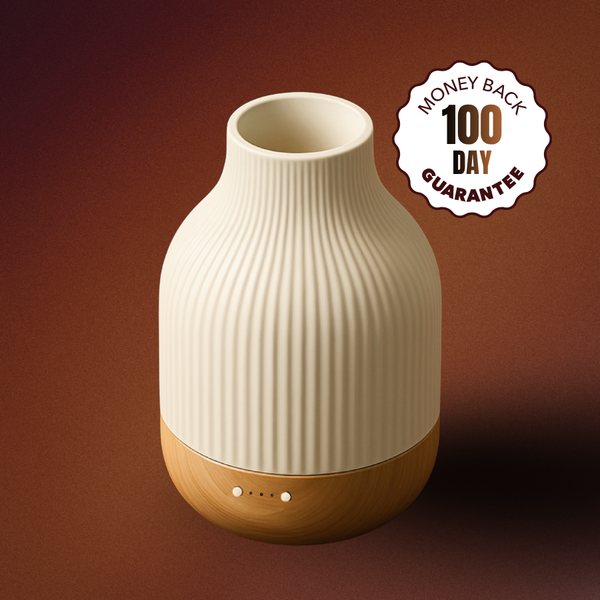
Whisper-quiet at 27.3 dB(A), made for sleep
Quiet Ceramic Essential Oil Diffuser for Bedroom & Sleep★★★★★ 4.92 (86 reviews)
Limited Offer — Free Lavender Oil View full product detailsWhat Makes a Ceramic Diffuser Different?
In almost every ceramic diffuser, the ceramic is the outer cover. Underneath sits a plastic reservoir, an ultrasonic plate and the electronics, because water and circuitry need a housing that ceramic is not well suited to. A diffuser described as ceramic is not a ceramic vessel with a motor in it.
That is worth knowing because material and performance are separate questions. Ceramic changes how a diffuser looks, feels and weighs; it does not change how the mist is produced. Two diffusers with identical ultrasonic hardware will behave identically whether the shell is porcelain or plastic. What ceramic does deliver is a surface that does not yellow with sunlight, hides fingerprints better than gloss plastic, and reads as an object rather than a gadget.
Real Ceramic vs. Ceramic-Look Plastic

Real ceramic is fired clay. It has weight in the hand, a slightly cool surface, and small variations between units — a glaze that pools differently, a fluted rib that is not machine-identical. It chips rather than scratches, and it holds a matte finish over years of sunlight.
Ceramic-look plastic is moulded ABS or PP with a stone-effect coating. It is lighter, cheaper, far more impact-resistant, and in a photograph it can be indistinguishable. Neither is the wrong choice — a plastic shell in a child's room or a rental is entirely sensible — but you should know which one you are paying for.
Three checks separate them: the weight in the listing, the word used in the materials line (fired ceramic and porcelain are specific; "ceramic finish", "stone effect" and "ceramic-like" are not), and the price. If a brand will not say plainly what the shell is made of, treat that as the answer. Our guide to whether ceramic diffusers suit a home goes further into everyday use.
Ceramic vs. Other Diffuser Materials
- Ceramic. Decorative, weighty, stable on a surface, and it hides dust and fingerprints. Chips if it falls.
- Plastic. Light, inexpensive and hard to break. Gloss finishes show fingerprints and can yellow in direct sun.
- Wood. Warm and quiet in a room, usually as a base or a veneer rather than the whole body, and it needs to stay dry.
- Ceramic and wood together. The combination most often used by design-led models, including the Scentreat: ceramic where it is seen and handled, wood for the base.
Whatever the shell, check the reservoir separately. It will almost certainly be plastic, and "BPA-free" plus a named polymer is more useful than a claim about the outside.
What to Look for in the Best Ceramic Diffuser
- Material authenticity. Look for "fired ceramic" or "porcelain", not "ceramic finish".
- Reservoir material. Named and BPA-free is the standard to expect; silence about it is a gap.
- Capacity. 70–180 ml across this list. Larger means fewer refills, not stronger scent.
- Runtime. Compare continuous and intermittent separately — intermittent roughly doubles the hours per fill.
- Coverage. A manufacturer rating for a closed room; treat it as a guide, not a promise.
- Noise. A measured figure with a distance beats "whisper-quiet". Only one model here publishes a laboratory measurement.
- Timer and auto shut-off. The features that make overnight use practical.
- Design and footprint. Check height as well as width, especially for a nightstand.
- Cleaning. Wipe the plate regularly and descale if your water is hard — see how to clean a diffuser.
- Essential-oil compatibility. Ultrasonic models take a few drops of 100% pure oil in water, not carrier blends.
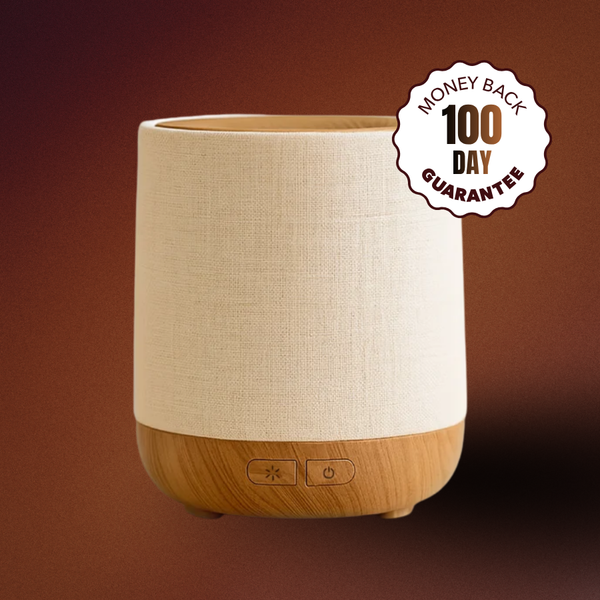
Up to 10 hours on one 200 ml fill
Wood Essential Oil Diffuser for Bedroom★★★★★ 4.93 (60 reviews)
Limited Offer — Free Lavender Oil View full product detailsConclusion
Choosing between the best ceramic diffusers comes down to a short list of checks: whether the ceramic is real, what the reservoir is made of, how much it holds, how long a fill lasts in each mode, the room it is rated for, how the light and timer behave, and whether it takes the essential oils you already use. Price sorts itself out once those are answered.
If your priorities are real fired ceramic, a natural wood base, a light that goes fully off and published material and noise figures, the Scentreat Ceramic & Rubber Wood Diffuser is the option on this list that answers all four, at $99.95 with a 100-day money-back guarantee. If your priority is price or pure design, the InnoGear and the Vitruvi are the better fits.
Still weighing two of them up? Message us on Facebook or Instagram, or email support@scentreat.com.
Frequently Asked Questions
Are ceramic diffusers actually made from ceramic?
The outer cover is, on a genuine ceramic model. The water reservoir and the ultrasonic parts inside are plastic, because that is what suits water and electronics. A diffuser sold as ceramic is a ceramic shell over a plastic core, and the honest listings say so.
Is a ceramic diffuser better than a plastic diffuser?
Not in how it works. Two diffusers with the same ultrasonic hardware produce the same mist whether the shell is ceramic or plastic. Ceramic is heavier, more stable on a surface, hides fingerprints and looks better on display; plastic is lighter, cheaper and far harder to break.
What is the best ceramic diffuser?
It depends on what you are optimising for. For published detail, material disclosure and a light that switches off, our pick is the Scentreat Ceramic & Rubber Wood Diffuser at $99.95. For the lowest price the InnoGear 150 ml is $34.99, and for design the Vitruvi Stone is the reference at $129.99.
Are ceramic diffusers good for essential oils?
Yes. All the models here are ultrasonic, which means a few drops of 100% pure essential oil in a tank of water, dispersed cold. Do not add carrier oils or fragrance blends unless the maker allows them, since they can clog the plate.
What should I look for when buying a ceramic diffuser?
Check that the material line says fired ceramic or porcelain rather than "ceramic finish", that the reservoir material is named and BPA-free, and that the runtime is quoted for both continuous and intermittent modes. Then look at the practical details: timer, auto shut-off, whether the light turns fully off, and the height if it will sit on a nightstand.
Is the Scentreat diffuser made entirely from ceramic?
No, and no diffuser on this list is. The Scentreat has a handcrafted ceramic cover on a solid rubber wood base, with a BPA-free ABS + PP reservoir inside. Scentreat publishes all three materials, which is the point of the distinction rather than a caveat.
How do I clean a ceramic essential oil diffuser?
Empty the tank after use, wipe the ultrasonic plate with a soft cloth or a cotton swab, and let the ceramic dry before reassembling. If your water is hard, run a white vinegar rinse periodically to clear scale. Our guide on how to clean a diffuser covers the routine in full.

