

This page is about how coverage actually behaves in a big room — the maths, the diffuser types, and where to stand them. If you want a shortlist of units to buy instead, that is Best Diffuser for Large Rooms. Not every diffuser can handle a large room — and the answer usually isn't a bigger device. For spaces over 300 sq ft, what matters most is output type, placement, and whether you're scenting the whole room or just where you actually sit. A well-placed ultrasonic diffuser (200–500 ml tank) covers 200–400 sq ft comfortably; nebulizing diffusers reach 400–900 sq ft using undiluted oil. For most living rooms, a targeted scent zone outperforms brute-force coverage.
Room size is one criterion of five — the full round-up shows how the same machines score on the rest.
Below: a plain-English breakdown of coverage thresholds, a placement strategy that actually works in big spaces, and how to avoid the most common large-room mistakes. For a side-by-side comparison of top picks, see our best diffuser for large rooms roundup.

Why Large Rooms Behave Differently

Coverage in a large room comes down to two variables: how oil is vaporized and how far that vapor travels before it dilutes. Most diffuser specs skip this — they advertise a coverage number without telling you the airflow conditions it was measured in. The U.S. Environmental Protection Agency puts the safe indoor range at 30–50% relative humidity, which is worth checking in a large room before you add any mist to it at all.
Three setups consistently perform in big spaces:
High-Output Ultrasonic Diffusers
Ultrasonic units with a 400–500 ml tank and continuous mist mode push enough vapor to reach 300–400 sq ft before the scent thins out. They use water + essential oil, so the output is gentler and runs longer — typically 8–12 hours on a full tank.
Nebulizing Diffusers for Maximum Reach
Nebulizers atomize pure oil with no water, producing a denser, faster-spreading mist. They can reach 400–900 sq ft — the strongest option for open floor plans or commercial-style spaces. Trade-off: oil burns through quickly (3–5× faster than ultrasonic), and the scent can feel intense at close range.
Targeted Scent Zones for Everyday Living
Most people don't use every corner of a large room. A 200 ml diffuser placed 1 meter off the floor near a sofa, desk, or bed creates a consistent scent zone of roughly 150–250 sq ft — enough to cover where you actually sit. This is the approach most likely to feel natural rather than overwhelming.
How Diffuser Coverage Really Works

"Coverage" on a diffuser box is a best-case figure measured in a still, climate-controlled room. Real homes have airflow, furniture, and open doorways — all of which change the result. For how the four diffuser technologies differ, see essential oil diffuser benefits, types, and how to choose.
Coverage by Output Type — Concrete Numbers
| Output Tier | Typical Coverage | Ideal Room Size | SCENTREAT Fit |
|---|---|---|---|
| Low-output ultrasonic (≤150 ml) | Up to ~150–200 sq ft | Bedroom, small office | Good for personal zones |
| Mid-output ultrasonic (200–300 ml) | 200–350 sq ft | Medium living room, open bedroom | Best fit — 200 ml wood diffuser sits here — rated 35 m² (375 sq ft) |
| High-output ultrasonic (400–500 ml) | 350–500 sq ft | Large living room, studio | No single unit at this tier — pair two mid-output SCENTREAT essential oil diffusers at opposite ends |
| Nebulizing / waterless | 400–900 sq ft | Open plan, commercial space | Scentreat Pillar, rated up to 1,076 sq ft (100 m²) |
What each column means
Output Tier — How much mist a diffuser puts out, sorted by tank size. ml means milliliters, and ≤150 ml means 150 milliliters or less.
Typical Coverage — The floor area that tier can realistically scent. sq ft means square feet.
Ideal Room Size — The kind of room that area usually describes.
SCENTREAT Fit — Which of our diffusers belongs in that tier, if any.
A ~ means "about". m² means square meters, the same area written in the other unit.
Example: the mid-output row
The mid-output tier covers tanks of 200 to 300 milliliters, which scent roughly 200 to 350 square feet, about the size of a medium living room or an open bedroom. That is where the Scentreat 200 ml Minimalist Wood sits, rated for 375 square feet, or 35 square meters. One tier up means a 400 to 500 milliliter unit, and we do not make one. For a room that size, two mid-output diffusers at opposite ends scent the space more evenly than a single large unit in a corner.
Why Coverage Feels Different in Real Life
Even a diffuser rated for 500 sq ft may feel weak if:
- An AC vent is directly above it (disperses mist before it settles)
- It's placed in a corner (limits natural air circulation)
- The room has high ceilings (scent rises and thins faster)
- It hasn't been running long enough (scent builds over 15–20 minutes)
Why No-Heat Diffusion Keeps Oil Compounds Intact
Ultrasonic diffusers use no heat, so the molecular structure of the essential oil is preserved during diffusion — linalool in lavender, limonene in sweet orange, and 1,8-cineole in eucalyptus stay intact. Diffusers that use heat (candle warmers, plug-in heating pads) can alter these compounds. If you're diffusing around children or pets, no-heat ultrasonic is the safer default. Our Ceramic & Rubber Wood Diffuser uses a handcrafted ceramic cover on a natural rubber wood base — ceramic bowl, rubber wood base.
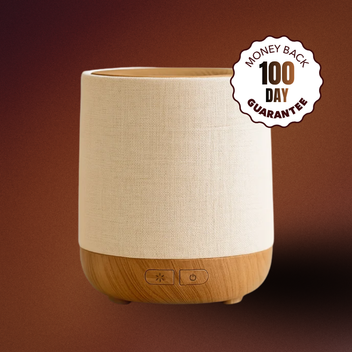
Wood essential oil diffuser that runs up to 10 hours on one 200 ml fill. Quieter than a whisper (27.3 dB, l...
Which Type of Diffuser Suits a Big Space

1. Nebulizing — Best for Full Large Room Coverage
Nebulizing diffusers work without water, atomizing pure oil directly into fine particles. Coverage: 400–900 sq ft. Best for open-plan kitchens, studios, or commercial rooms where you need scent to reach every corner fast.
- Pure oil — no dilution, stronger aromatic effect
- Faster room saturation than ultrasonic
- Higher oil consumption (plan for 3–5× more oil vs. ultrasonic)
- Can feel intense at close range — use intermittent mode if available
The Scentreat Pillar is our cold-air option in this tier, rated by the manufacturer for up to 1,076 sq ft.
2. Ultrasonic — Best Balanced Setup for Daily Living
For rooms where you spend real time — living room sofa, reading corner, bedroom — a 200 ml ultrasonic diffuser runs 6–8 hours and covers your activity zone without overwhelming the space. The Minimalist Wood Diffuser (200 ml, rubber wood, whisper-quiet) sits in this tier.
- Ultrasonic diffusion — no heat, oil compounds preserved
- 200 ml tank: 4–5 hours continuous, 8–10 hours on intermittent mode
- Quiet operation — suitable for sleep and focused work
- BPA-free ABS + PP reservoir under a fabric cover on a solid wood base
Why This Approach Works Better
Trying to fill an entire 600 sq ft room leads to wasted oil, uneven distribution, and scent that feels clinical rather than calming. A controlled zone that's consistently pleasant is more liveable than a whole room that smells intermittently strong.
Key Takeaway
- Nebulizing diffusers → best for full large-room saturation (400–900 sq ft)
- Mid/high ultrasonic → best for comfort zones in large rooms (200–500 sq ft)
- Pair two mid-output diffusers → placed at opposite ends of a 500+ sq ft room for even coverage
Placement Strategy for Large Rooms

Placement changes the effective coverage radius by as much as 30–40%. A strong diffuser in the wrong spot can feel weaker than a smaller one placed correctly. For bedroom-specific placement, see our detailed bedroom diffuser placement and airflow setup guide.
The Four Placement Rules for Large Rooms
1. Center of the room, not a corner. Corners trap mist and cut your effective radius roughly in half. Aim for the geometric center of your activity zone, or at least a meter from any wall.
2. About 1 meter (3 ft) off the floor. Mist is heavier than dry air and naturally settles. Starting at counter or table height (80–100 cm) gives it room to drift and spread before it reaches breathing level. Avoid floor placement.
3. Away from AC vents and ceiling fans. Forced airflow disperses mist before it has a chance to accumulate. Keep the diffuser at least 1.5–2 meters from any active HVAC vent. A slow ceiling fan is fine — it helps distribute scent; a high-speed fan works against you.
4. Diagonal from the main door. This lets natural air circulation from foot traffic carry scent across the room rather than straight out the door. In an open-plan space, position the diffuser on the opposite side from the kitchen or hallway opening.
Two-Diffuser Setup for 500+ sq ft
For rooms over 500 sq ft, one diffuser rarely covers the full space comfortably. Place two mid-output ultrasonic diffusers at opposite ends — each handles its half of the room. Run them on the same timer so scent builds evenly. This also means you can use gentler oils and fewer drops per unit.
Common Mistakes When Using a Diffuser in Large Rooms

- Using a small (≤100 ml) diffuser and expecting full-room fill — scent will stay within 1–2 meters of the device
- Placing it in a corner or on the floor — reduces effective range significantly
- Running it directly under an AC vent — the cool air stream breaks up the mist immediately
- Expecting instant scent — ultrasonic diffusers need 15–20 minutes to build a noticeable aroma in a large space
- Adding too many drops at once — for a 200 ml tank in a large room, 9–13 drops — the medium range — is usually enough; more creates intensity at close range but doesn't help coverage
- Moving it often — scent builds in a zone over time; repositioning resets that accumulation
SCENTREAT — A Smarter Way to Use Diffusers in Large Rooms

After understanding how coverage actually works, the simplest setup for a big space is one diffuser built for it, instead of several small units fighting the room.
The Scentreat Pillar Diffuser is built around that idea. It is a waterless cold-air diffuser that turns pure essential oil into a dry mist using air, with no water and no heat, straight from a 100 ml bottle that screws into the top. The manufacturer rates it for up to 1,076 sq ft (100 m²) at under 30 dB, enough for an open-plan living area, and the Bluetooth app timer lets you run it in sessions so the scent stays steady without using oil all day. It works with 100% pure essential oils, so what you breathe is exactly what came out of the bottle.
- Waterless cold-air diffusion, no water and no heat
- Up to 1,076 sq ft (100 m²), manufacturer rating
- Brushed aluminum body, leak-proof screw-on 100 ml bottle
- 100-day money-back guarantee and 1-year warranty
If you only need to scent one corner of a large room, such as a reading chair or a bedroom area, a smaller ultrasonic unit like the Minimalist Wood Diffuser is enough, and two of them at opposite ends cover about 400–500 sq ft.

Waterless cold-air diffuser in aluminum: 100 ml oil bottle, covers up to 1,076 sq ft, under 30 dB, app time...
Conclusion
Large room diffusion is a placement and output-type decision, not only a size decision. If you want the whole open space scented, one cold-air diffuser such as the Scentreat Pillar, rated for up to 1,076 sq ft, does it from a single spot; run it in timed sessions and keep it away from AC vents. If you only need a scent zone where you sit, a 200 ml Minimalist Wood Diffuser at the sofa or desk, or a pair at opposite ends of a 500+ sq ft room, is enough. Either way, place it at about 1 meter height and let the scent build for 15–20 minutes.
Frequently Asked Questions
What is the best diffuser for a large room?
For full coverage (400–900 sq ft), the practical answer is two ultrasonic units placed at opposite ends of the room rather than one larger machine — you get even coverage instead of a strong pocket of scent near the unit and nothing at the far wall. For daily comfort in a 200–400 sq ft activity zone, a mid-output ultrasonic (200–300 ml tank) placed at table height gives a more liveable, consistent result.
What size diffuser do I need for a 500 sq ft room?
A single nebulizing diffuser or two ultrasonic units (200–300 ml each) placed at opposite ends of the room. One mid-output ultrasonic on its own will cover roughly half that space — enough for a sofa or desk zone, but not the full room perimeter.
Can a small diffuser work in a large room?
For full-room saturation, no. But for creating a comfortable scent in a specific area — your sofa, bed, or desk — a well-placed 150–200 ml diffuser works well. Most people spend time in one part of a large room anyway.
How can I improve diffuser performance in a big space?
Move it away from corners and AC vents, raise it to about 1 meter (table or shelf height), position it toward the center of your activity zone, and let it run for at least 15–20 minutes before judging the scent level. Add 9–13 drops of oil per 200 ml of water, the medium range — more drops won't extend coverage, just intensity near the device.
In a home with cats, do not shut the door on the animal — cats lack the liver pathway that handles phenols and monoterpenes, so a sealed room turns a mild scent into a long exposure. The risk runs lower for dogs, but the same rule holds for both: nothing goes on the coat, and nothing goes in the food or the water bowl.
Why can I only smell my diffuser when I'm close?
Usually a placement issue — corner position, floor level, or an AC vent directly above. Try moving it to a central table at sitting height and keeping it at least 1.5 meters from HVAC vents. Also check you're using enough oil: under-oiling in a large room results in a scent that's barely detectable past arm's reach.
Is it better to fill the whole room or just one area?
For most people, a consistent scent zone feels more comfortable than full-room saturation. Full-room diffusion often means the scent is too strong near the device and too faint at the edges. A targeted setup — centered on where you sit or sleep — creates an even, pleasant experience without wasted oil.

