

Quick answer: For a desk or office, a compact ultrasonic diffuser running 100–200 ml works best. It's quiet enough to stay on during calls (Scentreat's own machines measure 27.3 dB(A) at 1 m), covers a personal workspace without overwhelming shared air, and runs 4–6 hours on a single fill. Pair it with peppermint, lemon, or rosemary — scents linked to alertness and mental clarity — and you have a simple, non-toxic focus setup that runs all morning.
For the same machines scored for a whole home rather than a desk, see the main round-up.
In this guide, Scentreat covers which office diffuser specs matter most (tank size, noise level, runtime), which oils support focus, and how to handle shared vs. private workspaces without bothering your colleagues.
In this article
Why Use a Diffuser at Work?

Scent reaches the brain faster than almost any other sense — it connects directly to the limbic system, which regulates attention, mood, and memory. A compact diffuser at your desk puts that pathway to work without supplements or screens.
Improved Focus and Mental Clarity
Peppermint and rosemary are the two most-studied scents for workplace alertness. Research suggests that inhaled peppermint may reduce mental fatigue and support reaction time, while rosemary aroma has been associated with improved working memory performance, according to guidance published by the National Center for Complementary and Integrative Health (NCCIH). The key word is "may" — these are supportive tools, not substitutes for rest or good habits.
The goal isn't intensity. A light, consistent scent running in the background works better than diffusing heavily for 20 minutes and stopping.
Reduced Stress During Work Hours
Desk work carries a low-grade background stress that builds over hours. A soft, controlled scent — lavender, frankincense, or a citrus blend — can help lower that ambient tension without making you sleepy. The result is a clearer head, not a calmer body.
Better Air Feel in Air-Conditioned Spaces
Air-conditioned offices tend to feel dry. Ultrasonic diffusers release a cool mist that adds a touch of humidity while scenting the air — a small change that makes a long workday more comfortable. Unlike humidifiers, a 100–200 ml diffuser keeps output modest and targeted.
Consistent Environment = Faster Flow State
Using the same oil blend every morning creates a sensory cue. Over time, your brain starts to associate the scent with "work mode," making it easier to settle into focus without effort. It's the same logic as having a dedicated desk or consistent morning routine.
If you're new to workplace aromatherapy, our guide on Essential Oil Diffuser Benefits, Types, and How to Choose covers how ultrasonic, nebulizing, heat, and evaporative diffusers compare for different environments.

Handcrafted ceramic essential oil diffuser for bedroom and sleep: quieter than a whisper (27.3 dB, lab-test...
Which Oils Work Best for Focus at Work?

Start with three: peppermint, lemon, and rosemary. They're effective, widely tolerated in shared spaces, and easy to find. Heavier or more polarizing oils — patchouli, ylang-ylang, vetiver — are better saved for a private home office.
Peppermint — Alertness on Demand
Sharp and cooling, peppermint is the go-to for afternoon energy dips. Its active compound, menthol, stimulates cold receptors in the nasal passage and creates an immediate sense of alertness. Use it in short sessions (30–45 min) when focus starts to slip.
Best for: Resetting focus, quick productivity boosts, pre-meeting clarity.
Rosemary — Memory and Recall
Rosemary contains 1,8-cineole, a compound that may support cognitive performance. Research suggests inhaling rosemary aroma may improve working memory and alertness — useful for tasks involving numbers, writing, or detailed analysis.
Best for: Deep work, studying, problem-solving.
Lemon — Clean and Uplifting
Lemon offers a bright, refreshing scent that lifts mood without overpowering. It's the most office-friendly citrus because it dissipates quickly and rarely bothers sensitive coworkers. The active compound limonene is associated with mood support and reduced perceived stress.
Best for: Creative work, maintaining energy, shared office use.
Eucalyptus — Open and Clear
Eucalyptus brings a crisp, airy quality that makes a space feel less stuffy. It doesn't linger the way mint does, so it works well during video calls — present but not distracting. Note: use sparingly in tight shared spaces, as some people find strong eucalyptus irritating.
Best for: Light focus, long work sessions, open-plan offices.
Frankincense — Calm but Focused
Unlike stimulating oils, frankincense supports a grounded, settled kind of concentration. It's warmer and slower — good for strategic thinking, long writing sessions, or when you need to stay calm under pressure without losing edge.
Best for: Strategic thinking, writing, analytical work.
A Simple Office Focus Blend
Try this in 100 ml of water: lemon (2 drops) + peppermint (1 drop) + rosemary (1 drop). Run for 60 minutes, then let the air clear for 30. Refresh with the same blend or switch to frankincense for your second work block. Every oil in this blend is 100% pure — no synthetic fragrance, no heat-distorted compounds.
If your cat follows you from room to room, keep the session short and the room open — a cat cannot process the phenols and monoterpenes in essential oils, so the dose it cannot avoid is the one that matters. Dogs clear these compounds normally, but a dog should never be given oil to lick either, and diluted or not, it does not belong on fur.
Looking for oils pre-selected for focus? The Focus & Energy collection has blends matched to this kind of workday.
 Pair it with 100% Pure Peppermint Essential Oil
$14.99
Pair it with 100% Pure Peppermint Essential Oil
$14.99
Shared Office vs. Private Desk — What Changes?
This is the angle most diffuser guides skip. Whether you work alone or near others changes everything about which oils and settings to use.
| Setting | Best oils | Output level | Session length |
|---|---|---|---|
| Private home office / solo desk | Peppermint, rosemary, frankincense, eucalyptus, lemon | Medium — up to 5 drops / 100 ml | 60 min on, 30 min off |
| Open-plan or shared office | Lemon, sweet orange, light citrus blends only | Low — 2–3 drops / 100 ml | 30 min on, then assess |
Oils to avoid near colleagues: patchouli, ylang-ylang, clove, and strong eucalyptus. These are polarizing scents — people either love them or find them headache-inducing. In a shared space, err on the side of neutral citrus. When in doubt, ask before you diffuse.
What to Look for in a Desk Diffuser
Office buyers have a short list of must-haves: quiet enough for calls, small enough for a desk, and long enough to run through a work block. Here's what each spec actually means in practice.
| Spec | What to look for | Why it matters at a desk |
|---|---|---|
| Tank size | 100–200 ml | Right-sized for personal use; won't over-humidify a shared space |
| Noise level | <30 dB (ultrasonic) | Below the threshold where background hum becomes noticeable on calls |
| Runtime | 4–5 hr continuous / 8–10 hr intermittent | Covers a morning or afternoon work block without refilling |
| Coverage | 150–250 sq ft | Scents a personal zone without drifting too far into shared space |
| Power | USB or standard plug | USB means you can power from your laptop or hub — no extra outlet needed |
| Materials | Ceramic and wood shell, BPA-free reservoir | Cold mist, so nothing in the path is heated — comfortable to run near your breathing space all day |
Many of the best essential oil diffusers suit a desk when they stay around 30 dB and run 4 hours or more on a fill — the two specs that matter most at arm's length. Scentreat's own two machines are measured at 27.3 dB(A) at 1 m in independent laboratory testing.
Portable Option: USB or Battery-Powered

If you move between a home office and a co-working space, a portable diffuser makes sense. The CalmRide Portable Diffuser ($79.95) is a compact, waterless USB-C rechargeable option designed for exactly this — personal spaces, travel, or a desk that changes day to day. Independent laboratory testing puts it under 35 dB, with up to 60 hours per charge and coverage of 10–20 m², so it runs slightly louder than the desk figure above — but there is no water tank to carry or refill. For the full comparison of cordless, USB and waterless units, see the portable essential oil diffuser guide.
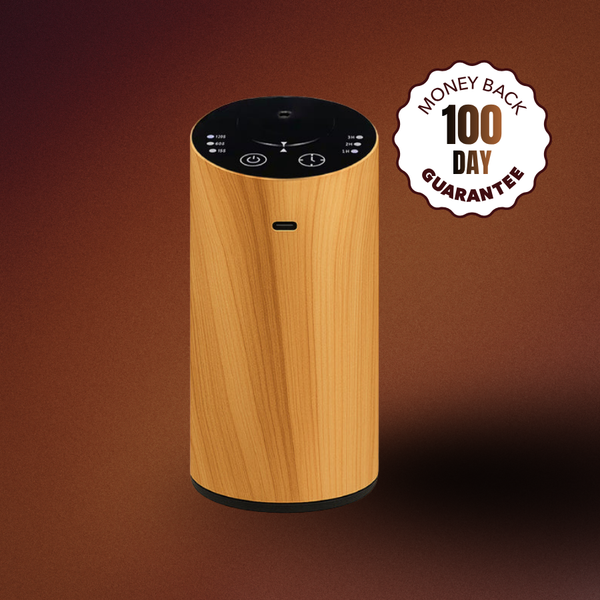
Waterless car diffuser, up to 60 hours per charge
Car Diffuser for Essential Oils★★★★★ 4.86 (63 reviews)
Limited Offer — Free Lavender Oil View full product detailsWhy the SCENTREAT Diffuser Works for Office Focus

The SCENTREAT Ultrasonic Diffuser ($99.95) is built around the specs that matter most for desk use: 27.3 dB(A) at 1 m, a 180 ml tank (4–5 hr continuous, 8–10 hr on intermittent mode), and a handcrafted ceramic cover over a solid rubber wood base, with a BPA-free ABS/PP reservoir inside. It covers rooms up to 320 sq ft (30 m²) — enough for a personal office or home desk without sending scent into your neighbor's cubicle.
The reservoir is BPA-free and sits under a handcrafted ceramic cover, and the mist is never heated — so your 100% pure essential oils reach the air unaltered. No heat, no synthetic carrier, no flame. That matters when you're breathing it for 4+ hours straight.
Key Specs at a Glance
- Noise: 27.3 dB(A) at 1 m ultrasonic — silent enough for video calls
- Tank: 180 ml — 4–5 hr continuous, 8–10 hr on intermittent mode
- Coverage: up to 320 sq ft (30 m²) — desk, home office, or a small room
- Materials: handcrafted ceramic cover on a solid rubber wood base, over a BPA-free reservoir
- Non-toxic: no-heat diffusion, no BPA, no synthetic fragrance carrier
- Mist control: adjustable output for shared vs. private settings
For a full side-by-side, see our guide on running a diffuser all night — the same quiet operation and runtime specs that make it work for sleep also make it ideal for a focused work session.
SCENTREAT Essential Oils for Focus
The diffuser works best with 100% pure oils — no dilution, no filler. Pair it with peppermint, lemon, or rosemary for a focus session, or try the blend above (lemon 2 + peppermint 1 + rosemary 1 in 100 ml). All SCENTREAT single oils are 100% pure and cold-pressed or steam-distilled — no synthetic fragrance.
Browse the focus oil collection for pre-selected oils matched to work and energy.
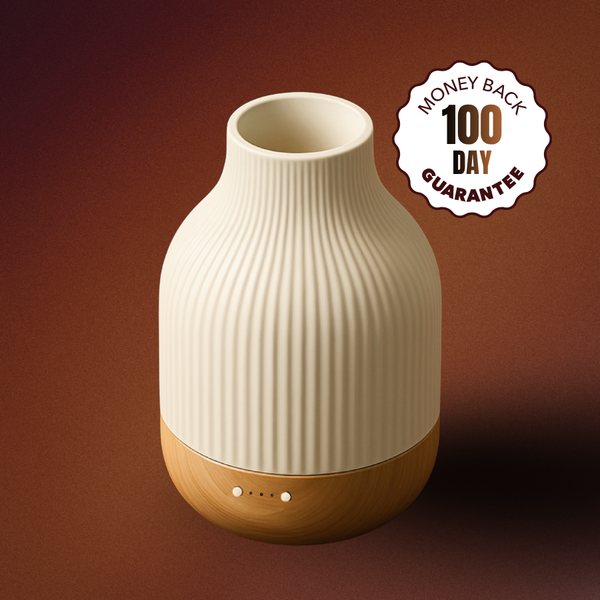
Whisper-quiet at 27.3 dB(A), made for sleep
Quiet Ceramic Essential Oil Diffuser for Bedroom & Sleep★★★★★ 4.92 (86 reviews)
Limited Offer — Free Lavender Oil View full product detailsHow to Use a Diffuser at Your Desk

- Start light: 3–5 drops in 100 ml. More drops = stronger mist, not better focus.
- Run in blocks: 30–60 minutes on, then let the air clear. Continuous diffusion leads to scent fatigue — you stop noticing and add more drops, which can get overwhelming.
- Position it offset: Place the diffuser 18–24 inches from your nose, slightly to the side. Directly in front of you concentrates the scent too much.
- Use a flat, stable surface: Reduces vibration and keeps the unit quiet. Don't put it on a hollow desk surface that amplifies sound.
- In shared offices: Choose citrus-only blends at low output, and let your colleagues know. A quick heads-up goes a long way.
Common Mistakes to Avoid

- Using polarizing scents in shared spaces: Patchouli, ylang-ylang, and strong eucalyptus are the biggest offenders. Save them for solo use.
- Running the diffuser all day without a break: Scent fatigue kicks in after 60–90 minutes. Take breaks so the scent stays effective.
- Choosing a diffuser that's too large: A 500 ml unit in a small office will overpower the room and everyone in it.
- Placing it too close to your face: Direct exposure at short range feels intense. Offset it and let the mist disperse first.
- Using too many different oils in one day: Switching blends every hour makes the environment feel unstable. Pick one blend per work block and stick with it.
The Bottom Line
The best diffuser for office use gets three things right: quiet enough to disappear on a call (under 30 dB), sized for a desk (100–200 ml), and built from non-toxic materials you'd be comfortable breathing near all day. Add the right oil — peppermint, lemon, or rosemary for focus; citrus-only for shared spaces — and you have a setup that supports a clear head without any fuss.
The non-toxic essential oil diffuser from SCENTREAT checks all three boxes. Or if you need something portable, the portable essential oil diffuser travels with you between desk and co-working space. Explore the full diffuser collection to find the right fit for your setup.
Frequently Asked Questions
What is the best diffuser for office use?
A compact ultrasonic diffuser with a 100–200 ml tank, under 30 dB noise level, and at least 4 hours of runtime is ideal for desk use. Look for a BPA-free reservoir and a ceramic or wood shell if you'll be running it near your face for hours.
Are diffusers allowed in office environments?
Most offices allow personal diffusers, but it's courteous to ask first — especially in open-plan spaces. Keep the scent light, choose neutral citrus oils, and run short sessions rather than all-day diffusion. In a large open-plan floor a personal unit will not carry; the best diffuser for large rooms guide covers coverage ratings and two-unit setups.
What oils are best for focus at work?
Peppermint, lemon, and rosemary are the most widely used. A simple office blend: lemon (2 drops) + peppermint (1 drop) + rosemary (1 drop) in 100 ml, refreshed every 60 minutes. These are also the most tolerated in shared spaces.
Should I run a diffuser all day at work?
No — 30–60 minute sessions with breaks work better. Continuous diffusion leads to scent fatigue, where you stop noticing the scent and tend to add more drops, making the environment too heavy. Use it in blocks tied to your work sprints.
What size diffuser is best for a desk?
100–200 ml is the sweet spot. It gives you 4–6 hours of runtime, covers 150–250 sq ft (plenty for a personal workspace), and stays compact enough not to take over your desk.
Which oils should I avoid in a shared office?
Avoid patchouli, ylang-ylang, clove, vetiver, and strong eucalyptus blends. These are polarizing scents that frequently cause headaches or discomfort in coworkers who didn't choose them. Stick to light citrus — lemon or sweet orange — when others are nearby.

