

Key Takeaways
BEST BUY PICKS
Essential oil blends for a diffuser are combinations of two or more 100% pure oils chosen to complement each other — top, middle, and base notes working together to create a layered, lasting scent. A sleep blend might use lavender, chamomile, and sandalwood; a focus blend pairs lemon with peppermint and rosemary. Add 3–6 drops per 100 ml of water and run your diffuser for 30–60 minutes at a time.
For the complete guide, see Essential Oil Diffuser: Benefits, Types, and How to Choose.
In this guide, Scentreat explains how blending works (including the notes structure), shares ready-to-use diffuser recipes for six different goals, and gives you the ratios so you can confidently mix your own at home.
What Are Essential Oil Blends for Diffuser?

A blend is simply two or more essential oils mixed together so their scent characters support each other. Instead of a single sharp note, you get something with dimension — a fresh top that draws you in, a soft middle that carries the mood, and a grounding base that lingers.
When dispersed through an ultrasonic diffuser, the blend mist spreads evenly, giving you a consistent atmosphere rather than an intense burst from one source. The goal is always balance: the right oils in the right proportions, matched to what you actually need in the moment.
While a good blend improves how a room smells, it works best in a clean, well-ventilated space. For context on keeping your environment fresh, see our guide on Common Reasons Your Bedroom Smells Bad.
Top, Middle, and Base Notes — Why They Matter for Blending
Every essential oil falls into one of three "note" categories based on how quickly it evaporates and how long its scent lasts. Understanding notes is what separates a blend that smells intentional from one that just smells busy.
Top notes are the first impression — light, bright, and fast-fading (think citrus and peppermint). They hit immediately but dissipate within the first 20–30 minutes. Middle notes are the heart of the blend. Oils like lavender, chamomile, and rosemary carry the mood and linger for 1–2 hours. Base notes are the anchor — deep, warm oils like cedarwood, frankincense, and sandalwood that slow down evaporation and give the whole blend staying power (2–4+ hours).
A well-built blend uses all three layers. The classic starting ratio is 3 parts top : 2 parts middle : 1 part base — this creates a scent that opens bright, settles into a mood, and leaves a soft trace. You can shift the ratio toward more middle or base notes if you want something warmer or longer-lasting.
For more on getting the quantities right per diffuser size, see How Many Drops to Add to a Diffuser.
Diffuser Blends by Goal — Recipes with Drop Counts

Each blend below gives you exact drop counts for a standard 100 ml water fill. If your diffuser tank is larger (e.g. 200 ml), simply double the drops — the ratios stay the same.
Sleep Blend
Goal: calm nervous system, ease into rest. Per 100 ml: 3 drops lavender + 2 drops chamomile + 1 drop sandalwood.
- Lavender (middle note) — linalool, its primary compound, is associated with reduced anxiety signals
- Chamomile (middle note) — soft, apple-floral; pairs with lavender without competing
- Sandalwood (base note) — warm, woody anchor that carries the scent through the night
Research from the Sleep Foundation notes that inhaled lavender may support perceived sleep quality for some people. Run this blend 30–45 minutes before bed.
Pair it with one of the best essential oil diffusers for bedroom sleep for a consistent nighttime environment.
Focus Blend
Goal: sharpen alertness, reduce mental fog. Per 100 ml: 3 drops lemon + 2 drops peppermint + 1 drop rosemary.
- Lemon (top note) — bright citrus lifts mood quickly; fades in ~20 min, giving way to the middle notes
- Peppermint (top/middle) — menthol gives a cool, alert quality that anchors the blend
- Rosemary (middle note) — herbaceous and grounding; 1,8-cineole is the key compound linked to cognitive alertness
Use during work or study sessions. Avoid around children under 10 or near pets — peppermint and rosemary are high in compounds that can be irritating for small bodies. See the safety note at the end of this post.
Relax Blend
Goal: decompress after a busy day, reduce tension. Per 100 ml: 3 drops bergamot + 2 drops ylang-ylang + 1 drop frankincense.
- Bergamot (top note) — citrus with a floral edge; lighter than lemon, softer than orange
- Ylang-ylang (middle note) — rich, slightly sweet; use only 2 drops — this oil is potent
- Frankincense (base note) — resinous, earthy anchor; completes the blend's calm
Morning Ritual Blend
Goal: start the day energized and clear-headed. Per 100 ml: 3 drops grapefruit + 2 drops rosemary + 1 drop peppermint.
- Grapefruit (top note) — fresh, uplifting citrus; brighter and slightly more complex than lemon
- Rosemary (middle note) — herbal backbone that bridges the citrus and the cool mint
- Peppermint (top/middle) — the sharp finish that makes the blend feel truly awake
Run this for 20–30 minutes while getting ready. The citrus top note will fade first, leaving a cleaner herbal scent as the middle notes take over.
Unwind Blend
Goal: deep decompression for evenings when you need more than just "calm". Per 100 ml: 2 drops frankincense + 3 drops lavender + 1 drop ylang-ylang.
- Frankincense (base) — resinous, grounding; slows down the blend's evaporation so the scent stays soft for hours
- Lavender (middle) — the calming heart; its linalool works with the frankincense boswellic compounds
- Ylang-ylang (middle/base) — a single drop adds a warm floral depth without going heavy
This blend pairs well with the sleep & relax oil collection if you want to explore other combinations in the same mood family.
Matching Blends to Your Daily Routine
Blends work best when they match the rhythm of what you're doing — not just what you like the smell of.
Morning: citrus-led blends (Morning Ritual, Focus) — bright, short burn time.
Afternoon: herbal blends (Focus, Relax) — sustained clarity without overstimulation.
Evening: floral + wood blends (Sleep, Unwind, Relax) — run 30–45 min before bed, not all night.
Most diffuser blends are effective at 3–6 drops per 100 ml. Going higher doesn't make the scent better — it often makes it overwhelming.
How to Mix Your Own Essential Oil Blends

Step 1 — Start with a Goal, Not Oils
Decide what you want the blend to do before you pick any oils. "Calm" and "focus" call for completely different note structures. Mixing without a direction usually produces something muddled.
Step 2 — Pick 2–3 Oils Max to Start
Simple blends usually outperform complex ones. Two well-matched oils often smell more cohesive than five random ones. Once you're comfortable, you can build to three — but rarely need more.
Step 3 — Use the 3:2:1 Ratio
For a 6-drop blend per 100 ml: 3 drops top note + 2 drops middle note + 1 drop base note. Scale up proportionally for larger tanks — a 300 ml diffuser takes 9–18 drops total.
Step 4 — Test One Change at a Time
If the blend doesn't smell quite right, change one oil. Swapping multiple things at once makes it impossible to know what actually worked. Give each test 5 minutes to diffuse before judging.
Step 5 — Watch for Strong Oils
Some oils punch above their weight. Ylang-ylang, clove, oregano, and cinnamon can easily overpower a blend at standard drop counts. Keep these at 1 drop maximum (or avoid entirely in blends — see the safety note below).
Essential Oil Blend Ratios — Quick Reference
| Diffuser Tank Size | Total Drops | Top Note | Middle Note | Base Note |
|---|---|---|---|---|
| 100 ml | 6 drops | 3 drops | 2 drops | 1 drop |
| 200 ml | 10–12 drops | 5–6 drops | 3–4 drops | 2 drops |
| 300 ml | 15–18 drops | 7–9 drops | 5–6 drops | 3 drops |
Adjust down if you have a sensitive nose or small room — less is almost always better when starting a new blend.
A Note on Blending Safety
Not all oils blend safely in all situations. A few things to keep in mind:
- High-sensitization oils — cinnamon bark, clove, and oregano are potent sensitizers. If you use them in a blend, limit to ≤1 drop per 100 ml and diffuse briefly (15–20 min max). Many people prefer to skip these in blends entirely.
- Children (under 10): avoid blends containing peppermint, eucalyptus, or rosemary — these oils are high in menthol and 1,8-cineole, which can cause breathing discomfort in young children. Lavender and chamomile blends are generally considered safer for family spaces.
- Pets: cats and dogs process essential oils differently than humans. Tea tree, eucalyptus, clove, and citrus oils can be toxic if inhaled in concentrated amounts. Diffuse in well-ventilated rooms your pets can leave freely, and keep sessions short. If your pet seems lethargic or distressed, stop diffusing and ventilate the space. The ASPCA Animal Poison Control is a reliable resource for specific oil concerns.
- Pregnancy: some oils (clary sage, rosemary, clove) are traditionally avoided during pregnancy. Consult your healthcare provider before using any new aromatherapy blend if pregnant or breastfeeding.
Common Mistakes When Making Essential Oil Blends

Mixing Without a Direction
Blends need a purpose. Combining oils randomly leads to something inconsistent — not "complex", just unclear. Start with a goal and let it guide which notes you reach for.
Letting One Oil Dominate
Strong oils (ylang-ylang, clove, eucalyptus) can take over a blend at regular drop counts. Keep potent oils at 1 drop and build the rest of the blend around them.
Changing Too Many Variables at Once
Small changes, one at a time. If you swap three oils simultaneously, you won't know what fixed (or broke) the scent. Patience in blending pays off.
Expecting Instant Results
Some blends need time to settle after mixing — and your nose adapts to familiar scents quickly. If you've been smelling it for 10 minutes, take a break and come back fresh.
Ignoring the Recipes Post
If you want seasonal blends or named recipes like "Winter Spice" and "Spring Garden", those have their own guide — see our Essential Oil Diffuser Recipes post for ready-made options by season.
A Diffuser Built for Blending

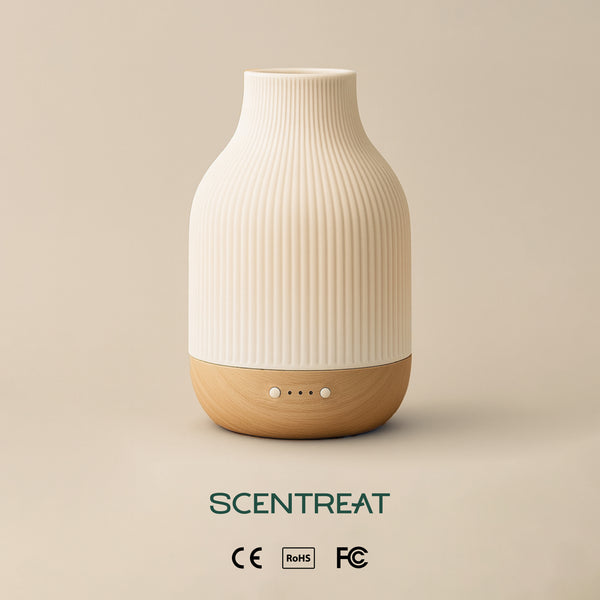
A good blend deserves a diffuser that disperses it evenly — not one that burns off the top notes too fast or pools the base notes at the bottom. The SCENTREAT Rubber Wood & Ceramic Diffuser uses ultrasonic cold-water mist, which keeps all three note layers intact as the scent fills the room.
It's also quiet enough for a bedroom — no heat, no plastic, no interruption. If you want a diffuser that actually lets your blends perform, this one sits at $89.95 and pairs well with any of the blends in this guide.
You can also browse the full essential oil diffuser collection to find the right tank size for your space — smaller tanks for the desk, larger for the bedroom.
Conclusion
Essential oil blends turn a diffuser from a scent source into a mood tool. The key is knowing your notes — top, middle, base — and using them with intention. Start with the recipes above (3–6 drops per 100 ml), get comfortable with the 3:2:1 ratio, and adjust from there. Most people find a handful of go-to blends that cover 80% of their needs.
For more, follow Scentreat on Facebook and Instagram. Questions about products or orders? Reach us at support@scentreat.com — our team is available 24/7.
Frequently Asked Questions
What are the best essential oil blends for diffuser?
It depends on your goal. For sleep: lavender + chamomile + sandalwood (3:2:1, per 100 ml). For focus: lemon + peppermint + rosemary. For morning energy: grapefruit + rosemary + peppermint. Start simple — two or three oils chosen with a purpose almost always outperform a complex mix.
How many drops of essential oil should I use per 100 ml?
3–6 drops per 100 ml is the standard range for diffuser blends. Start at 4 drops and adjust up or down based on how strong the scent feels in your room. Bigger rooms and open-plan spaces may need 5–6 drops; small bedrooms often do fine with 3–4.
Can I mix any essential oils together?
Not all oils blend well — and some can cause problems at higher concentrations. Avoid mixing more than 3–5 oils at once; complexity rarely improves the result. High-sensitization oils like cinnamon bark, clove, and oregano should be kept to 1 drop maximum in any blend, or skipped entirely. Some oils are also unsafe around children and pets (see the safety section above).
What ratio should I use for blending oils?
Start with 3:2:1 — three parts top note, two parts middle note, one part base note. This gives you a blend with a bright opening, a sustained mood, and a lasting finish. Shift the ratio toward more base notes if you want something warmer and longer-lasting.
How long should I run a diffuser blend?
30–60 minutes is ideal for most blends. Running a diffuser continuously for hours can cause scent fatigue (where you stop noticing the smell) and may be too much for sensitive people or pets. For sleep blends, run for 30–45 minutes before bed rather than all night.
Why does my blend smell too strong or uneven?
Most often this is one of two things: too many drops (scale back to 3–4 per 100 ml) or one oil overpowering the others. Potent oils like ylang-ylang, clove, or eucalyptus can dominate at regular drop counts. Keep them to 1 drop and rebuild from there.