

No, a candle warmer lamp uses very little electricity: under 1 cent an hour at the average US price. This guide from Scentreat explains watts and kilowatt-hours, works out the cost of 35W and 50W lamps and compares them with 6 things you already plug in.
Which one is for you?
- You want the lowest bill: choose a 35W lamp, which costs about 76 cents a month at 4 hours a day.
- You warm wide jars: a 50W lamp usually melts them faster and costs about 33 cents more a month at 4 hours a day. For wide, multi-wick jars, see our guide to the best candles for a candle warmer lamp.
- You often forget it's on: choose a candle warmer with timer that switches itself off, since the hours it runs are what you pay for.
- You live in a high-price state: the cost stays under $3 a month at 4 hours a day, even in Hawaii.
What Is a Watt and a kWh?

Two words on your power bill help explain it all. As electricity flows through the lamp's cord, the bulb turns that energy into the light and heat you enjoy.
A watt (W) tells you how fast a device is using electricity right now. Think of a car's speedometer: a 35W lamp holds the needle at 35 for as long as it's on at full brightness. A hair dryer, by comparison, can push that needle past 1,000.
A kilowatt-hour (kWh) tells you the total used, like miles on an odometer. "Kilo" means 1,000, so 1 kWh is 1,000 watts running for 1 hour. Your power company charges for those miles, the kWh, rather than the speed.
A lamp running at 50 watts takes 20 hours to use a single kWh, while one running at 35 watts takes almost 29 hours. That helps explain why the numbers below are so small.
How Much Electricity Does a Candle Warmer Use?

A candle warmer lamp uses the wattage its bulb is rated for. Most use one 35W or 50W halogen bulb, which gives off heat as it glows, and we make lamps in both sizes. Here's how that electricity use looks in kWh:
| Bulb | 1 hour | One 8-hour timer run | 4 hours a day, 30 days |
|---|---|---|---|
| 35W | 0.035 kWh | 0.28 kWh | 4.2 kWh |
| 50W | 0.05 kWh | 0.4 kWh | 6 kWh |
To find your lamp's watts, look in three places: the label under the base, the bulb's rim, where the watts are usually printed, and the product page. The listed figure tells you the most a device draws, so use it as the top of the range.
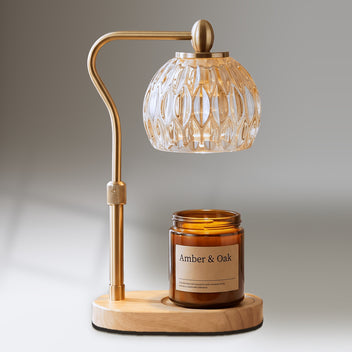
Amber cut crystal candle warmer lamp on a brass arm and wood base, with a timer and dimmer. Free 4-oil set,...
What It Costs: Per Hour, Month and Year

To turn kWh into dollars, you need one more number: the price of 1 kWh. The latest US home average is 18.16 cents per kWh for August 2026. That figure comes from the U.S. Energy Information Administration (EIA), the government office that tracks energy prices; August was the newest month published as of November 15, 2026.
| At 18.16¢ per kWh | 35W lamp | 50W lamp |
|---|---|---|
| 1 hour | 0.64¢ | 0.91¢ |
| One 8-hour timer run | 5.1¢ | 7.3¢ |
| 30 days, 4 hours a day | $0.76 | $1.09 |
| 365 days, 4 hours a day | $9.28 | $13.26 |
These figures assume full brightness every minute. Over a 6-month candle season at 4 hours a day, a 35W lamp costs about $4.63 and a 50W lamp about $6.61.
Use Your Own Rate
Your electricity price may be higher or lower than the average. To work out your own cost, follow this 3-step method from Virginia Cooperative Extension, part of Virginia Tech. We'll use a 35W lamp, like our Crystal Globe, running 4 hours a day:
- Daily kWh: multiply watts × hours a day ÷ 1,000. For this lamp, 35 × 4 ÷ 1,000 = 0.14 kWh a day.
- Monthly kWh: multiply daily kWh × days. Here, 0.14 × 30 = 4.2 kWh a month.
- Cost: multiply kWh × your price. Here, 4.2 × $0.1816 = $0.76 a month.
Look for your rate on your power bill, shown as a charge "per kWh" in cents or dollars. If you see separate per-kWh charges, such as supply and delivery, add them together to get a closer estimate.
Does It Cost More in My State?

It can, and prices vary quite a bit. EIA home prices for August 2026 ranged from 12.72 cents per kWh in Nevada to 47.18 cents in Hawaii. Here's the monthly cost of using a 35W lamp for 4 hours a day:
- Nevada (12.72¢): $0.53
- Florida (14.99¢): $0.63
- Texas (15.91¢): $0.67
- California (29.75¢): $1.25
- Hawaii (47.18¢): $1.98
Even at Hawaii's price, a 50W lamp costs about $2.83 a month. That means a candle warmer lamp makes only a small difference to your bill, even at the highest state price.
Candle Warmer vs Other Things You Plug In

It's hard to picture what 0.64 cents buys, so let's compare a 35W lamp with things you already plug in. We've used the highest watts listed for each item in Virginia Cooperative Extension's table and worked out the costs ourselves at 18.16 cents.
| Item | Watts | 1 hour costs | Same as a 35W lamp for |
|---|---|---|---|
| Hair dryer | up to 1,875 | about 34¢ | about 54 hours |
| Portable heater | up to 1,500 | about 27¢ | about 43 hours |
| Coffee maker | up to 1,200 | about 22¢ | about 34 hours |
| Microwave | up to 1,100 | about 20¢ | about 31 hours |
| Flat-screen TV | 120 | about 2.2¢ | about 3.4 hours |
| Laptop | 50 | about 0.9¢ | about 1.4 hours |
Of course, those big appliances run for only minutes at a time. The table simply puts things in perspective: enjoying candle scent for 4 hours with a 35W lamp uses less electricity than a 10-minute blow-dry with a 1,875W dryer.
Do you also run an essential oil diffuser? Find its running cost in our guide to how much an essential oil diffuser costs.
Why the Bulb Needs Those Watts
With a candle warmer lamp, almost every cent pays for heat, which is exactly the point. ENERGY STAR says more than 90% of the energy an incandescent bulb uses becomes heat rather than light, and a halogen bulb belongs to that incandescent family.
In a reading lamp, you'd probably rather not pay for that heat. In a candle warmer lamp, though, the heat does the work you want: melting the top of the wax and carrying its scent into the room. Think of it as a small heater aimed at your candle, with a glow to enjoy along the way.
That's why swapping in a low-watt LED bulb isn't a shortcut. An LED produces light without much heat, leaving the wax solid. Our candle warmer light bulb guide explains the difference, while our guide to how a candle warmer lamp works shows where the heat goes.
3 Ways to Keep the Cost Low
The cost is already small, but these habits help trim it further.
- Use the timer: you pay for the hours the lamp runs, so choosing a 2-hour run instead of 4 hours cuts the cost in half. See how long you can leave a candle warmer on.
- Dim it once the top has melted: turning the setting down draws a little less power while still keeping the melt pool soft.
- Set the shade at the right height: lower it toward the jar while leaving a clear gap above the rim. This helps the wax melt faster, so you need fewer hours. Our guide to using a candle warmer lamp walks you through it.
If you're heading away for a few days, unplug the lamp.
Shop It at Scentreat: Low-Watt Lamps With a Timer

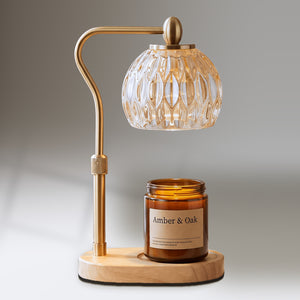
If keeping the bill low matters most, the Crystal Globe candle warmer lamp uses a 35W bulb, costing about 0.64 cents an hour at the US average. Its amber cut-crystal globe hangs from a brass-tone arm above an oval wood base, with the amber glass giving the glow a warm honey tint.
The trade-off is how quickly the wax melts: a 35W bulb usually takes longer than a 50W bulb to melt the top of a wide jar. If you'd like to compare features beyond running cost, take a look at our guide to the best candle warmer lamps.
- Bulb: 35W GU10 halogen, with 2 in the box.
- Timer: choose 2, 4 or 8 hours before it switches itself off.
- Dimmer: from soft glow to full brightness.
- Shade height: adjusts along a brass-tone arm, from 9.8 to 12.6 in tall.
- Support: email us your jar height for a free fit check.
Free US shipping · 100-day returns · 1-year warranty
For wide jars, the black marble candle warmer lamp and gold candle warmer lamp each use a 50W bulb: under 1 cent an hour at the US average. Both include an auto-off timer, a dimmer and 3 bulbs. The retro candle warmer lamp also uses a 50W halogen bulb, while the clear ribbed glass candle warmer lamp offers another 35W option.
Conclusion
At the US average price, a candle warmer lamp costs under a cent an hour, or about $1 a month at 4 hours a day. Let your candles guide your choice: 35W for the lowest cost or 50W for wide jars. Either way, choose a timer so the lamp doesn't run longer than you need.
For a low-watt lamp with a timer and a dimmer, consider the Crystal Globe candle warmer lamp. You'll get 2 bulbs in the box, along with free US shipping and 100-day returns.
Have a question? Email support@scentreat.com and we'll reply within 24 hours, 7 days a week.
Frequently Asked Questions
Do candle warmers use a lot of electricity?
No, a candle warmer lamp uses very little electricity. A 35W or 50W lamp costs about 0.64 to 0.91 cents an hour at the US average home price of 18.16 cents per kWh (August 2026). At 4 hours a day, that's about $0.76 to $1.09 a month.
How much does it cost to run a candle warmer all day?
A full 24 hours with a 50W lamp would cost about 22 cents. For a shorter stretch, one 8-hour timer run costs about 5 cents with a 35W bulb and 7 cents with a 50W bulb. Although the cost is small, we don't suggest leaving it on all day because the bulb and shade stay hot.
Does a candle warmer use more electricity than a regular lamp?
No, lamps with the same watts use the same amount of electricity. A 50W candle warmer draws as much as a 50W bulb in a table lamp. An LED bulb uses less, but it gives off too little heat to melt the wax.
Is a 35W or 50W candle warmer cheaper to run?
The 35W lamp costs less to run, by about 33 cents a month at 4 hours a day. A 50W lamp usually melts wide jars faster, though, so with such a small difference in cost, let the candles you warm guide your choice.
Does the dimmer save electricity?
Yes, a little: the bulb draws less power at a lower dimmer setting. You probably won't notice a change on your bill, though. The timer usually saves more by shortening the time the lamp runs, since those hours are what you pay for.
Does a candle warmer use electricity when it's turned off?
A plugged-in candle warmer may still use a tiny amount of electricity through its cord control after the bulb is off. The heat and almost all power use stop, though. We found no published figure for that remaining draw, so unplug the lamp if you'll be away for a few days.
A few words you'll see in this guide
- Watt (W): how fast a device is using electricity right now, like the speed shown on a speedometer.
- Kilowatt-hour (kWh): 1,000 watts used for 1 hour, measuring the total electricity your power bill charges for.
- Rate: what you pay for each kWh, listed on your power bill in cents or dollars.
- Halogen: a type of incandescent bulb that heats a tiny wire to make it glow, giving off plenty of heat.
- Auto-off timer: a built-in countdown that cuts the lamp's power after the number of hours you choose.
- Dimmer: the control you use to make the bulb brighter or softer.
Sources
- Virginia Cooperative Extension (Virginia Tech), Estimating Appliance and Home Electronic Energy Use, checked November 15, 2026.
- U.S. Energy Information Administration, Electric Power Monthly, Table 5.3: Average Price of Electricity to Ultimate Customers, data for August 2026, released October 23, 2026, checked November 15, 2026.
- U.S. Energy Information Administration, Electric Power Monthly, Table 5.6.A: Average Price of Electricity by State, data for August 2026, checked November 15, 2026.
- ENERGY STAR (U.S. EPA), Lighting Technologies: A Guide to Energy-Efficient Illumination fact sheet, checked November 15, 2026.

