

A candle warmer light bulb does two jobs at once: it lights up the lamp and heats the top of your candle until the wax melts. This guide from Scentreat explains which bulb your lamp takes, what GU10 and 35W or 50W mean and how to swap a bulb in 4 steps. If these lamps are new to you, start with how a candle warmer lamp works.
Which bulb do you need?
- Your old bulb says GU10 and 35W or 50W: buy a GU10 halogen bulb with the same watts.
- The print has worn off: check the label under the lamp or the product page.
- You're thinking about an LED: skip it. It may fit the socket, but the wax barely melts.
- You own a Scentreat lamp: spares are in the box. See the lamp table.
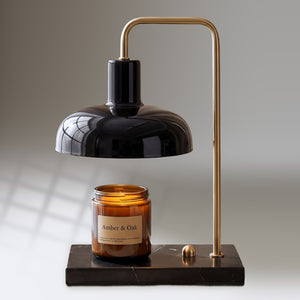
What Is a Candle Warmer Light Bulb?

A candle warmer lamp doesn't just use light to melt wax. It uses heat from the bulb.
Most candle warmer lamps use a halogen bulb, which gives off plenty of heat as it shines. The lamp's shade helps direct that heat down toward the candle jar.
As the wax warms up, the top layer begins to melt. This creates a small pool of liquid wax, called the melt pool, that releases fragrance into the air. There's no need to light the wick.
That's why the right bulb matters. If it doesn't produce enough heat, the wax may barely melt, and you won't get much scent from your candle.
How to Identify the Bulb in Your Candle Warmer Lamp

Not sure which replacement bulb your candle warmer lamp needs? Check these three places, in this order:
- The old bulb. Unplug the lamp and let it cool completely. Take the bulb out and read the print on its base or rim. This is the quickest starting point, but confirm it against the label or product page in case the wrong bulb was fitted before.
- A label on the lamp. Look under the base or near the bulb socket. Many lamps have a sticker with the bulb type and the highest wattage it takes.
- The product page or manual. No old bulb? Look up your lamp's specs. Every Scentreat lamp lists its bulb on its product page.
Wherever you look, check these four things:
- Bulb type: is it halogen or another type?
- Base: does your lamp use GU10, E26 or E12?
- Wattage: does it need 35W, 50W or something else?
- Voltage: does the bulb match the voltage listed for your lamp? Scentreat lamps take 120-volt GU10 bulbs.
GU10 vs. E26 vs. E12: What's the Difference?

The bulb base is the part that connects to your lamp. Different lamps use different bases, so it's important to choose one that fits. Here are three common types:
GU10: this bulb has two short pins, spaced 10 millimeters apart. You push it in and twist to lock it in place [7]. GU10 halogen bulbs are often used in candle warmer lamps because their compact reflector design helps direct heat toward the candle [7].
E26: this is the standard screw-in base found in most household lamps in the US, also called a medium base [7]. The "E" stands for Edison, and 26 refers to its diameter in millimeters.
E12: a smaller screw-in base, just 12 millimeters wide, also called a candelabra base [7]. It's commonly found in chandeliers, decorative lights and some smaller candle warmer lamps.
| GU10 | E26 | E12 | |
|---|---|---|---|
| How it fits | Push and twist | Screw in | Screw in |
| Base size | Pins 10 mm apart | 26 mm wide | 12 mm wide |
| Common bulb shape | Small reflector | Round, globe, flood | Flame, tube, globe |
| Scentreat lamps | All 12 models | None | None |
Does the Bulb Base Affect Heat or Lifespan?
Not directly. The base tells you whether a bulb fits your lamp. How much heat it produces and how long it lasts depend on the bulb type, wattage and design.
- Bulb type matters: halogen bulbs produce plenty of heat [2], which makes them suitable for melting candle wax. A regular LED uses much less energy and runs far cooler [4], even with the same GU10 base.
- Wattage matters, too: for similar halogen bulbs, more watts means more heat. The 35W vs. 50W section explains which one your lamp needs.
- Lifespan depends on the technology: not on the base. See how long a candle warmer bulb lasts.
One last tip: don't use an adapter to fit a different bulb base into your candle warmer lamp. Even if the bulb fits, it may not be safe or work as intended. Always use the bulb type and wattage the manufacturer recommends.
35W vs. 50W Candle Warmer Bulbs: Which One Do You Need?

You'll often see candle warmer replacement bulbs labeled 35W or 50W. The "W" stands for watts, which tell you how much electrical power a bulb uses.
With similar halogen bulbs, higher wattage generally means more heat. So a 50W bulb will usually melt wax faster than a comparable 35W bulb.
| 35W halogen | 50W halogen | |
|---|---|---|
| Heat output | Gentler | Stronger |
| Wax melting | Usually slower | Usually faster |
| Power use | 35 watts | 50 watts |
| Best for | Lamps designed for 35W | Lamps designed for 50W |
Is 50W Better Than 35W?
Not necessarily. A 50W bulb produces more heat in a comparable design, but that doesn't make it the right choice for every candle warmer. Some lamps are designed for 35W bulbs, while others are built to handle 50W.
Always match the listed wattage: use the wattage your lamp's manufacturer lists. The National Fire Protection Association's safety tips say to use a bulb with the right number of watts [5]. A bulb with too much power can overheat parts of the lamp, and a lower-wattage bulb might not melt the wax properly.
Can You Adjust the Heat Without Changing Bulbs?
Yes, if your candle warmer has a built-in dimmer. A dimmer changes how much power reaches the halogen bulb, and halogen bulbs work with dimmers, the Department of Energy notes [3]. A higher setting gives more heat, while a lower setting warms more gently.
Start with the setting your lamp's manufacturer recommends. Once enough wax has melted, adjust the heat to suit your candle. Some lamps also have shades you can move or tilt. If yours does, follow the instructions when you change the distance between the bulb and the candle.
There's no need to switch to a higher-wattage bulb just to melt the wax faster.
Why Do Candle Warmer Lamps Use Halogen Bulbs?

Halogen bulbs are a type of incandescent light bulb. They work by heating a small metal wire inside the bulb, called a filament, until it glows [2].
That process produces both light and a lot of heat. ENERGY STAR says more than 90% of the energy an incandescent bulb uses escapes as heat, and a halogen runs at an even higher temperature [2].
For an ordinary reading lamp, most of that heat isn't useful. For a candle warmer, it's exactly what melts the wax. Halogen bulbs are also compact, and many candle warmer lamps are designed around their size and heat, which makes them well suited to lamps that warm candles from above.
Can You Use an LED Bulb in a Candle Warmer Lamp?

Usually, no. A regular LED bulb isn't a suitable replacement for a halogen candle warmer bulb.
LEDs are designed to make light efficiently: electricity passes through a tiny chip, and the chip lights up [1]. They make some heat too, but ENERGY STAR explains that LEDs use heat sinks, small metal parts that carry that heat away into the air around the bulb [1]. Much less of it reaches the candle than with a halogen bulb.
That's great for everyday lighting, but not for melting wax. Even if an LED bulb fits your GU10 socket and lights up perfectly, your candle may barely melt or release much fragrance.
How to Tell Halogen and LED Bulbs Apart
When shopping for a replacement, look at the packaging rather than the bulb's appearance:
- The word: the pack should say "halogen" if your lamp needs halogen. If it says "LED," it won't melt your wax properly.
- Dimming: if your lamp has a dimmer, choose a bulb the pack lists as dimmable.
Be especially careful with packages that say "50W equivalent." That usually describes how bright an LED is compared with an older 50W bulb. It doesn't mean the LED actually uses 50 watts or produces the same amount of heat.
What About CFL Bulbs?
CFL stands for compact fluorescent lamp. You might recognize these as the bulbs with curly glass tubes.
Like LEDs, CFLs are designed for efficient lighting, not for warming candle wax. The Department of Energy says a CFL gives off about 75% less heat than an old-style bulb [4], so it isn't a suitable substitute for a halogen candle warmer bulb.
CFLs also contain a small amount of mercury and need to be recycled according to local guidelines [2]. For a candle warmer designed for halogen, the simplest choice is to stick with the recommended halogen replacement.
How to Change a Candle Warmer Light Bulb
Replacing a candle warmer bulb is usually straightforward once the lamp has completely cooled. The steps below are for a GU10 bulb, the twist-and-lock type used in every Scentreat candle warmer lamp. You'll need a compatible replacement bulb and a clean, dry cloth.
Step 1: Turn Off the Lamp and Let It Cool

- Switch off your candle warmer and unplug it from the wall.
- Wait until the bulb, shade and surrounding parts have cooled completely. Halogen bulbs can stay very hot after they're turned off. Our guide on candle warmer safety explains how hot each part gets.
- Remove the candle jar if needed to give yourself room to work.
- Never try to replace a bulb while the lamp is plugged in.
Step 2: Remove the Old GU10 Bulb

- Once everything is cool, gently hold the bulb around its rim.
- Push it slightly into the socket, then turn it counterclockwise to release it.
- Pull the bulb straight out once it's unlocked.
- If it doesn't come out easily, don't force it. Check your lamp's instructions before trying again.
Step 3: Install the New Bulb

- Before fitting the replacement, make sure its type, base, wattage and voltage match your lamp.
- Use a clean, dry cloth to handle the bulb and avoid leaving fingerprints on the glass.
- Line up the two GU10 pins with the socket openings. Push the bulb in gently and turn it clockwise until it locks into place.
- Make sure it's secure without overtightening or forcing it.
Step 4: Plug In and Test

- Put your candle back in place and plug the lamp in.
- Turn it on using the recommended setting.
- The bulb should light up, and the wax should gradually soften and melt. How quickly depends on your candle, the bulb and the distance between them.
- If the lamp doesn't work, switch it off and unplug it before checking the bulb again.
E26 and E12 bulbs: these use screw-in bases instead. Once the lamp is unplugged and cool, turn the old bulb counterclockwise to remove it and screw in the approved replacement.
The old bulb: halogen bulbs have no mercury. San Francisco's environment department, for example, lists them for the regular trash [6]. Wrap the bulb in paper first, and check your own city's rules.
Candle Warmer Bulb Problems and How to Fix Them

Sometimes the bulb lights up, but the candle doesn't melt. Other times, the lamp flickers or stops working altogether. Here are a few common problems and what to check.
| Problem | What to try |
|---|---|
| The lamp won't turn on | Check the plug and power controls. If your lamp has a timer, it may have switched the lamp off, so press power again. |
| The bulb lights up, but the wax won't melt | Check that you're using the correct halogen bulb and wattage. An LED or the wrong bulb may not give enough heat. |
| The light flickers | Turn off and unplug the lamp. Once cool, check the bulb is fitted correctly. If an approved replacement flickers too, contact the seller. |
| Bulbs burn out often | Check the replacement matches your lamp and look for signs of damage. Contact the seller if it keeps happening. |
| The shade looks scorched or smells unusual | Turn off and unplug the lamp. Stop using it until the cause has been checked. |
If your bulb works but the wax still isn't melting, also check that your candle jar suits the lamp and sits where the manufacturer recommends.
How Long Does a Candle Warmer Bulb Last?

Halogen bulbs generally have a shorter lifespan than LEDs. The Department of Energy says halogen bulbs usually last about as long as old-style incandescent bulbs [3], while LEDs last up to 25 times longer [4]. How long yours lasts depends on the bulb and how you use your lamp.
The most useful number to check is the rated lifespan in hours printed on the bulb's packaging. To help your candle warmer bulb last:
- Use the bulb type and wattage your lamp lists.
- Avoid moving or knocking the lamp while the bulb is hot.
- Use the built-in timer when there is one, so the lamp doesn't stay on longer than needed.
Halogen bulbs can stop working suddenly, so keeping a compatible spare at home helps. If your Scentreat lamp came with spare bulbs, check the original box before ordering new ones. You may already have one ready to use.
Which Light Bulb Does Each Scentreat Candle Warmer Use?

All 12 Scentreat candle warmer lamps use GU10 halogen bulbs, but the wattage isn't the same on every model. Here's a quick reference from our product pages, checked November 13, 2026. To compare the lamps themselves, see our best candle warmer lamps guide.
| Scentreat candle warmer lamp | Bulb | Bulbs included |
|---|---|---|
| Clear ribbed glass | GU10 halogen, 35W | 3 (1 fitted + 2 spares) |
| Crystal globe | GU10 halogen, 35W | 2 |
| Metal cone | GU10 halogen, 50W | 3 (1 fitted + 2 spares) |
| Lantern | GU10 halogen, 50W | 3 (1 fitted + 2 spares) |
| Adjustable arm | GU10 halogen, 50W | 3 (1 fitted + 2 spares) |
| Black marble | GU10 halogen, 50W | 3 (1 fitted + 2 spares) |
| Gold | GU10 halogen, 50W | 3 (1 fitted + 2 spares) |
| Flower | GU10 halogen, 50W | 3 (1 fitted + 2 spares) |
| Mushroom glass | GU10 halogen, 35W | 3 (1 fitted + 2 spares) |
| Mosaic glass | GU10 halogen, 35W | 3 (1 fitted + 2 spares) |
| Moroccan glass | GU10 halogen, watts printed on the bulb | 3 (1 fitted + 2 spares) |
| Retro Bauhaus | GU10 halogen, 50W | 3 (1 fitted + 2 spares) |
Most models come with one fitted bulb and two spares, and the Crystal Globe comes with two bulbs. For the Moroccan glass lamp, read the watts on a spare bulb from the box, or email us before you buy a replacement. Once the spares are used up, choose a replacement that matches the bulb type, base, wattage and voltage for your model.
Our Pick: The Black Marble Candle Warmer Lamp

The Black Marble Candle Warmer Lamp suits this guide because the bulbs are sorted from day one: a 50W GU10 halogen is fitted and two spares come in the box. Its glossy black dish shade hangs from a brushed gold frame over a black marble base, a darker, more graphic look that sits well on a walnut nightstand or a desk against a pale wall.
For everyday candle warming, it has:
- 50W GU10 halogen bulb: gives the heat needed to melt candle wax.
- Two spare bulbs: three bulbs in total, including the one already fitted.
- Dimmer: + and − buttons on the cord, 4 brightness levels, so you control the warmth.
- Auto-off timer: 2, 4 or 8 hours, then the lamp turns itself off.
- Support: free US shipping, 100-day returns and a 1-year warranty.
The shade sits at a fixed height, about 5.1 in (13 cm) above the marble, so jars up to about 4 in (10 cm) tall fit best. Email us your jar size for a free fit check.
Prefer a lighter look? The gold dome lamp on white marble uses the same 50W GU10 bulbs, and its dome tilts to aim the heat.
See the Black Marble Lamp + 2 Free Bulbs
Free US shipping · 100-day returns · 1-year warranty
Final Thoughts: Choosing the Right Candle Warmer Bulb
The right candle warmer light bulb should do more than fit your lamp. It also needs to make the right amount of heat to melt your wax safely, so match the bulb type, base and wattage your lamp lists, and keep it halogen.
If you want a lamp that takes the guesswork out of bulbs, the black marble candle warmer lamp is a great choice. It comes with three 50W GU10 bulbs, an auto-off timer and a dimmer.
Questions? Email support@scentreat.com, we reply within 24 hours, 7 days a week.
Frequently Asked Questions
What kind of light bulb does a candle warmer use?
Many candle warmer lamps use a halogen light bulb, commonly with a GU10 base. Wattage varies by model, with 35W and 50W being common options. Always check your lamp's specifications before buying a replacement.
Can I put an LED bulb in my candle warmer?
A regular LED bulb usually won't produce enough heat to melt candle wax properly. If your lamp requires halogen, use the recommended halogen bulb rather than an LED replacement.
What size light bulb does a candle warmer take?
It depends on the lamp. Many overhead candle warmers use GU10 bulbs, while some use E12 or E26 bases. Check the base, wattage, voltage and physical size listed for your model.
Can I use a 50W bulb in a 35W candle warmer lamp?
No. Don't put a 50W bulb in a lamp designed for 35W. The extra heat can damage the lamp or create a safety risk. Follow the wattage your lamp lists.
How do you change a candle warmer bulb?
Unplug the lamp and let it cool completely. For a GU10 bulb, gently push the old bulb into the socket, twist it counterclockwise and remove it. Insert the approved replacement and twist it clockwise until it locks.
Why isn't my candle warmer bulb melting the wax?
The bulb may be the wrong type or wattage, or your candle may be too far from the heat. Check the bulb, your lamp's settings and the jar size your lamp recommends before making changes.
Words you'll see in this guide
- Melt pool: the thin layer of liquid wax on top of the candle, where the scent comes from.
- GU10: a bulb base with two short pins and wide tips that locks with a push and a quarter turn.
- E26: the regular US screw-in bulb base, 26 millimeters wide, also called a medium base.
- E12: a small screw-in base, 12 millimeters wide, called candelabra.
- Watts (W): how much electrical power a bulb uses. With halogen, more watts means more heat.
- Halogen: a type of incandescent bulb that runs extra hot, so it gives off plenty of warmth.
- Incandescent: an old-style bulb that makes light by heating a wire until it glows.
- Filament: the tiny metal wire inside an incandescent or halogen bulb.
- LED: a bulb that makes light from a small chip and stays cool.
- Heat sink: the metal parts on an LED that carry its heat away into the air.
- CFL: a compact fluorescent bulb with a curly glass tube; it runs cool and holds a little mercury.
Sources
- ENERGY STAR, Learn About LED Lighting, checked November 15, 2026.
- ENERGY STAR (U.S. EPA), Lighting Technologies: A Guide to Energy-Efficient Illumination fact sheet, checked November 15, 2026.
- U.S. Department of Energy, Briefing for Media and Retailers: Lighting, checked November 15, 2026.
- U.S. Department of Energy, Energy Saver: Lighting consumer guide (2021), checked November 15, 2026.
- National Fire Protection Association, Be Fire-Safe with Electricity tip sheet (Ohio State University copy), checked November 15, 2026.
- San Francisco Environment Department, How to safely get rid of light bulbs, checked November 13, 2026.
- GE Lighting, A Guide to Light Bulb Sizes, Types, Shapes, and Codes, checked November 16, 2026.

