

Why does my diffuser get moldy? The most common reason is simple: moisture stays inside a water-based diffuser for too long. Leftover water, essential oil residue, poor drying, and infrequent cleaning all create conditions where microbial growth becomes more likely. In this guide, Scentreat explains how to tell mold from normal diffuser buildup, what causes it, how to clean your diffuser safely, and how to stop it coming back.
Why Does My Diffuser Get Moldy? At a Glance

Mold is mainly a concern in water-based ultrasonic diffusers, where moisture can sit in the reservoir between uses. Waterless diffusers work differently because they never hold standing water.
| What you notice | Most likely cause | What to do |
|---|---|---|
| Musty smell | Stale water or microbial buildup | Empty, clean, and dry thoroughly |
| Fuzzy or patchy growth | Possible mold | Stop using it and deep-clean |
| White crust or rings | Mineral scale | Descale with your model's method |
| Oily or sticky film | Essential oil residue | Routine cleaning |
| Slippery film | Residue or microbial buildup | Deep-clean and dry |
| Dark staining | Oil residue or a naturally dark oil | Clean before assuming mold |
| Buildup in a waterless diffuser | Oil residue, not tank mold | Use the waterless cleaning method |
Not every dark spot or film is mold. Mineral deposits and oil residue can look surprisingly similar.
Can Mold Grow in an Essential Oil Diffuser?

Yes — especially in a diffuser that uses water. An ultrasonic diffuser has an open reservoir of water and essential oil. If water stays in the tank after use, the inside can stay damp for hours or even days. Mold does not appear every time water is left behind, but repeated moisture makes microbial buildup more likely. The conditions that encourage it:
- Water left in the reservoir overnight
- A tank that never fully dries
- Infrequent cleaning
- Essential oil residue on the reservoir walls
- Putting the cover back while the tank is still wet
- High room humidity that slows drying
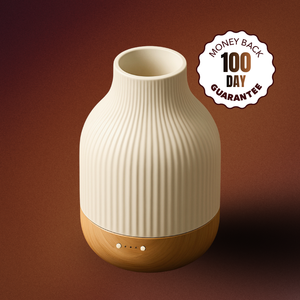
Scentreat's water-based models are the Ceramic Diffuser and the Wood Diffuser. Both should be emptied and dried between uses, never left with standing water inside.
Is It Really Mold or Just Diffuser Residue?

Before treating every mark as mold, look at what is actually inside the reservoir. Several kinds of normal buildup look similar.
May point to mold
- A persistent musty smell
- Fuzzy or patchy growth
- Dark spots that come back after cleaning
- A slippery film inside a damp reservoir
- Buildup after water stood for several days
More likely normal buildup
- White or chalky residue — mineral scale from water
- Oily or sticky film — essential oil residue
- Dark staining — naturally darker oils
- Fine grey residue — dust settling in an open reservoir
Appearance alone cannot confirm mold. The more useful signs are a musty smell, or a film that keeps coming back even after proper cleaning and complete drying.

Handcrafted ceramic essential oil diffuser for bedroom and sleep: quieter than a whisper (27.3 dB, lab-test...
Why Does My Diffuser Get Moldy?

A handful of everyday habits let moisture and residue stay inside a diffuser.
1. Water is left in the reservoir
The most common cause. Even after an ultrasonic diffuser finishes, a little water usually remains in the tank. Left overnight or for days, the reservoir stays continuously damp. Scentreat's guidance is to empty leftover water after use and wipe the reservoir, not leave it until the next session.
2. The diffuser never fully dries
An empty reservoir is not a dry reservoir. Droplets cling to the walls, around the ultrasonic plate, under the cover, and in the seams and corners. Put the cover straight back on after cleaning and that moisture is trapped inside. Wipe the reservoir and leave the cover off until the inside is fully dry.
3. Essential oil residue builds up
Essential oil does not completely disappear during diffusion. Some stays on the walls and the ultrasonic plate as an oily film, sticky residue, lingering fragrance, discoloration, or buildup around the disc. That residue is not mold — but a heavily coated tank is harder to keep clean and holds moisture more easily. Regular cleaning stops it becoming difficult to remove.
4. Mineral scale accumulates
Water contains minerals, and as it disperses they stay behind as white rings, chalky deposits, cloudy patches, or scale around the plate. Scale is not mold. If the buildup is white and crusty, treat it as scale. Keeping the plate clean also keeps mist output normal.
5. The diffuser is stored while damp
Storing a diffuser right after rinsing can trap moisture for days. Before putting a water-based diffuser away:
- Empty the remaining water.
- Wipe the reservoir.
- Leave the lid off.
- Let the inside dry completely.
- Store it only once it is dry.
This matters most if it will not be used again for several days or weeks.
6. High humidity slows drying
A humid room does not cause mold on its own, but it makes a reservoir take much longer to dry. In a humid room, give the diffuser more airflow after cleaning and keep the lid off until there is no visible moisture left.
Can Waterless Diffusers Get Moldy?

Not in the same way as a water-based diffuser. Waterless diffusers have no standing-water reservoir, so the classic conditions for mold in an ultrasonic tank are simply absent. Scentreat's CalmRide and Pillar are waterless.
Buildup in one of these is far more likely to be:
- Essential oil residue
- Thickened oil
- Dust
- Deposits around the atomizer
- Residue near the oil bottle connection
One real advantage of waterless diffusion: there is no reservoir of standing water to empty and dry after every use.
What Should You Do If You Find Mold in Your Diffuser?

If you suspect mold or microbial growth, stop using the diffuser before you clean it — running it can disperse whatever is growing in the tank. Take extra care if anyone in the home has asthma or a weakened immune system. The right method depends on whether the device is water-based or waterless.
For an ultrasonic diffuser
Scentreat's general deep-clean for its water-based models:
- Switch off and unplug the diffuser.
- Empty any remaining water.
- Wipe away loose residue.
- Fill the tank about halfway with water.
- Add 10 drops of white vinegar.
- Run it for about five minutes.
- Switch off and unplug again.
- Gently clean the ultrasonic plate with a cotton swab lightly dampened with white vinegar or rubbing alcohol.
- Empty and rinse the reservoir.
- Leave it open until completely dry.
The Wood Diffuser's own care guide uses a stronger monthly descale — equal parts water and white vinegar filled to the line, run for five minutes — plus a weekly rubbing-alcohol swab of the disc. If your model's instructions differ from the general routine, follow your model.
For a waterless diffuser
Waterless diffusers need a different approach. For CalmRide, and for the Night Light in waterless mode, Scentreat's routine is a cotton swab with a little rubbing alcohol on the atomizer when you change oils or the output weakens — never a water or vinegar flush. If contamination appears somewhere you cannot safely reach, contact Scentreat Support rather than opening the diffuser. Full routines for every model are in how to clean an essential oil diffuser.
Mold Prevention by Scentreat Model

Different Scentreat diffusers need different care, because not every model uses water. Jump to yours: Ceramic · Wood · CalmRide · Waterless & Night Light · Pillar
Scentreat Ceramic Diffuser
The Ceramic Diffuser uses a 180 ml water reservoir. To reduce the chance of mold or stale buildup:
- Empty leftover water after use and wipe the reservoir.
- Leave the cover off while it dries.
- Deep-clean weekly with daily use, or monthly at three or four sessions a week.
- Never store it damp.
Because the Ceramic usually lives on a nightstand, it is easy to leave water sitting in it after an evening session. Emptying it the next morning, rather than leaving the water another day, is the single most useful habit.
Scentreat Wood Diffuser
The Wood Diffuser uses a 200 ml reservoir. Its care guide is specific: after each tank, tip out leftover water and wipe the reservoir dry, because oily water left standing is what builds the film. Weekly, swab the disc with rubbing alcohol; monthly, or whenever the mist thins, run the equal-parts water-and-vinegar descale. Never store it damp, and wipe any standing water off the wood base straight away.
Scentreat CalmRide Car Diffuser
The CalmRide Car Diffuser is waterless, so mold inside a tank is not the normal concern. Focus instead on the oil bottle connection, the accessible atomizing surfaces, essential oil residue, and keeping the USB-C charging area dry. Do not put water or vinegar into the atomizing path.
Scentreat Waterless Diffuser & Night Light
The Waterless Diffuser & Night Light runs two ways, so identify the active mode before cleaning.
Liquid mode
- Empty and dry the 120 ml reservoir after each tank.
- Leave it open until completely dry.
- Run a five-minute water-and-vinegar cycle monthly to clear scale.
Waterless mode
- Check the oil bottle.
- Swab the ceramic core with rubbing alcohol when you change oils.
- Never flush the oil path with water or use the vinegar routine.
Scentreat Pillar Cold-Air Diffuser
The Pillar Diffuser is also waterless, with no standing-water reservoir, so tank mold is not the main concern. If you notice buildup, switch it off, keep it upright, check the oil bottle, and wipe the aluminum body with a soft, dry cloth — no harsh cleaners, and no water or vinegar in the atomizing system. If something suspicious appears inside an internal oil path you cannot safely reach, contact Scentreat rather than trying to flush it.
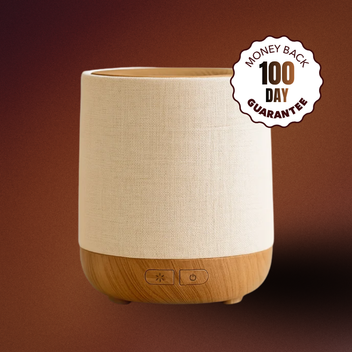
Wood essential oil diffuser that runs up to 10 hours on one 200 ml fill. Quieter than a whisper (27.3 dB, l...
How to Prevent Mold in an Essential Oil Diffuser

The most effective prevention is simple: keep water-based diffusers clean and dry between uses.
- Empty leftover water after use. Do not leave the reservoir sitting full until the next session.
- Let the tank dry with the lid off. Closing the lid on a wet interior traps humidity inside.
- Clean oil residue regularly. Do not wait until the reservoir feels sticky.
- Deep-clean on a schedule. Scentreat's general routine is weekly with daily use, monthly at three or four sessions a week; adjust if scale or residue builds faster.
- Store it dry. If it is going away for days or weeks, make sure the reservoir is completely dry first.
- Keep electrical areas dry. Never submerge the base, and keep water away from power connections, air vents, charging ports, and internal openings.
- Use the right method for the type. Ultrasonic reservoirs and waterless atomizers are different systems and are maintained differently.
What Should You Avoid When Cleaning a Moldy Diffuser?

Stronger cleaning is not safer cleaning. Avoid:
- Bleach, unless the manufacturer specifically approves it
- Harsh solvents
- Abrasive scrubbers
- Metal tools on the ultrasonic plate
- The dishwasher
- Immersing the electrical base
- Vinegar in a waterless oil path
- Adding extra essential oil instead of cleaning
That last one is common. Some essential oils show antimicrobial activity in laboratory conditions, but that does not mean adding more oil to a dirty tank disinfects it. Clean the reservoir properly and let it dry.
Does a Moldy Diffuser Need to Be Replaced?

Usually not. If the buildup is limited to an accessible water reservoir and disappears after proper cleaning and drying, the diffuser can carry on working normally. Replacement or a manufacturer assessment makes sense when:
- Growth keeps returning after proper cleaning.
- A musty smell remains after cleaning and drying.
- Contamination appears inside a part you cannot reach.
- The reservoir is cracked.
- Water has got into the electrical base.
- The diffuser behaves abnormally after cleaning.
- Reaching the affected area would mean taking the device apart.
Mold vs Other Common Diffuser Problems

Not every diffuser problem points to mold.
| Symptom | More likely cause |
|---|---|
| Musty smell, standing moisture, recurring film | Mold or microbial buildup |
| No mist or weak mist | Water level, ultrasonic plate, residue, settings |
| Water escaping from the diffuser | Overfilling, tilting, the cover, or a leak |
| Essential oil leaking | Waterless bottle or atomizer connection |
| White chalky buildup | Mineral scale |
| Oily film | Essential oil residue |
| General dust or grime | Routine cleaning needed |
Separating these problems means you use the right cleaning or troubleshooting method instead of treating every mark as mold. If the scent rather than the mist is the problem, see why your diffuser smells weak.

Waterless cold-air diffuser in aluminum: 100 ml oil bottle, covers up to 1,076 sq ft, under 30 dB, app time...
Conclusion
If your diffuser gets moldy, standing moisture is usually the first thing to fix. Empty leftover water, wipe the reservoir, clean it regularly, and let it dry completely before replacing the lid or putting it away. Waterless diffusers need a different routine, because they never hold a standing-water tank.
For more diffuser and essential oil tips, follow Scentreat on Facebook and Instagram. If buildup keeps returning, or appears inside a part you cannot safely reach, contact Scentreat Support at support@scentreat.com.
Frequently Asked Questions
Can mold grow in an essential oil diffuser?
Yes. Mold or other microbial growth can develop in a water-based diffuser when moisture stays in the reservoir for long periods, especially if the tank is not regularly cleaned and dried.
Why does my diffuser smell musty?
A musty smell can come from stale water, old essential oil residue, or microbial buildup. Empty the tank, clean it thoroughly, and let it dry completely before using it again.
Is black residue in my diffuser mold?
Not necessarily. Dark essential oils can stain a reservoir, and ordinary residue can look dark too. If the buildup is fuzzy, smells musty, or keeps returning after cleaning, treat it as possible microbial growth.
Is white buildup in my diffuser mold?
White, chalky buildup is far more likely to be mineral scale from water than mold. Descale the reservoir with the method your diffuser's instructions give.
Can I leave water in my diffuser overnight?
It is better to empty leftover water after use than to leave it sitting in the reservoir again and again. Standing moisture is what makes buildup and microbial growth likely.
Can a waterless diffuser get moldy?
Waterless diffusers do not normally develop tank mold, because they never hold standing water. Buildup in them is much more likely to be essential oil residue, dust, or deposits around the atomizer.
Can I use bleach to clean mold from my diffuser?
Not unless the manufacturer specifically approves it for that model. Strong cleaners can damage diffuser components or leave residue behind.
How often should I clean my diffuser to prevent mold?
Empty and dry the tank after every use. For a deeper clean, Scentreat's general routine for its ultrasonic models is weekly with daily use, or monthly at three or four sessions a week. The Wood Diffuser adds a weekly alcohol swab of the disc and a monthly descale.
Should I replace a diffuser if mold keeps coming back?
If growth keeps returning after proper cleaning and complete drying, or appears inside a part you cannot safely reach, contact the manufacturer. Persistent contamination may need assessment or replacement.
I ran the diffuser before I noticed mold. What should I do?
Stop using it, empty it, clean it thoroughly with the right method for your model, and let it dry completely before using it again. If you have health concerns or symptoms after exposure, speak with a healthcare professional.

