

Quick answer: A postpartum aromatherapy routine pairs simple, time-boxed self-care moments — morning, midday, and evening — with gentle oils like lavender, chamomile, and sweet orange that research suggests may help calm the nervous system and support sleep. Fifteen to twenty minutes a day, split across those three windows and with the diffuser on a low setting — 30 minutes on, 30 minutes off — plus some basic safety rules around your baby, is enough to notice a difference. If you are breastfeeding, avoid peppermint and sage — both can reduce milk supply.
What Is the Postpartum Period?

Postpartum means after giving birth. It usually refers to the first six weeks after delivery, though many people use it to describe the first several months to a year. You are in the middle of one of the most physically and emotionally demanding seasons of life.
Most moms describe the early weeks as a blur of sleepless nights, emotional swings, physical healing, and nonstop learning. ACOG recognizes this as a much deeper transition than a six-week medical window — a time that deserves warmth, nourishment, rest, and real emotional support.
Why Does a Postpartum Routine Actually Matter?

The World Health Organization calls the first six weeks after birth the period of highest risk for both mother and baby — yet structured support during this time is often limited. WHO urges quality care for women in the critical first weeks after childbirth. Even a simple daily routine can:
- Support physical recovery
- Improve sleep quality
- Calm the nervous system
- Reduce stress and emotional overload
- May help support emotional wellbeing during hormonal shifts
Common Challenges Moms Face Postpartum

Many moms experience a range of physical, emotional, and mental challenges in the weeks and months after giving birth:
- Chronic fatigue
- Fragmented sleep
- Hormonal changes (falling estrogen and progesterone, rising cortisol)
- Emotional overwhelm
- Stress and anxiety
- Difficulty finding time for themselves
Roughly 37–64% of new moms report significant fatigue around five to six weeks postpartum, and nearly 80% of women experience sleep problems during or after pregnancy. Tired and overwhelmed does not mean you're doing anything wrong.
Below is a realistic way to help you feel more grounded — a simple daily routine and aromatherapy tips that many moms swear by, so you can move through this phase with more comfort and support. You can also explore Postpartum Recovery 101: Fatigue, Mood Swings & Stress for a broader view of this stage.
 Pair it with 100% Pure Lavender Essential Oil
$14.99
Pair it with 100% Pure Lavender Essential Oil
$14.99
Does Aromatherapy Actually Help Postpartum Moms?

What the Research Says
Lavender aromatherapy is one of the most studied oils for new moms. Linalool — one of its main aromatic compounds — is thought to act on the limbic system, the brain's emotional processing center, and small clinical trials have reported lower self-rated anxiety and easier sleep onset. The trials are small and the results are mixed, so this is promising rather than settled. The National Center for Complementary and Integrative Health (NCCIH) notes that inhaled lavender may help reduce anxiety and improve sleep quality, particularly when used consistently as part of a routine. As always, individual results vary.
From One Mom to Another
One evening, after visiting a friend who had just given birth, I suggested she try lavender essential oil in her evening wind-down — for herself, diffused gently across the room. A few days later she messaged me:
"Oh wow, it's such a difference! I feel so much calmer, I'm sleeping more deeply, and even the baby seems more relaxed at night. It's honestly the first time I've felt a little rest during these exhausting early weeks."
A small, consistent ritual. That's really all it takes to carve out a moment of peace in the chaos.
Safe Usage Tips for New Moms
- Diffuse in a well-ventilated room on a low setting — 30 minutes on, 30 minutes off is a gentle starting point.
- Keep the diffuser at least a meter from your baby's direct breathing space.
- Always dilute oils before any skin contact (1–2 drops per tablespoon of carrier oil).
- Stick to gentle, well-tolerated oils: lavender, chamomile, sweet orange, frankincense.
- Avoid peppermint and eucalyptus around any baby under two — the menthol and 1,8-cineole in these oils have been linked to a reflex slowing or pause in an infant's breathing, so keep them out of the room entirely rather than simply using less.
⚠️ Breastfeeding Safety Note
If you are breastfeeding, avoid peppermint and sage essential oils — both are associated with reduced milk supply (a property called galactofuge) and can affect your nursing relationship. This includes peppermint tea in large amounts. If you are unsure about any oil during breastfeeding, consult your midwife, lactation consultant, or healthcare provider before adding it to your routine. NCCIH has general guidance on aromatherapy safety during this period.
Step-by-Step Postpartum Aromatherapy Routine

Here are three small windows you can realistically protect each day — even on the most fragmented schedule.
Morning: Gentle Wake-Up (5 minutes)
- Hydrate first thing — a big glass of water before anything else.
- Slow breathing or a gentle stretch — one to two minutes while your baby is nearby and settled.
- Diffuse a safe, uplifting oil — Sweet Orange or Lavender, both gentle enough to diffuse in a ventilated room with your baby nearby. Keep peppermint and eucalyptus out of the room entirely while there is a baby under two in the house — that rule is about your baby's airways, so it applies however you are feeding. If you are breastfeeding, skip peppermint at any hour as well, since it may reduce your milk supply.
Midday: Recharge (5–10 minutes)
- Short walk with baby — fresh air and natural light help regulate your circadian rhythm, which matters for sleep.
- Protein-rich snack — protein and healthy fats keep blood sugar stable and energy more even.
- Mini aromatherapy break — while baby naps, hold a personal inhaler, or a tissue with one drop of lavender or sweet orange on it, a few inches from your nose and take three slow breaths. No diffuser needed, and no oil on your skin.
Evening: Wind-Down (5 minutes)
- Warm shower or bath — a small reset for your nervous system.
- Diffuse relaxing oils — lavender or Chamomile on a low setting. Both are gentle as long as you diffuse them lightly and keep the room ventilated.
- Two to three minutes of quiet — journaling or simple gratitude while baby sleeps nearby. It sounds small. It helps.
Postpartum Oils: Quick Reference
| Oil | Primary benefit | Safe to diffuse near baby? | Breastfeeding caution? |
|---|---|---|---|
| Lavender | Calm, sleep, anxiety | Yes (dilute, ventilated) | No known concern |
| Chamomile | Gentle relaxation | Yes (low setting) | No known concern |
| Sweet Orange | Mood uplift, energy | Yes | No known concern |
| Frankincense | Grounding, stress | Yes (minimal) | No known concern |
| Peppermint | Cooling, alertness | No — avoid near babies | Avoid — may reduce milk supply |
| Sage / Clary Sage | Traditionally used for relaxation; hormone effects are not established | No — avoid near newborns | Avoid sage — may reduce milk supply |
| Eucalyptus | Respiratory, focus | No — avoid near babies | No specific concern, but avoid near baby |
Postpartum hormones move on their own timetable, and essential oils have not been shown to change those levels. What a calming oil can realistically do is make the wind-down easier while your body does its own work. For the longer version, read our deep-dive on How Clary Sage Supports Postpartum Hormone Balance.
Trusted Source (Mayo Clinic): Mayo Clinic recommends structured self-care routines to improve postpartum wellbeing and reduce stress. MayoClinic.org
 Pair it with 100% Pure Geranium Essential Oil
$14.99
Pair it with 100% Pure Geranium Essential Oil
$14.99
When Should You Call Your Provider?
Aromatherapy is a supportive tool — it does not replace medical care. Please contact your doctor, midwife, or reach out as ACOG advises if you notice any of the following:
- Heavy or unusual bleeding — soaking more than one pad per hour, or passing large clots.
- Fever above 38°C / 100.4°F — which can signal infection and needs prompt attention.
- Persistent sadness, anxiety, or intrusive thoughts lasting more than two weeks — these may be signs of postpartum depression (PPD) or postpartum anxiety (PPA). Both are treatable, and reaching out early makes a real difference. Your provider can connect you with support.
You are not expected to push through everything alone. Getting help is part of taking care of your baby.
Additional Tips to Boost Energy Postpartum — and Tools That Help

Along with aromatherapy, your physical baseline matters. Food, water, and a little rest are what make the rest of the day easier to carry — for you and for your baby.
- Eat balanced meals — protein and omega-3 fats fuel hormonal recovery.
- Drink plenty of water throughout the day, especially if you are breastfeeding.
- Move gently — short, postpartum-safe walks count.
- Prioritize naps — even 20-minute rest windows add up.
- Reduce overstimulation — dim lights and quieter evenings help your cortisol settle before sleep.
- Accept help from family or friends without guilt.
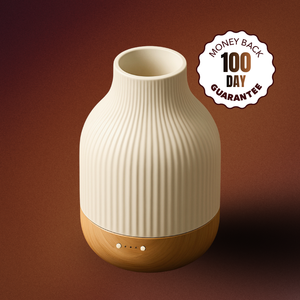
For your aromatherapy moments, a quiet, consistent diffuser makes the biggest difference. The SCENTREAT Ceramic & Rubber Wood Diffuser has a ceramic cover on a rubber wood base and uses ultrasonic cold-mist technology — so heat never degrades the oil and there is nothing synthetic adding to your home's air. Paired with 100% pure essential oils from the calm & balance collection, it is an easy starting point for a postpartum ritual that actually fits into a tired mom's day.
We cover the wider recovery picture in Postpartum Recovery 101. For a cross-topic view of how diffusing affects sleep quality in general, see Diffuser Benefits for Sleep: What Really Changes. If the house has to stay quiet, loudness is the figure to check — Scentreat's Ceramic & Rubber Wood Diffuser was measured at 27.3 dB(A) at 1 m in independent laboratory testing.
Frequently Asked Questions
1. Which essential oils are safe after giving birth?
Lavender, chamomile, sweet orange, and frankincense are widely considered gentle for postpartum use when diffused in a ventilated room and kept away from your baby's direct airflow. Always dilute before skin use. If you are breastfeeding, avoid peppermint and sage, which may reduce milk supply.
2. How long should a postpartum aromatherapy routine take per day?
Even 10–15 minutes spread across three small windows — morning, midday, and evening — can make a real difference. You do not need a long block of time. Consistency matters more than duration.
3. Can aromatherapy help with postpartum depression?
Aromatherapy may ease anxiety and support mood, but it is not a treatment for postpartum depression (PPD). If you are experiencing persistent sadness, withdrawal, or intrusive thoughts lasting more than two weeks, please speak with your doctor or midwife. PPD is common and treatable.
4. Can I use essential oils while breastfeeding?
Many oils are fine to diffuse in a well-ventilated room while breastfeeding. The main oils to avoid are peppermint and sage, both of which may reduce milk supply. If you are unsure about a specific oil, ask your lactation consultant or healthcare provider before using it.
5. Are diffusers safe to use around a newborn?
Yes, with precautions: keep the diffuser at least a meter from your baby's breathing space, keep the room ventilated, run the diffuser on a low setting in 30-minute intervals, and stick to gentle oils (lavender, chamomile, sweet orange). Avoid peppermint, eucalyptus, and clary sage near newborns.
Conclusion
The weeks after giving birth are full of challenges — fragmented sleep, hormonal shifts, emotional ups and downs. All of that is normal, and none of it means you are doing anything wrong.
A simple, structured postpartum routine with gentle aromatherapy can support your body's recovery, steady your nervous system, and give you small pockets of calm in an overwhelming season. Keep the safety rules close — especially if you are breastfeeding — and never hesitate to ask for help from your provider when you need it.
Your wellbeing matters, mama. Small, intentional practices really do add up.

