

Diffusers can genuinely support better sleep — but not in the way most people expect. Research suggests aromatherapy improves perceived sleep quality and relaxation, particularly how bedtime feels, rather than changing sleep architecture or duration. The real benefit is environmental and perceptual: a consistent scent cues your nervous system that it's time to wind down.
If you're researching diffuser benefits for sleep, it helps to separate realistic outcomes from common assumptions. Many people expect deeper sleep, faster sleep onset, or longer duration. In practice, most diffuser benefits for sleep are environmental and perceptual rather than neurological or medical. For the mechanism in more detail, see Essential Oil Diffuser for Sleep.
For what a diffuser changes outside the bedroom as well, see the full breakdown of diffuser benefits and types.
Understanding that distinction prevents disappointment and sets clearer expectations.
Setting Clear Expectations for Diffuser Use at Bedtime

Sleep is scheduled and structured by internal systems — circadian timing, sleep-stage architecture, and the hormone cycle that drives them. A diffuser does not reset any of that. What scent can reach is the state you arrive in: how wound-up or settled you are on the way to bed. That is a real physiological effect, and it sits upstream of sleep rather than inside it.
Rather than functioning as sleep therapy, a diffuser acts as an environmental support tool. When noticeable, its effects appear in how the room feels and how the evening transitions into rest — not in REM cycles or deep sleep architecture.
In community discussions on Reddit and Quora, users rarely describe dramatic transformations. Instead, they report subtle shifts:
"It doesn't knock me out, but my room feels calmer."
"I still take time to fall asleep, but I don't dread bedtime as much."
"It helps signal that the day is over."
These reflections point to changes in atmosphere and perception — not structural changes in sleep biology.
The diffuser doesn't force sleep. What it often does is create a softer boundary between day and night: a cue, a ritual, a slight change in how the space feels.
That boundary is where most diffuser benefits for sleep actually occur.
What Really Changes

Three things shift when a diffuser becomes part of a bedtime routine, and none of them happen inside your sleep cycle. They show up in the room itself, in the handoff from evening to night, and in how you feel about going to bed at all.
1. The Sensory Atmosphere
A consistent scent subtly alters how a bedroom feels. The lighting and layout may remain identical, yet the space begins to feel less like an extension of daytime activity and more like a zone reserved for rest.
Environmental cues play an important role in sleep hygiene. When a specific scent is associated only with bedtime, it can reinforce the brain's expectation that the day is winding down.
2. The Transition Into Bedtime
Sleep resistance often stems from ongoing mental stimulation rather than physical alertness.
Turning on a diffuser can act as a repeatable signal that the day is ending. Over time, this cue becomes integrated into a nightly routine, supporting a gradual shift toward parasympathetic (rest-and-digest) activity — the nervous system state associated with slowing heart rate, relaxing muscles, and easing into rest.
The effect is not sedation. It is a smoother transition.
3. The Emotional Tone Around Sleep
Many users describe bedtime feeling less tense or less pressured. Thoughts may still arise, but they feel less urgent or sharp.
Aromatherapy research frequently reports improvements in perceived relaxation and subjective sleep quality. Almost all of that research measures sleep with questionnaires rather than with sleep-stage monitoring, so what it establishes is a change in how bedtime is experienced. That is the benefit worth planning around: diffuser benefits for sleep are experiential rather than structural.
In short: what changes is how bedtime feels — not how your sleep system functions.
What the Research Actually Found
A 2021 systematic review and meta-analysis of aroma inhalation therapy pooled studies across adults and older adults — people with diagnosed sleep problems, shift workers, post-operative and cardiac patients, and healthy volunteers — and found significant improvements in sleep quality. It is worth being precise about what was measured: those results came from self-report instruments such as the Pittsburgh Sleep Quality Index, not from polysomnography. The evidence tells us how people rated their own sleep. It does not tell us that their sleep stages stayed the same — sleep staging was largely never measured in the first place.
This is actually what the honest framing of this post describes: diffusers shape the experience of bedtime. The mechanism researchers point to includes activation of the limbic system (the brain's emotional-processing center) via olfactory pathways, and a possible reduction in cortisol (the primary stress hormone) — both of which can influence how calm or tense we feel before bed.
The Sleep Foundation's guidance on the bedroom environment makes a related point: the sensory conditions of a room — noise above all — shape how easily a person settles at night. Scent belongs to that same category of environmental input, which is why its effect is felt in the approach to sleep rather than in the sleep that follows. The takeaway: aromatherapy's value is real, just appropriately scoped to subjective experience and mood.
For a deeper look at the science, see Can Scent Help You Sleep Better? The Science Explained.

Handcrafted ceramic essential oil diffuser for bedroom and sleep: quieter than a whisper (27.3 dB, lab-test...
What Doesn't Change

While diffuser benefits for sleep are often discussed, certain core aspects of sleep remain unaffected.
1. Sleep Architecture
A diffuser does not alter REM cycles, deep sleep stages, or the body's internal sleep timing. These processes are regulated by neurological and hormonal systems that scent alone does not override.
2. Measurable Sleep Duration
It does not reliably increase total sleep time in a clinical or measurable sense. While some people may feel more relaxed, objective sleep metrics typically remain unchanged.
3. Medical or Behavioral Factors
A diffuser does not replace consistent sleep habits, regulate circadian rhythms, or function as treatment for insomnia or other sleep disorders.
Sleep is governed by biological timing and behavioral consistency. Environmental scent may shape the setting around bedtime — but it does not reprogram the system itself.
In short: nothing a diffuser does replaces the sleep habits, the schedule, or the medical care that actually move these parts of sleep.
Handcrafted ceramic essential oil diffuser for bedroom and sleep: quieter than a whisper (27.3 dB, lab-test...
How a Diffuser Shapes the Sleep Environment

If the earlier sections covered what moves and what doesn't, this one is about the how. Whether a diffuser ever becomes a real sleep cue comes down to two things: whether the scent is the same night after night, and whether it stays subtle enough to fade into the background instead of demanding attention.
Sleep hygiene guidance consistently emphasizes repeatable pre-bed cues — the same sequence, the same conditions, night after night — because predictability is what the brain learns to read as a signal. Scent can work as one of those cues. Used consistently, it becomes part of a broader wind-down ritual rather than a sleep intervention in its own right.
This aligns with core principles of sleep hygiene: consistent signals, reduced stimulation, and predictable transitions.
A diffuser does not create sleep. It shapes the environment surrounding it.
That is where most diffuser benefits for sleep tend to be noticeable. Curious which oils work best in this role? Our guide to the best essential oils for sleep and relaxation covers the most-researched options.
Handcrafted ceramic essential oil diffuser for bedroom and sleep: quieter than a whisper (27.3 dB, lab-test...
Real-World Bedtime Examples

Consider someone whose mind remains in "work mode" after finishing tasks. They may not fall asleep faster with a diffuser, but the scent becomes a consistent cue that the workday has ended. The bedroom feels more clearly separated from unfinished responsibilities.
Or someone who delays bedtime because the shift into quiet feels abrupt. Running a diffuser 20–30 minutes before bed can create a gradual transition, making going to bed feel less like an abrupt stop and more like a gentle landing.
In both cases, the benefit is environmental support — not sedation. If you're looking for the right diffuser for this kind of nightly ritual, the best essential oil diffusers for bedroom sleep breaks down what to look for.
A Note on Safety and When to Seek Professional Support
Essential oils used in diffusers are generally safe for healthy adults when the room is well-ventilated and used in normal amounts. A few guidelines to keep in mind:
- Oils to use with caution around children: eucalyptus and peppermint should be avoided near young children (under age 6); always dilute and ventilate.
- Oils to avoid around pets: tea tree, eucalyptus, and pennyroyal can be toxic to cats and dogs — keep pets out of diffused rooms or consult your vet.
- Pregnancy: if you are pregnant, consult your healthcare provider before using essential oils; some (clary sage, rosemary, certain citrus) may not be appropriate in the first trimester.
If you are experiencing persistent sleep difficulties — difficulty falling or staying asleep most nights, chronic fatigue, or mood disruption — please consult a healthcare provider. Aromatherapy is a supportive tool, not a medical treatment for sleep disorders.
Conclusion: What Changes — and What Doesn't

Diffuser benefits for sleep are primarily environmental rather than biological.
You may notice:
- A softer atmosphere before bed
- A clearer boundary between day and night
- Less emotional sharpness at lights-out
- Reduced resistance toward lying down
You likely won't notice:
- Instant deep sleep
- Major increases in total sleep duration
- Resolution of chronic insomnia
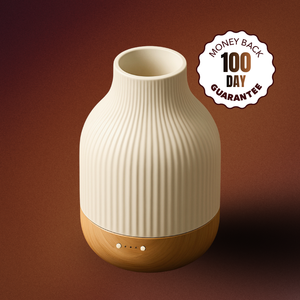
For many people, improving rest begins with small, consistent cues that it's safe to slow down. A quiet diffuser for the bedroom can become one of those cues — steady, low-light, and supportive through the night.
Small environmental cues can meaningfully shape perception — even when they don't alter biology. Understanding what truly changes — and what doesn't — allows diffuser benefits for sleep to be recognized for what they realistically are. What does change is consistency: the same 6–8 drops in a 180 ml Scentreat Ceramic & Rubber Wood tank produce the same light scent every night, and repeatability is the part the brain actually learns.
If a cat is dozing nearby while the diffuser runs, an open door matters more than which oil you pick — cats lack the enzyme that clears essential oil compounds, so an exposure they cannot escape is the actual problem. A dog can usually share the room without trouble, but oil on the coat is never appropriate: animals groom themselves, which turns a topical dab into a swallowed dose.
FAQs
Do diffusers directly improve sleep quality?
Diffuser benefits for sleep relate to the environment surrounding bedtime rather than biological sleep processes. Research shows improvements in subjective sleep quality — how rested and relaxed you feel — rather than measurable changes to sleep architecture like REM or deep sleep stages.
Can a diffuser treat insomnia?
No. Aromatherapy is a supportive tool, not a medical treatment. If you experience persistent difficulty falling or staying asleep, consult a healthcare provider. A diffuser may help create a calmer bedtime environment, but it does not address the underlying causes of chronic insomnia.
How long before bed should I run a diffuser? Most people start it 20–30 minutes before they intend to sleep, so the room already feels settled by the time they lie down. The exact window matters less than repeating it — the cue works because it is the same scent at the same point in the evening, night after night, not because of how strong it is.
Can a diffuser help with chronic insomnia?
Not as a standalone treatment. Chronic insomnia often has behavioral, psychological, or medical roots that require professional evaluation — Cognitive Behavioral Therapy for Insomnia (CBT-I) is the first-line recommended approach. A diffuser may complement a wind-down routine, but consult your healthcare provider if sleep problems are persistent or affecting your daily functioning.

