

A candle warmer lamp is easy to switch on after dinner and forget until bedtime. We haven't found an official time limit, but a few hours at a time, while you're home, is a sensible habit. This guide from Scentreat covers session length, the 4-hour rule, bedtime, auto-off timers and signs it's time to switch off.
How much time feels right for you?
- Fixing a tunneled candle: often just a few minutes, until the top is flat.
- Scenting a room: about 1 to 2 hours, so set the timer to 2 hours.
- A long evening at home: up to about 4 hours, with the dimmer turned down once the top has melted.
- Dozing off: dim it low as a night light and choose the shortest timer. If you sleep in the dark, switch it off.
- Going out: switch it off before you head out.
- Your lamp has no timer: add an outlet timer at the wall.

How Long Can You Leave a Candle Warmer On?
Your lamp's user guide is the best place to start, since we couldn't find an official time limit for a candle warmer lamp from fire-safety groups.
A candle warmer lamp has a hot bulb tucked inside its shade, just above a jar candle. The bulb melts the top layer of wax, letting the scent fill the room without a flame. If you're new to these small lamps, here's how a candle warmer lamp works.
Our rule of thumb is one session of up to about 4 hours while you're home, with the auto-off timer there as a backup.
A session simply means one stretch from switch-on to switch-off, and "about 4 hours" is a habit, not a law.
Where the 4-Hour Rule Comes From
You may have heard "never more than 4 hours," and that rule is real, but it was written for burning candles. The National Candle Association, the trade group for US candle makers, advises against burning a candle longer than 4 hours at a time.
That rule has to do with the flame: after a long burn, carbon can build up on the wick, making the flame grow too large and the candle start to smoke.
Here, carbon means soot, the black dust left behind when a flame doesn't burn completely. You might recognize it as a dark smudge around a jar rim.
A lamp never lights the wick, so that reasoning doesn't carry over. Instead, a lamp session depends on how much scent remains in the top layer, how hot the jar and shade get, and whether someone is in the room to keep an eye on it.
How Long One Session Really Needs

Once you switch on the lamp, the candle's top melts into a melt pool, a thin layer of liquid wax, a little like butter softening in a warm pan. Scent rises from that layer, and the strength of a melted candle's scent is called hot throw.
Candle makers blend a set amount of fragrance oil into the wax, which the melted top releases gradually. A longer session doesn't necessarily mean a stronger scent, because that top layer has only so much to give. For more on melt speed, see our guide to what a candle warmer lamp is.
To Fix a Tunneled Candle
Tunneling happens when a lit wick melts a narrow hole down the middle, leaving a wall of wax around the sides. A lamp warms the whole surface at once to level that wall, and owners say a small tunnel can flatten in minutes. Once the top looks even, switch it off.
To Scent a Room
Many people notice their candle's scent within 10 to 20 minutes, though owners report that a wide three-wick jar can take an hour or two to melt from edge to edge. For everyday scent, 1 to 2 hours is plenty, making the 2-hour timer setting a good fit for most days.
For a Long Evening
For a movie night or an evening with friends, up to about 4 hours works well. Start bright, then lower the dimmer once a pool covers the top. The dimmer makes the bulb brighter or softer, so a softer glow also means a little less heat.
Can You Leave a Candle Warmer On Overnight?

We don't recommend planning to leave it running all night. If you like falling asleep with it on, dim the lamp low as a night light and choose the shortest timer so it switches off soon after you drift off. If you sleep in the dark, switch it off before bed.
Fire-safety advice points in the same direction: the National Fire Protection Association says to blow out candles before bed and notes that more than a third of home candle fires start in the bedroom.
Although that advice is about flames, the same habit makes sense for a hot lamp. The U.S. Fire Administration offers another simple reminder: unplug small appliances you aren't using.
Why Your Nose Stops Noticing the Scent

Running it all night adds little scent, too, because your nose grows used to a steady smell. Scientists call this olfactory adaptation, often known as nose blindness. Your brain stops drawing your attention to an unchanging smell, keeping it alert to new ones, like smoke.
This adjustment happens quickly: in one clinical test, people stopped noticing a smell after about 2.5 minutes on average, while the slowest took about 12 minutes. Another study found that the nose continues tuning out a smell it lives with every day.
Within minutes to about 20 minutes, you'll barely notice your candle, but step out of the room for a few minutes and the scent seems to return. In that same test, noses reset after about 3 minutes away, on average. Once you're asleep, those extra hours add little you'll smell.
How Auto-Off Timers Work

An auto-off timer works like a little countdown clock inside the lamp. Choose the hours, and it counts down until it reaches zero, then cuts power to the bulb, much like a TV sleep timer.
On many lamps, you'll find the timer in a small control box on the cord, with buttons for 2, 4 or 8 hours. Others have a touch button on the base or a single button that steps through 1 to 5 hours.
The "ON" setting skips the countdown and keeps the lamp running until you switch it off. For an automatic shut-off, choose a number of hours instead.
Some lamps also offer a delayed off: hold the power button for a second, and the light goes out 60 seconds later. Think of any of these timers as a backup, not a babysitter. Here's how the common types compare:
| Timer type | How it works | Good to know |
|---|---|---|
| Control box on the cord | Pick 2, 4 or 8 hours, then off | Often shares the box with a dimmer |
| Touch button on the base | Tap through ON, 2, 4 or 6 hours | ON means no countdown at all |
| Single clock button | Steps through 1 to 5 hours | One button sets the hours |
| Delayed off | Hold power 1 second: off after 60 seconds | A short delay, not a countdown |
| Outlet timer at the wall | Cuts the power when you set it to | For a lamp with no timer built in |
The Retro Bauhaus lamp uses the first kind, with a small box on its cord offering 2, 4 or 8 hours and + and − buttons for the dimmer.
No Timer on Your Lamp? Add an Outlet Timer
An outlet timer is a small box that goes between your lamp's plug and the wall socket. First, check that it's rated for your lamp, then plug the timer into the wall and the lamp into the timer. Set when you want the power to stop. Some have a dial, others are digital, and a smart plug lets you set it from your phone.
If your lamp already has a built-in timer, like the Retro, you don't need another. An outlet timer is only worth buying for an older lamp or one with a plain on/off switch.
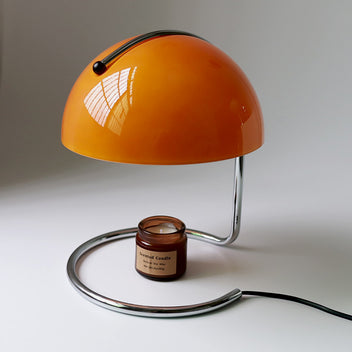
Retro Bauhaus candle warmer lamp, glossy dome in white, orange, amber or red, with a timer. Free 4-oil set,...
6 Signs It's Time to Switch Off

Your lamp and candle usually tell you when it's time for a break. Switch off as soon as you notice any of these six signs:
- The scent has faded: most of the fragrance in the top layer is gone. To refresh it, follow step 7 of our guide on using a candle warmer lamp.
- The jar is too hot to hold: the pool has gone deep, so leave the jar where it is and give it a rest.
- You see smoke or smell burning: switch off right away and let everything cool, then find the cause before using it again.
- About ½ inch of wax is left: the National Candle Association recommends stopping at ½ inch when burning a jar candle. That makes a sensible stopping point under a lamp, too.
- You're leaving, or it's lights out: switch off before heading out or settling down to sleep in the dark.
- The cord or plug feels hot, or looks damaged: stop using it. The U.S. Fire Administration recommends replacing an appliance if its cord is cracked or damaged.
For guidance on heat, pets, kids and placement, take a look at our candle warmer safety guide.
Does Running It Longer Hurt the Candle or the Lamp?
A longer session is fine now and then, though it comes with a small cost in three places.
- The candle: the top layer loses its scent sooner. For a look at whether a warmer makes candles last longer, see candle warmer vs burning.
- The bulb: these lamps use a hot halogen bulb, which wears out with use. You'll find more on how long bulbs last in our candle warmer light bulb guide.
- Your power bill: at the US average price, a 35W or 50W lamp costs under a cent an hour. For details, see how much electricity a candle warmer uses.
Simple Habits for Safe, Long Sessions
A simple routine makes long sessions easy to manage. It comes down to three steps: one before you switch the lamp on, one while it runs and one when you're done.
Step 1: Before You Switch It On
Choose a flat, steady spot for the lamp. Keep curtains, paper and anything else that can burn away from the shade and bulb. Stick to the bulb type and watts your lamp calls for.
Step 2: While It's On
Stay home while the lamp runs, and keep the cord clear of walkways. Once the top has melted, dim the lamp.
Step 3: When You're Done
Switch the lamp off and unplug it. Then let the wax set before you move anything.
Try It With a Scentreat Lamp That Turns Itself Off

With its glossy half dome and curved chrome bar, the Retro Bauhaus candle warmer lamp takes its cues from 1970s design. The candle stands in an open chrome ring beneath the dome, and the lamp switches itself off, too.
- Timer: choose 2, 4 or 8 hours on the power cord, and the lamp switches itself off afterward.
- Dimmer: use the + and − buttons on the cord to soften the glow at bedtime.
- Colors: choose white, orange, amber or red. The dome tints the light while directing heat down toward your jar. White blends into a pale room, while orange or red adds a more noticeable accent.
- Candles: both jar and pillar candles sit inside the chrome ring, directly beneath the middle of the dome.
- Bulbs: 50W halogen, with 1 fitted and 2 spares included in the box.
- Free gift: a 4-oil set (Lemon, Peppermint, Eucalyptus, Lavender), a $59.96 value.
- Fit check: send us your jar size by email, and we'll check the fit.
Free US shipping · 100-day returns · 1-year warranty
At 11 inches (28 cm) tall, the lamp has about 6.3 inches (16 cm) between the table and the dome. That makes jars up to about 5 inches (13 cm) tall the best fit.
Conclusion
How long to leave your lamp on depends mostly on what you'd like it to do. A few minutes can level a tunnel, an hour or two often covers everyday scent, and up to about 4 hours suits a long evening at home. Pair an auto-off timer and dimmer with the habit of switching it off before you go out.
If you like a mid-century look, the retro candle warmer lamp pairs that style with an auto-off timer. It also comes with 3 bulbs in the box, free US shipping and 100-day returns.
Have a question? Email support@scentreat.com and we'll reply within 24 hours, 7 days a week.
Frequently Asked Questions
Can you leave a candle warmer on all night?
It's best not to plan on leaving it on all night. If you like falling asleep with it on, dim it low as a night light and choose the shortest timer so it switches off soon after you drift off. If you sleep in the dark, switch it off before bed. The timer is a backup, and your nose often stops noticing the scent within minutes anyway.
How many hours a day can you use a candle warmer lamp?
We haven't found an official daily limit. A sensible habit is to keep sessions to about 4 hours while you're home, though 1 to 2 hours is usually enough to scent a room. If your lamp's user guide specifies a number, follow that instead.
Does the melted wax disappear, or does it stay in the jar?
It stays in the jar. A lamp melts the wax without burning it, so when you switch off, the liquid layer cools and turns solid again, often with a smoother, flatter top. The jar looks almost as full as before. What changes is the scent: each session releases some of the fragrance oil in that top layer, so after many sessions the wax is still there but smells weaker. That's the time to lower the shade or scoop off the spent top layer.
Is it safe to leave a candle warmer on when you leave the house?
No, switch it off before you head out, even for a quick errand. The auto-off timer is a backup for those moments when you forget, rather than a reason to keep the lamp running in an empty home.
Does a candle warmer turn off by itself?
Only a lamp with an auto-off timer switches itself off. Many offer 2, 4 or 8 hours, while some have a touch button on the base. Watch for the "ON" setting: it means no countdown. Without a timer, your lamp stays on until you switch it off, so add an outlet timer at the wall.
Can you leave a candle warmer on for 8 hours?
You can if you're home and awake and your lamp's guide doesn't say otherwise, such as during a long day at your desk. You rarely need that long for scent, though: your nose tunes out a steady smell within minutes to about 20 minutes. For most days, 2 to 4 hours is plenty, with the dimmer lowered once the top has melted.
How long should a candle warmer cool before you move it?
Wait until the wax is solid all the way down and the shade feels cool to the touch before moving the lamp or jar. Let the wax, rather than the clock, guide you: liquid wax spills easily and stays hot enough to burn skin.
A few words you'll see in this guide
- Session: one stretch of use, starting when you switch the lamp on and ending when you switch it off.
- Auto-off timer: a built-in countdown that cuts power to the lamp after the number of hours you choose.
- Outlet timer: a small plug-in box between your lamp and the wall socket that turns the power off on a schedule.
- Melt pool: the layer of liquid wax across the top of a warm candle that releases its scent.
- Hot throw: the strength of a candle's scent while its wax is melted.
- Tunneling: what happens when a lit wick melts a narrow hole down the middle, leaving wax along the sides.
- Nose blindness: when your brain stops noticing a steady smell, even though that scent is still in the air.
Sources
- National Candle Association, Candle Labels 101: Understanding Product Claims and Safety Instructions, checked November 15, 2026.
- National Fire Protection Association, Candle Safety tip sheet, checked November 15, 2026.
- U.S. Fire Administration, Appliance Fire Safety card, checked November 15, 2026.
- Journal of Laryngology and Otology (2007), Olfactory clearance: what time is needed in clinical practice?, checked November 15, 2026.
- Dalton, P. and Wysocki, C. J. (1996), The nature and duration of adaptation following long-term odor exposure, Perception and Psychophysics.
- National Candle Association, Frequently Asked Questions, checked November 15, 2026.

