

When you weigh a diffuser vs a candle vs a room spray, an ultrasonic diffuser is the easiest way to keep your home smelling good every day, because it keeps releasing scent without a flame or constant respraying. Candles still suit a cozy evening and sprays a quick refresh, so we compare all three on scent, upkeep, and safety to show where each one fits.
Diffuser vs Candle vs Room Spray: Quick Comparison
Here, a diffuser means an electric ultrasonic essential oil diffuser, which turns water and a few drops of essential oil into a fine, cool mist. Reed diffusers, which draw scented oil up wooden sticks without any power, are a different product and are not covered in this comparison.
Diffuser vs candle vs room spray, side by side
| Ultrasonic diffuser | Scented candle | Room spray | |
|---|---|---|---|
| How the scent arrives | Continuously, for as long as it runs | While it burns, fading once it is out | In a burst right after you spray |
| Open flame | No | Yes | No |
| What it asks of you | Water, a few drops of oil, and regular cleaning | Trimming the wick, staying nearby, and blowing it out when you leave or go to bed | Spraying again when the scent fades |
| Best fit | Everyday scent in the rooms you use most, on a timer if you like | An evening when you stay in the room | A fast refresh before guests or after cooking |
| Main trade-off | Needs a power outlet and regular cleaning | Needs supervision, and a long wick or a draft can make it smoke | Needs respraying, and how long it lasts varies by formula and airflow |
For scent that stays in the background for hours, the diffuser is the option built for that job, while candles and sprays work best for specific moments.

Handcrafted ceramic essential oil diffuser for bedroom and sleep: quieter than a whisper (27.3 dB, lab-test...
Pros and Cons of Each Option
Ultrasonic Essential Oil Diffuser

An ultrasonic diffuser uses a small disc that vibrates under the water to break water and essential oil into a cool mist, with no heat and no flame. It keeps releasing scent for as long as it runs, and many models let you choose continuous or intermittent mist, set a timer, and switch off automatically when the water runs out. Once it is filled and started, it is a relatively hands-off way to scent a room for several hours.
Curious about the full range of diffuser styles? Our guide to diffuser types and how to choose walks through ultrasonic, nebulizing, heat, and evaporative models side by side.
Pros
- Scent for hours from one fill
- No flame to watch or put out
- Easy to change the mood by switching essential oils
- A well-designed diffuser looks like decor rather than an appliance
Cons
- Needs a power outlet, water, and regular cleaning
- How evenly the scent spreads depends on room size, placement, and airflow
- Homes with pets need extra care with essential oils, as explained below
Scented Candle

A scented candle releases fragrance as the flame melts the wax, and it pairs that scent with a flickering light. Because it needs someone nearby the whole time it burns, it works best for a planned evening rather than all-day scent.
Pros
- Warm candlelight for an evening
- No electricity or cleaning needed
Cons
- An open flame that needs someone in the room
- Burning releases fine particles: the EPA lists candles among indoor particle sources, and a long wick or a draft can make a candle smoke
- Not an all-day option, since the National Candle Association recommends burning a candle for no longer than four hours at a time
- Most of the scent fades once the flame is out, and a used-up candle has to be replaced
Room Spray

A room spray puts fragrance straight into the air with a few pumps or a press of the nozzle. Some sprays are simply scented, while others are sold as odor fighters, so check the label to see what a particular spray is designed to do.
Pros
- Instant scent
- No setup, power, or flame
- Some formulas are made to fight odors rather than only add fragrance
Cons
- How long the scent lasts depends on the formula, how much you spray, and ventilation, and even sprays that advertise up to six hours of freshness need respraying once it fades
- The scent arrives in bursts rather than continuously
- Not every spray is meant for fabrics or furniture, so you have to follow the label
Which One Should You Choose?

Start with what you want most of the time. If the goal is a home that smells good every day, a diffuser does that job on its own, and candles and sprays become extras for particular moments.
Choose a Diffuser for Everyday, Flame-Free Scent

A diffuser suits the rooms where you spend hours at a time, such as a home office, a living room, or a bedroom in the evening. It keeps releasing fragrance while it runs, so there is no relighting or respraying, although how strong the scent feels still varies with room size, placement, and airflow. You can switch oils whenever you want a change, and it is the natural choice for rooms where an open flame does not belong.
If you are still deciding whether one is worth adding to your routine, see our guide on whether diffusers are worth it. And because diffusers and humidifiers look alike but do different jobs, our diffuser vs. humidifier breakdown explains the difference if you are weighing both.
Choose a Candle for an Evening in the Room
A candle fits a dinner or a quiet evening when someone stays nearby the whole time. The US Fire Administration advises against using lit candles in bedrooms, bathrooms, and sleeping areas, and says to blow them out when you leave the room or go to bed. If you like the look of a candle but not the flame, the same agency suggests battery-operated flameless candles.
Choose a Room Spray for a Quick Refresh
A spray covers short, one-off moments: the minutes before guests arrive, the kitchen after cooking, or a bathroom or entryway where you do not stay long.
Using Them Together
A simple setup is a diffuser as the everyday base in the rooms you use most, with a candle for an evening at home and a spray for a quick fix. Keep the scents in the same family, for example all fresh or all warm, so the room does not end up smelling muddled.
Care and Safety Tips

A little care keeps each option working well and safely.
Essential Oil Diffuser
Follow the cleaning steps in your diffuser's manual, because the right routine depends on the model. For the Scentreat Ceramic & Rubber Wood Diffuser, tip out any leftover water and wipe the tank dry after each tankful. Once a week, clean the ultrasonic disc at the bottom of the tank with a cotton swab lightly dipped in rubbing alcohol. Once a month, or whenever the mist thins, fill the tank to the line with a 1:1 mix of water and white vinegar, run it for 5 minutes, then empty, rinse, and wipe it dry. Never use hot water, and keep abrasive cleaners away from the disc.
For each session, start with 3–5 drops per 100 ml of water, check the directions for the oil you use, keep the room ventilated, and switch the diffuser off if anyone gets a headache or irritated airways.
Scented Candle
The National Candle Association recommends trimming the wick to ¼ inch (6 mm) before every use and keeping candles at least 12 inches (30 cm) from anything that can burn, away from drafts, vents, and fans. On the first burn, let the wax melt all the way to the edge, which takes roughly one hour per inch (2.5 cm) of the candle's width, so it does not tunnel.
Room Spray
Read the label before you spray. It tells you whether the product is meant only for the air or also for fabrics, how to store it, and what to avoid. Unless the label says otherwise, spray toward the middle of the room rather than onto wood, fabric, or delicate finishes, and keep the bottle out of children's reach.
Pets and Young Children
With pets, the risk depends on the animal, the oil, how concentrated it is, and how long the exposure lasts. The Merck Veterinary Manual advises keeping pets out of the room while a diffuser runs, keeping sessions short, and airing the room afterward. Cats and birds are the most sensitive: cats are deficient in an enzyme called glucuronyl transferase, which leaves them sensitive to phenolic compounds in some oils, and droplets that settle on fur or feathers can be swallowed during grooming. Dogs can be affected too. Candles and other passive scent sources mainly pose a risk of airway irritation, so ventilation helps whichever option you use. Never put essential oil on a pet, and ask your vet about the specific oil you plan to use.
For young children, safety depends on the oil and the child's age. Johns Hopkins Medicine advises against peppermint oil for children under 30 months, and Poison Control says children under 2 should not be given eucalyptus oil. That warning is about giving the oil to a child, not a published limit for diffusing it, so ask your pediatrician before you diffuse regularly in a young child's room, and store all oils out of reach.
Our Pick for Everyday Scent: Scentreat Ceramic & Rubber Wood Diffuser

If you want your home to smell good every day without watching a flame or reaching for a spray, the Scentreat Ceramic & Rubber Wood Diffuser is the one we recommend. A single 180 ml fill gives 4–5 hours of continuous mist or 8–10 hours on intermittent mode, so one tank can carry a room from afternoon into the night. A 1, 3, or 8-hour timer lets you set how long it runs, and it switches itself off when the water runs out.
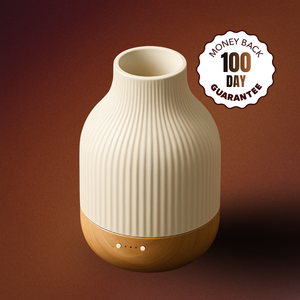
It is built to sit out on a shelf or nightstand as a piece of decor: a handcrafted ceramic cover on a natural rubber wood base, with a warm yellow light you can set to bright, dimmed, or breathing, or switch fully off. The mist and the light have separate buttons, so you can run the scent in a dark room. An independent laboratory measured it at 27.3 dB(A) at 3.3 ft (1 m), quieter than a whisper (about 30 dB), so it stays in the background while you work, read, or unwind.
| Specification | Details |
|---|---|
| Price | $99.95 |
| Type | Ultrasonic (cool mist) |
| Capacity | 180 ml |
| Runtime | 4–5 hours continuous · 8–10 hours intermittent |
| Coverage | Up to 320 sq ft (30 m²) |
| Noise | 27.3 dB(A) at 3.3 ft (1 m), measured by an independent laboratory; well below a refrigerator hum (about 40 dB) |
| Controls | Separate mist and light buttons |
| Light | Warm yellow LED: bright, dimmed, breathing, or off |
| Timer | 1 h, 3 h, 8 h, or continuous |
| Auto shut-off | Yes, when the water runs out |
| Materials | Handcrafted ceramic cover, natural rubber wood base; BPA-free ABS + PP reservoir |
| Returns | 100-day money-back guarantee · 1-year limited warranty |
Why It Stands Out:
- Flame-free scent for up to 8–10 hours per fill on intermittent mode
- Nothing to blow out or respray, with a timer and auto shut-off
- Noise measured by an independent laboratory
- A warm light that switches fully off
- Real ceramic and rubber wood that read as decor rather than a gadget
Who It's Best For:
- Anyone replacing daily candles or sprays with flame-free scent that keeps going for hours
- Bedrooms, living rooms, and home offices up to about 320 sq ft (30 m²)
- People who want a diffuser that doubles as decor
Trade-Offs:
- A plug-in model, so it needs an outlet nearby
- Sold only at scentreat.com
Order the Scentreat Ceramic & Rubber Wood Diffuser and try it at home with the 100-day money-back guarantee behind you. To compare it with Scentreat's other models by room size, browse the Scentreat Essential Oil Diffuser Collection, or read our top diffuser picks and buying guide.
Handcrafted ceramic essential oil diffuser for bedroom and sleep: quieter than a whisper (27.3 dB, lab-test...
Conclusion
So, diffuser vs candle vs room spray: which makes your home smell better? For everyday fragrance, an ultrasonic diffuser is the most practical of the three, because it releases scent steadily without a flame or repeated spraying. A candle still earns its place on an evening when you stay close by, and a spray handles a fast lift before guests or after cooking.
If you want one diffuser to rely on day after day, we recommend the Scentreat Ceramic & Rubber Wood Diffuser. A single 180 ml fill lasts 8–10 hours on intermittent mode, and its timer and auto shut-off mean nothing needs blowing out.
Unsure which model suits a particular space, or which oils to start with? Message us on Facebook or Instagram, or email support@scentreat.com, and we will gladly help.
Frequently Asked Questions
Is a diffuser better than a candle?
For everyday scent, yes. A diffuser keeps releasing fragrance for hours without a flame, and many models have a timer and auto shut-off, so it can keep running while you get on with your day. A candle is a good fit for an evening when you stay in the room with it.
Do diffusers make a room smell longer than room sprays?
A diffuser keeps releasing scent for as long as it runs, so you do not need to respray, although how strong it smells still varies with room size, placement, and airflow. How long a room spray lasts depends on the formula, how much you use, and ventilation. Some odor-fighting sprays advertise up to six hours of freshness, but once the scent fades you need to spray again.
Can I use a diffuser every day?
Many people do, but there is no one-size-fits-all schedule. Follow the instructions for your diffuser and for each oil, start with 3–5 drops of essential oil per 100 ml of water, keep the room ventilated, keep sessions moderate with intermittent mode or a timer, and stop if anyone gets a headache or irritated airways.
Is a diffuser safe around pets and young children?
It needs care. The Merck Veterinary Manual advises keeping pets out of the room while a diffuser runs, keeping sessions short, and airing the room afterward. Cats and birds are the most sensitive, but dogs can be affected too. For children, safety depends on the oil and the child's age: Johns Hopkins Medicine advises against peppermint oil for children under 30 months, and Poison Control says children under 2 should not be given eucalyptus oil, which is advice about giving the oil rather than a published limit for diffusing it. Ask your pediatrician before diffusing regularly in a young child's room, and your vet before diffusing around pets.
Which option works best for a large room?
For scent in a larger room, choose a diffuser rated for your floor area. The Scentreat Ceramic & Rubber Wood Diffuser is rated for about 320 sq ft (30 m²) and the Scentreat Minimalist Wood Diffuser for about 375 sq ft (35 m²). For a large open-plan space, consider two diffusers placed in different zones.
Can I use candles and a diffuser together?
Yes. Many people run a diffuser for everyday background scent and light a candle when they are home for the evening. Pick scents from the same family so they do not clash, keep the candle at least 12 inches (30 cm) from anything that can burn, and blow it out before you leave the room or go to bed.

