

A nebulizing diffuser is one of the strongest options if you want concentrated scent without mixing aromatic oil into a water tank. Traditional nebulizers use airflow to atomize undiluted essential oil, while some modern scent systems use related cold-air nebulizing technology for larger rooms, cars and HVAC applications. In this guide, Scentreat compares eight of the best nebulizing diffusers and cold-air nebulizing systems available in 2026 on scent throw, room coverage, oil consumption, noise, cleaning, materials, controls and oil compatibility, to help you find the right option for pure essential oils, bedrooms, large rooms, travel, smart homes and whole-home scenting.
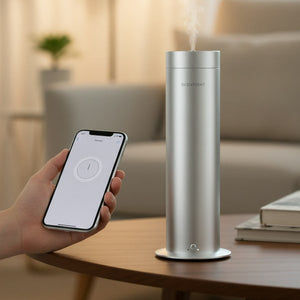
How We Tested Nebulizing Diffusers

For this guide, "tested" means each diffuser was evaluated against the same comparison criteria using current manufacturer specifications, product manuals, published measurements, available independent testing and documented product information.
Scentreat did not physically test all eight machines under the same controlled laboratory conditions. Where room coverage, noise, oil consumption or runtime comes from the manufacturer, we treat it as a manufacturer specification rather than an independently measured result. This matters because diffuser brands do not all measure performance under identical room conditions.
Scent Throw and Room Coverage
Room coverage tells you whether a diffuser is realistically designed for a bedroom, living room, open-plan home, car or whole-building scenting system.
We compared manufacturer-rated coverage alongside intensity controls, duty cycles, diffuser technology and whether a unit works as a standalone machine or through HVAC. Coverage should always be treated as a guide rather than a guarantee: ceiling height, room layout, doors, ventilation, furniture and HVAC circulation all affect how scent travels.
Oil Consumption per Hour
Oil consumption is one of the most important long-term differences between nebulizing and ultrasonic diffusion.
A traditional nebulizer disperses undiluted oil rather than adding a few drops to a water tank, so it can use substantially more oil. Where manufacturers publish an actual ml/hour or g/hour figure, we include it. When they publish only a duty cycle, bottle-life estimate or drops-per-session recommendation, we use that information instead of inventing an hourly figure.
Programmable intervals and adjustable intensity are valuable because they can reduce unnecessary oil consumption while keeping a room noticeably scented.
Noise Level
Nebulizing systems use airflow, so some mechanical sound is normal; it matters most beside a bed or desk.
We prioritize numerical decibel specifications where manufacturers publish them. Terms such as "quiet" or "whisper-quiet" are treated as manufacturer descriptions rather than as equivalent to an independently measured dB value.
Ease of Cleaning
Concentrated aromatic oil can leave residue in the reservoir, atomizer, nozzle, bottle or internal oil path.
We looked for removable reservoirs, accessible bottles, alcohol-cleaning instructions, recommended cleaning intervals and how easy it is to switch between very different scents. A diffuser that is simple to clean is particularly useful if you regularly move from strong oils such as Peppermint to softer woody or floral scents.
Build Quality and Materials (Glass, Wood, No Plastic)
Traditional essential-oil nebulizers often combine hand-blown glass with wood or ceramic bases, while newer smart and commercial systems tend to use enclosed aluminum housings.
We looked for:
- Borosilicate glass
- Wood or ceramic bases
- Aluminum construction
- Refillable bottles
- Replaceable components
- Plastic-free diffusion paths where explicitly documented
Exterior material alone does not tell you what the oil touches internally, so we only describe an oil path as plastic-free when the manufacturer specifically confirms it.
8 Best Nebulizing Diffusers: Reviewed

These eight products are not simply different versions of the same machine: some are traditional glass nebulizers made specifically for pure essential oils, while others use branded cold-air nebulizing technology for large-room, smart-home, portable or HVAC scenting.
The best choice depends on what you want to diffuse and where you want to use it.
Best Overall: Organic Aromas Raindrop 3.0
The Organic Aromas Raindrop 3.0 is our best overall pick for someone specifically looking for a traditional nebulizing diffuser for 100% pure essential oils.

It combines a hand-blown borosilicate glass reservoir with a hardwood base and uses airflow to nebulize pure essential oil without water or heat. Organic Aromas also states that there is no plastic in the diffusion path.
The diffuser is rated for rooms up to 800+ sq ft and includes adjustable output rather than forcing one scent intensity. Its traditional Raindrop design is simple, but that simplicity is useful: there are no proprietary fragrance cartridges or app ecosystem to manage.
Its main trade-off is oil consumption. Because the machine disperses undiluted essential oil, it will generally use oil faster than an ultrasonic diffuser that runs on a few drops mixed with water.
Key specs
| Spec | Details |
|---|---|
| Coverage | Up to 800+ sq ft |
| Oil | 100% pure essential oil |
| Water / heat | No / No |
| Output | Adjustable |
| Materials | Glass + hardwood |
| Oil path | No plastic stated |
| Warranty | 1 year |
Pros
- Designed specifically for pure essential oils
- No water or heat
- Glass-and-wood construction
- No plastic in the documented diffusion path
- Adjustable intensity
- Strong coverage for a tabletop diffuser
Cons
- Uses more essential oil than ultrasonic diffusion
- Glass requires careful handling
- Requires regular cleaning
- No standardized numerical noise figure
Best for: someone who wants a traditional essential-oil nebulizer with strong room coverage and natural materials.
Best for Large Rooms: AromaTech AromaPro BT
The AromaPro BT is the strongest fit here for large rooms where coverage and scheduling matter more than traditional glass construction.

AromaTech rates the system for 500–4,000 sq ft. It can operate as a standalone diffuser or connect to HVAC, while Bluetooth control provides intensity adjustment and up to five scent schedules.
The machine uses a 500 ml oil bottle, and AromaTech publishes estimated consumption of approximately 1–2 ml per hour. That makes running cost easier to estimate than with machines that provide only a bottle size.
This is a fragrance-scenting system rather than the classic glass nebulizer format, so buyers specifically looking for single pure essential oils should check the manufacturer's oil requirements first.
Key specs
| Spec | Details |
|---|---|
| Coverage | 500–4,000 sq ft |
| Oil capacity | 500 ml |
| Oil use | Approx. 1–2 ml/hour* |
| HVAC | Yes |
| Control | Bluetooth app |
| Schedules | Up to 5 |
| Build | Aluminum + acrylic |
*Manufacturer estimate.
Pros
- Excellent large-room coverage
- Standalone or HVAC installation
- App scheduling
- Large oil capacity
- Published oil-consumption estimate
Cons
- Much more expensive than a tabletop nebulizer
- Large footprint
- Fragrance-system focused
- Excessive for a small bedroom
Best for: large open-plan homes, offices, studios, lobbies and commercial spaces.
Best Budget: AIRVERSA U1 Smart Waterless Diffuser
The AIRVERSA U1 is a strong lower-cost choice if you want waterless cold diffusion, smart scheduling and broad oil compatibility without moving into commercial pricing.

AIRVERSA gives the U1 a 120 ml bottle and rates it for spaces up to 1,200 sq ft. The manufacturer says it is compatible with most essential and fragrance oils, although individual formulations should still be checked before use.
The U1 works intermittently rather than running continuously. Its default program diffuses for 15 seconds and pauses for 60 seconds, and those intervals can be changed in the Sleekpoint Bluetooth app.
The main limitation is comparison data: AIRVERSA does not currently publish a standardized dB figure or an easy ml/hour consumption figure for the U1.
Key specs
| Spec | Details |
|---|---|
| Coverage | Up to 1,200 sq ft |
| Oil capacity | 120 ml |
| Oil compatibility | Most essential and fragrance oils* |
| Control | Bluetooth app |
| Default cycle | 15 sec on / 60 sec off |
| Lighting | 3 brightness levels |
*Manufacturer compatibility statement.
Pros
- Lower-cost smart option
- Large 120 ml bottle
- App scheduling
- Strong stated coverage
- Flexible oil compatibility
Cons
- Not a traditional glass nebulizer
- No standardized published dB figure
- No clear ml/hour consumption figure
- Oil compatibility still varies by formulation
Best for: buyers who want to try smart waterless diffusion without starting with a high-priced scent machine.
Best for Bedrooms (Quietest): Scentiment Air 2
The Scentiment Air 2 stands out for bedroom use because the brand publishes a motor-noise specification below 22 dB.

Now listed by Scentiment as the "Diffuser Air 2 LE," it covers up to 1,000 sq ft and uses a 120 ml refillable bottle. Bluetooth and Wi-Fi control allow scheduled morning, sleep and other daily routines, so the diffuser can run at lower intensity when maximum scent throw is unnecessary.
The important distinction is oil compatibility. Scentiment positions the Air 2 around fragrance oil, so it is not our pick for someone specifically searching for a pure-essential-oil glass nebulizer. The <22 dB number is also a manufacturer figure rather than an independent acoustic measurement.
Key specs
| Spec | Details |
|---|---|
| Coverage | Up to 1,000 sq ft |
| Bottle | 120 ml |
| Noise | <22 dB* |
| Control | Bluetooth + Wi-Fi |
| Build | Recycled aluminum |
| Oil system | Fragrance oil |
*Manufacturer specification.
Pros
- Very low published noise figure
- Useful bedroom scheduling
- Refillable bottle
- Strong room coverage
- Compact aluminum housing
Cons
- Fragrance-oil focused
- Not a traditional pure-essential-oil nebulizer
- Noise figure is manufacturer-supplied
- Smart controls may be unnecessary for basic use
Best for: bedrooms and home offices where quiet operation and scheduling matter more than traditional essential-oil nebulization.
Best Cold-Air / HVAC-Ready: AromaTech Air Stream BT
The Air Stream BT is built for whole-home and commercial scenting rather than individual-room diffusion.

AromaTech rates it for approximately 3,000–15,000 sq ft on the product page, although the sizing table in its manual only goes up to 7,000 sq ft, so treat the upper figure as a best case. It connects directly to HVAC and distributes fragrance through existing ductwork, making it significantly more suitable for multi-room environments than a tabletop nebulizer.
The spec table lists a 4-liter oil supply (the same page also describes filling it with four half-gallon jugs, so confirm capacity before ordering oil), with a published consumption range of approximately 1–3 ml per hour. Bluetooth control supports up to five schedules, allowing output to be reduced when a building is unoccupied.
This is a large scent-delivery system, not something most people need for a bedroom or ordinary living room. When we checked in October 2026, the official store listed it as sold out.
Key specs
| Spec | Details |
|---|---|
| Coverage | 3,000–15,000 sq ft |
| Oil supply | 4 L |
| Oil use | Approx. 1–3 ml/hour* |
| HVAC | Direct connection |
| Control | Bluetooth |
| Schedules | Up to 5 |
*Manufacturer estimate.
Pros
- Very large coverage
- Direct HVAC integration
- Programmable schedules
- Large oil capacity
- Published consumption range
Cons
- Overkill for single rooms
- High purchase cost
- Requires an appropriate HVAC setup
- Primarily designed for fragrance scenting
Best for: large homes, hotels, offices, retail spaces and multi-room commercial environments.
Best Portable for Cars: Scentia MiniPod Version 2
The MiniPod V2 is one of the more practical options for car and travel use because it combines waterless cold-air scenting with a compact rechargeable body.

Scentia currently describes the MiniPod V2 as suitable for bedrooms, offices, bathrooms, dorms, cars and travel, with coverage of roughly 500–600 sq ft. The unit is rechargeable over USB-C and designed around Scentia's fragrance-oil system.
Its main advantage is scale. Carrying an 800 sq ft glass nebulizer into a vehicle makes little sense; a small cordless machine is much easier to position and control.
If pure single essential oils are your priority, however, this is not the first model we would choose, because Scentia primarily markets it around its own scent oils.
Key specs
| Spec | Details |
|---|---|
| Coverage | 500–600 sq ft |
| Power | Rechargeable |
| Charging | USB-C |
| Diffusion | Waterless cold-air |
| Build | Recycled aluminum |
| Oil system | Scentia scent oils |
Pros
- Compact and cordless
- Car-friendly
- USB-C charging
- Aluminum housing
- Easy to carry while traveling
Cons
- Smaller scenting capacity than home units
- Primarily fragrance-system focused
- Not designed for whole-home use
- Not our first pick for pure essential oils
Best for: cars, travel, desks, hotel rooms and other compact spaces.
Best-Designed: Organic Aromas Aurora
The Aurora is the strongest design-led option if you want a true essential-oil nebulizer that looks more like a decorative object than a scent machine.

Organic Aromas combines a ribbed, iridescent hand-blown glass reservoir with a ceramic base. It nebulizes 100% pure essential oil using Bernoulli's principle and is described as using no water, heat or plastic in the diffusion path.
The manufacturer rates it for up to 800+ sq ft. It uses a 2-minute-on, 2-minute-off cycle, automatically shuts down after 120 minutes and includes a dimmable light. The glass is visually distinctive but also makes the diffuser more fragile than an enclosed aluminum machine.
Key specs
| Spec | Details |
|---|---|
| Coverage | Up to 800+ sq ft |
| Oil | 100% pure essential oil |
| Cycle | 2 min on / 2 min off |
| Auto-off | 120 minutes |
| Materials | Glass + ceramic |
| Oil path | No plastic stated |
| Light | Dimmable |
Pros
- Strong design
- True essential-oil nebulization
- No water or heat
- Plastic-free documented diffusion path
- Good stated coverage
Cons
- Glass requires careful handling
- Concentrated oil use
- Needs regular cleaning
- No standardized numerical noise figure
Best for: design-conscious users who still want traditional pure-essential-oil nebulization.
Best Smart / App-Controlled: AromaTech AroMini BT Plus
The AroMini BT Plus is our smart-control pick for buyers who want app scheduling and adjustable scent output without installing a full HVAC system.

AromaTech rates it for spaces from 100 to 1,500 sq ft. It holds 60 ml of diffuser oil, supports Bluetooth control and up to five schedules, and publishes estimated oil consumption of approximately 0.5 ml per hour.
The slim recycled-aluminum body fits modern interiors more easily than a visible glass reservoir. Like AromaTech's larger models, however, this is primarily a home-fragrance scent system rather than the traditional single-essential-oil nebulizer format.
Key specs
| Spec | Details |
|---|---|
| Coverage | 100–1,500 sq ft |
| Oil capacity | 60 ml |
| Oil use | Approx. 0.5 ml/hour* |
| Control | Bluetooth |
| Schedules | Up to 5 |
| Build | Recycled aluminum |
| Power | AC (plug-in) |
*Manufacturer estimate.
Pros
- Strong scheduling controls
- Adjustable intensity
- Good coverage range
- Published oil-use estimate
- Slim design
Cons
- Fragrance-system focused
- Needs to be plugged in
- More expensive than basic waterless units
- Not a traditional glass nebulizer
Best for: home users who value automated scheduling and precise scent control.
Which One Is the Best?

There is no single best nebulizing diffuser for every room: if your priority is pure essential oils, a traditional glass model such as the Organic Aromas Raindrop 3.0 is the most straightforward starting point, while large-scale or multi-room fragrance calls for a cold-air system with HVAC compatibility.
| Priority | Best match |
|---|---|
| Pure essential oils overall | Organic Aromas Raindrop 3.0 |
| Large rooms | AromaTech AromaPro BT |
| Budget smart option | AIRVERSA U1 |
| Quiet bedroom | Scentiment Air 2 |
| Whole-home / HVAC | AromaTech Air Stream BT |
| Car / travel | Scentia MiniPod V2 |
| Design | Organic Aromas Aurora |
| Smart scheduling | AromaTech AroMini BT Plus |
Key takeaway: the useful buying order is oil compatibility first, room size second, then noise, controls and design. A machine with the biggest coverage number is not automatically the best choice if it does not accept the oil you actually want to use.
What If You Want Waterless Pure-Essential-Oil Diffusion but Not a Traditional Nebulizer?
That is where Scentreat's own diffuser range fits: Scentreat does not currently sell the traditional glass, air-pump nebulizer format, but its waterless range uses cold-air or waterless atomization and runs directly on 100% pure essential oil without a conventional water tank.
| Scentreat option | Best for | Why consider it |
|---|---|---|
| Pillar | Large open rooms | Cold-air, pure oil, up to 1,076 sq ft |
| Spire Cordless | Moving room to room | Cordless cold-air, USB-C, app control |
| CalmRide | Car, desk, small room | Waterless pure oil, rechargeable, under 35 dB* |
*Manufacturer specification.
The distinction matters. If you specifically want a traditional glass nebulizer with an air pump and Bernoulli-style atomization, choose a true nebulizing model. If what you actually want is stronger waterless scent from pure essential oil without filling a water tank, Scentreat's Waterless & Cold-Air range is the adjacent category worth considering.
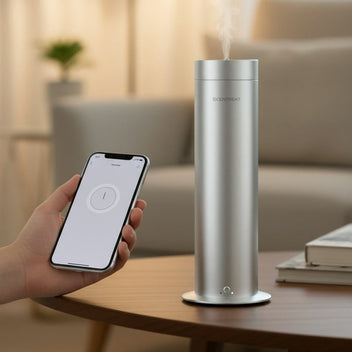
Waterless cold-air diffuser in aluminum: 100 ml oil bottle, covers up to 1,076 sq ft, under 30 dB, app time...
What Is a Nebulizing Diffuser?

A traditional nebulizing diffuser uses airflow to atomize undiluted aromatic oil into fine droplets without first mixing it into water.
The classic design uses an air pump and a narrow glass reservoir or nozzle: fast-moving air creates a pressure difference that draws the oil upward and breaks it into a fine mist. Retail terminology has become less consistent as waterless scent machines have expanded, and some brands now use nebulizing, cold-air and waterless for related technologies. They should not automatically be treated as identical. The more useful questions are:
- Does the device use water?
- Does it use heat?
- How is the oil atomized?
- Does it accept pure essential oil or formulated fragrance oil?
How Nebulization Works
In a traditional nebulizer, pressurized air moves through a narrow opening beside the oil, drawing concentrated oil into the airflow and breaking it into very small droplets.
Traditional glass nebulizers from brands such as Organic Aromas describe this process using Bernoulli's principle. Because there is no water tank, the aromatic oil is not diluted before dispersion, which is why nebulizing diffusion usually produces a stronger scent than an ultrasonic diffuser using only a few drops of oil in water.
Nebulizing vs Ultrasonic Diffusers
Nebulizing is generally better when you want stronger, waterless scent, while ultrasonic diffusion is usually better when you want gentler output and lower oil consumption.
| Feature | Nebulizing | Ultrasonic |
|---|---|---|
| Water | No | Yes |
| Heat | No | No |
| Oil delivery | Undiluted | Drops in water |
| Scent strength | Stronger | Softer |
| Oil use | Higher | Lower |
| Added humidity | Minimal | Slight |
| Cleaning | Oil path | Water tank |
| Best for | Concentrated scent | Everyday gentle diffusion |
An ultrasonic diffuser uses vibration to create a cool water-based mist, while a nebulizer atomizes concentrated oil directly. Neither technology is automatically better; they solve different scenting needs. For a deeper comparison, see ultrasonic vs nebulizing diffusers.
Nebulizing vs Evaporative vs Heat Diffusers
The main difference is how each technology moves aroma into the room.
| Type | How it works | Best fit |
|---|---|---|
| Nebulizing | Air atomizes concentrated oil | Strong, waterless scent |
| Evaporative | Air passes over scented material | Simple, quiet scenting |
| Heat | Warmth increases evaporation | Basic ambient fragrance |
Nebulizing offers the most active concentrated dispersion of the three. Evaporative diffusers are generally simpler and quieter but often have less scent throw, while heat diffusers use warmth rather than airflow or ultrasonic vibration, making them a separate delivery method from cold-air nebulization.
Why Choose a Nebulizing Diffuser?

A nebulizing diffuser makes sense when you want strong scent without water dilution.
There is no reservoir to fill before every session, and traditional nebulization does not add meaningful humidity to the room. Because concentrated oil is dispersed directly, the scent can become noticeable quickly and can work well in larger spaces when the diffuser is properly sized.
Many modern systems also provide intensity settings, duty cycles, timers and app schedules. These controls are useful because continuous maximum output can quickly become overwhelming and consume unnecessary oil.
The main trade-offs are oil consumption and maintenance: nebulizers generally use more oil than ultrasonic diffusers, while narrow oil pathways and atomizers may require regular cleaning to prevent residue buildup.
How to Choose a Nebulizing Diffuser

Start with oil compatibility and room size, then compare consumption, noise, cleaning and controls.
1. Check What Oil the Machine Accepts
Some traditional nebulizers are designed specifically for 100% pure essential oils, while many commercial cold-air scent systems use formulated fragrance oils instead.
Do not assume every machine described as waterless, cold-air or nebulizing accepts the same liquid.
2. Match the Coverage to Your Actual Space
A bedroom does not need a 4,000 sq ft scent machine, and a small tabletop nebulizer is unlikely to be the most efficient solution for several connected rooms.
Use manufacturer coverage as a guide and consider ceiling height, airflow, doors and room layout.
3. Look at Oil Consumption
Bottle capacity alone does not tell you the cost of ownership.
Where possible, compare ml/hour consumption, duty cycles or manufacturer bottle-life estimates.
4. Consider Noise
A small air pump may be barely noticeable in a living room but distracting beside a bed.
For bedroom use, numerical dB specifications are more useful than vague claims such as "quiet."
5. Decide Whether You Need Smart Controls
Schedules and app controls are valuable when you want automatic daily scenting.
For occasional use, a simple intensity dial may be easier.
6. Look at Materials
Glass, ceramic and wood appeal to buyers who prefer traditional aromatherapy design, while aluminum is more common in enclosed smart and commercial machines.
If a plastic-free oil path matters to you, look for an explicit manufacturer statement.
7. Check the Cleaning Method
Look for removable reservoirs, accessible atomizers, clear alcohol-cleaning instructions and replacement parts.
Cleaning becomes particularly important if you switch between very different oils.
How to Get the Most out of Your Nebulizing Diffuser

Start on a lower intensity and allow the scent time to circulate before increasing output, because more concentrated oil does not automatically create a better scent experience.
Use intermittent cycles when available. Short diffusion periods followed by rest periods can keep fragrance noticeable while reducing oil use. Position the diffuser where normal room airflow can distribute the scent, but avoid placing it directly beside an open window, exhaust fan or strong vent.
Always use the oil the manufacturer specifies. A pure-essential-oil nebulizer and a fragrance-oil scent machine can look nearly identical while having very different oil requirements.
Clean the oil path when output begins to weaken and when changing between strongly contrasting scents; residual Peppermint, for example, can noticeably change the next oil you use. Scentreat's diffuser cleaning guide covers the differences between nebulizing, waterless and ultrasonic systems.
Viscosity matters as well. Thick oils or carrier-oil blends can move poorly through some narrow atomizers, so follow the instructions for the individual machine rather than assuming every aromatic oil is compatible. Our guide to the best essential oils for nebulizing diffusers covers which oils flow well.
Finally, use concentrated aromatic oils thoughtfully around children and animals. Keep bottles out of reach, avoid over-scenting enclosed spaces and allow pets to move away from the scent.
Conclusion
A nebulizing diffuser is a good choice when you want concentrated scent, no water tank and stronger oil delivery than a typical ultrasonic diffuser. The right model depends on the oil you prefer, the size of your space and practical factors such as noise, oil consumption, cleaning and controls. Before buying, check the manufacturer's oil requirements and coverage guidance rather than choosing solely by maximum output. If you want traditional glass nebulization, choose a machine designed specifically for that technology. If your main goal is simply strong, waterless diffusion of pure essential oil, a cold-air model may be a better fit.
Scentreat's Waterless & Cold-Air collection includes options for large open rooms, cordless home use and cars while running directly on 100% pure essential oil. Questions about choosing the right diffuser or oil? Contact Scentreat at support@scentreat.com.
Frequently Asked Questions
What Is the Best Nebulizing Diffuser?
The best nebulizing diffuser depends on your oil type, room size and priorities. For traditional pure-essential-oil nebulization, the Organic Aromas Raindrop 3.0 is our most balanced overall pick in this comparison.
Are Nebulizing Diffusers Better Than Ultrasonic Diffusers?
Not universally. Nebulizing diffusers provide stronger, waterless scent but usually consume more oil. Ultrasonic diffusers use a small amount of oil in water, resulting in gentler scent and lower oil consumption.
Do Nebulizing Diffusers Use More Oil?
Usually, yes. A nebulizer disperses concentrated oil, while an ultrasonic diffuser typically uses only a few drops in a water reservoir. Intermittent operation and lower output settings can reduce consumption.
Are Nebulizing Diffusers Safe Around Pets?
Use extra caution with concentrated aromatic oils around animals. Keep oil bottles out of reach, avoid heavily scenting enclosed rooms, provide ventilation and make sure pets can move away from the scent. Ask a veterinarian if you are unsure about a particular oil or an animal with respiratory sensitivity.
Does Scentreat Make a Nebulizing Diffuser?
Scentreat does not currently sell the traditional glass, air-pump nebulizer format. Its waterless models instead use cold-air or waterless atomization to diffuse pure essential oil without a conventional water tank. The Pillar is designed for large open rooms, Spire is a cordless home option, and CalmRide is designed for cars and small spaces.

