

Skip the long setup: a waterless diffuser disperses pure essential oils into the air using cold-air or nebulizing technology — no water tank, no heat, no humidity. The result is a more concentrated aroma than you get from a traditional ultrasonic model, but it uses oil faster, so knowing the trade-offs helps you choose right.
In this article
What Is a Waterless Diffuser?

A waterless diffuser is an aromatherapy device that disperses essential oils into the air without using water or heat. Instead of producing a diluted mist, it uses cold-air atomization or nebulizing technology to break pure oil into ultra-fine particles that float directly into the room.
The two terms you'll often see — nebulizing diffuser and cold-air diffuser — share the same core idea: no reservoir of water, no heating element, just moving air that carries pure oil through a glass or ceramic chamber and releases it as a dry, concentrated mist. Where they differ is how that air breaks the oil apart, which is what the next section covers.
Most waterless diffusers share these features:
- Tankless design — no water to fill or spill
- Cold-air diffusion — preserves volatile compounds in the oil
- Adjustable intensity settings
- Compact, minimalist build
- Minimal daily cleanup
If you want a broader look at all diffuser types before deciding, our guide to essential oil diffuser benefits, types, and how to choose walks through every category side by side.
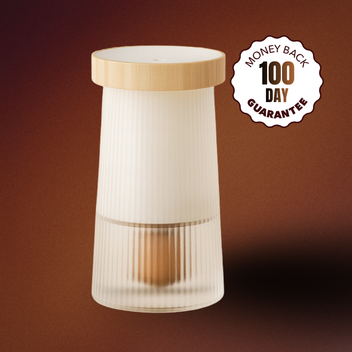
Cordless diffuser and warm night light in one: runs waterless up to 40 hours on one oil bottle, no tank to ...
How Does a Waterless Diffuser Work?

Cold-Air Diffusion vs. Nebulizing — What's the Difference?
Both are waterless. The distinction is in how they atomize oil:
- Nebulizing diffusers use the Bernoulli principle — a narrow air tube creates negative pressure that draws oil upward and shatters it into micro-droplets. No heat, no water, very high output. Best for larger rooms.
- Cold-air diffusers (sometimes called "passive" or "fan-assisted") pass room-temperature air over an oil-soaked pad or through an atomizer. Quieter and more oil-efficient than nebulizers; great for bedrooms and offices.
Either way, because no heat is applied, the volatile aromatic compounds — linalool in lavender, limonene in citrus, eucalyptol in eucalyptus — are not broken down by heat the way they are in a warmer. Heat-based diffusers (reed warmers, candle burners) degrade these molecules faster, which is the main reason cold-air technology is favoured for preserving a true aroma profile.
How the Diffusion Process Works Step by Step
When you add oil to a waterless diffuser:
- The pump or fan draws air through the oil chamber.
- Air pressure or atomization breaks the oil into particles typically under 5 microns.
- Those particles become a dry, invisible mist that disperses into the room.
- No visible vapor, no humidity — just fragrance in the air.
Scent travels from the nose to the limbic system — the part of the brain that processes smell and emotion — which is the usual explanation for why a familiar aroma can change how a room feels. The research here is still early and mostly small-scale, so treat essential oil aromatherapy as something that may support relaxation or focus rather than a proven effect. We cover this further in our waterless essential oil diffuser deep-dive.
Key Benefits of Using a Waterless Diffuser

1. Stronger and More Concentrated Fragrance
Because pure oil disperses directly into the air without dilution, the aroma is noticeably richer and more present than the light mist from an ultrasonic model. You'll typically notice the scent within a minute or two, rather than waiting for a diluted ultrasonic mist to slowly build up in the room.
One honest caveat: concentrated output can feel intense in very small, enclosed spaces. Start on the lowest intensity setting and increase gradually — especially in rooms under ~100 sq ft or with limited ventilation.
2. No Added Humidity
Traditional ultrasonic diffusers release a fine water mist alongside the oil, which raises relative humidity slightly. That's pleasant in dry winter air but can make a bathroom or closet feel clammy. Waterless diffusers add zero moisture to the air — a meaningful advantage in humidity-prone rooms or for people sensitive to dampness.
3. Lower Maintenance and Easier Cleanup
No water tank means no standing water and no risk of mineral buildup or mold inside the reservoir. Most waterless models need only an occasional wipe-down of the oil chamber — a task that takes about 30 seconds with a cotton swab and a drop of rubbing alcohol.
4. Compact and Modern Design
Without a water tank, the hardware footprint shrinks. Many waterless diffusers fit on a nightstand, bathroom counter, or office desk without dominating the surface — a reason they've become a staple in minimalist interiors.
5. Precise Scent Control
Adjustable interval timers and intensity dials let you dial in exactly how much fragrance fills the room. Most models let you set the diffuser to run for 30 seconds, then rest for 30–60 seconds — a cycle that maintains a consistent background scent without overwhelming the air.
Oil Usage Consideration — the Honest Trade-Off
Waterless diffusers consume more oil than ultrasonic models. Because there is no water to extend each drop, expect to use roughly 1–3 ml of pure oil per session, compared with the 3–5 drops per 100 ml of water an ultrasonic fill calls for — about 7–13 drops in a 200 ml tank depending on how strong you like it. Over a month of daily use, that difference adds up.
Factor this into your cost comparison: a waterless diffuser may have a lower upfront price than a high-end ultrasonic, but the ongoing oil cost is higher. If you use essential oils heavily, pairing a waterless diffuser with 100% pure single-note oils bought in larger bottles is the most economical approach.
Waterless Diffuser vs Traditional Diffuser — Side-by-Side

| Feature | Waterless / Nebulizing | Traditional Ultrasonic |
|---|---|---|
| Water required | No | Yes (50–300 ml tank) |
| Fragrance strength | Concentrated, fast | Lighter, slower build |
| Humidity output | None | Slight increase |
| Oil per session | 1–3 ml (undiluted) | 3–6 drops in water |
| Maintenance | Quick wipe of oil chamber | Tank rinse + drying |
| Best for | Small rooms, quick scent, no humidity | Larger rooms, gentle humidity, budget oil use |
| Heat used | No | No (ultrasonic only) |
How to read this table
The left column names one feature, and the two columns beside it answer that feature for each type of diffuser, so read across a row rather than down a column. ml means millilitres. None and No mean the type does not do that thing at all.
Example: the two rows that decide it
The "Water required" row reads No for waterless and "Yes (50–300 ml tank)" for ultrasonic, so one needs refilling with water and the other does not. The "Oil per session" row reads 1 to 3 millilitres of undiluted oil against 3 to 6 drops in water. Put the two together and you have the trade: a waterless diffuser scents faster and harder, and gets through your oil far more quickly.
Neither type is universally "better" — the right pick depends on room size, how sensitive you are to humidity, and how much oil you have on hand. For a detailed comparison that includes reed diffusers and candle warmers, see our guide to the best essential oil diffusers.
Are Waterless Diffusers Safe?

For most adults, yes — waterless diffusers are safe for everyday home use when paired with quality essential oils and reasonable session lengths (30–60 minutes at a time, with ventilation). A few situations call for extra care:
- Pets: Many oils are toxic to cats and dogs — tea tree, eucalyptus, peppermint, pine, and citrus oils in particular. Cats are the most vulnerable: they lack the liver enzyme that breaks down phenols and monoterpenes, and there is no established list of essential oils confirmed safe to diffuse around them. Run the diffuser in a room your pets cannot access, and never diffuse in a closed room an animal cannot walk out of on its own. If a pet starts drooling, coughing, wobbling, or vomiting, stop and ventilate. The ASPCA Animal Poison Control Center publishes a toxic and non-toxic plant list and runs a 24/7 emergency line for suspected poisonings.
- Babies and young children: Their airways are more sensitive. Under age 2, skip peppermint and eucalyptus entirely — the menthol and 1,8-cineole in them can trigger reflex breath-holding in infants and toddlers. The American Academy of Pediatrics (HealthyChildren.org) advises caution with essential oils around infants. Stick to gentler oils like lavender or chamomile, run the diffuser on its lowest setting in a well-ventilated room the child can be carried out of, keep sessions short, and check with your pediatrician first.
- Respiratory sensitivities: People with asthma or severe allergies may react to concentrated airborne particles. Start with shorter sessions and milder oils like lavender or chamomile.
- Pregnancy: Some oils are contraindicated during pregnancy (clary sage, rosemary, peppermint in high amounts). Consult your healthcare provider before diffusing regularly during pregnancy or postpartum.
General rule: start low, ventilate, and observe. A 20-minute session at low intensity in a ventilated room is a sensible starting point for any new oil or space.
Cordless diffuser and warm night light in one: runs waterless up to 40 hours on one oil bottle, no tank to ...
SCENTREAT Waterless Ceramic Night Light — A Closer Look

If you want to try a waterless diffuser without committing to a loud, high-output nebulizer, the SCENTREAT Waterless Ceramic Night Light is built exactly for everyday home use.
A few specs worth knowing before you buy:
| Spec | Detail |
|---|---|
| Price | $89.95 |
| Technology | Waterless cold-air ceramic diffusion |
| Best coverage | Rooms of 30–40 m² (325–430 sq ft) |
| Night light | Built-in, warm ambient glow |
| Materials | Ceramic body — non-toxic, BPA-free oil reservoir |
| Recommended for | Bedrooms, bathrooms, offices, nightstand use |
The ceramic cover shields the oil path, which matters for preserving the oil's true aroma profile. The built-in night light pulls double duty — a soft, warm glow at the bedside and steady scent through the night — so a diffuser with a built-in night light replaces both the lamp and the diffuser on your nightstand.
For a broader look at what makes a diffuser worth its price, our roundup of the best luxury essential oil diffusers for a home spa puts several options side by side — including when a waterless design earns its keep.
Pair the diffuser with 100% pure single-note oils — or explore the full essential oil diffuser collection if you want to compare styles before deciding.
Conclusion
A waterless diffuser gives you a cleaner, more concentrated fragrance experience without the humidity, maintenance, or setup of a traditional water-based model. The mechanism — cold-air atomization or nebulizing — keeps the oil's aromatic compounds intact for a truer scent. The honest trade-off is oil consumption: plan for 1–3 ml per session rather than a few drops in a full tank. For most people, that's a fair exchange for the low-maintenance convenience and stronger scent performance.
Frequently Asked Questions
What is a waterless diffuser?
A waterless diffuser is a device that disperses essential oils into the air without using water, often using cold-air or nebulizing technology to create a more concentrated, humidity-free aroma.
How does a waterless essential oil diffuser work?
It uses pressurized air or atomization to break pure essential oils into ultra-fine particles — typically under 5 microns — and releases them as a dry, invisible mist without any water vapor.
What is the difference between a waterless diffuser and a traditional diffuser?
Traditional ultrasonic diffusers mix oil with water to produce a light mist, adding slight humidity. Waterless diffusers disperse undiluted oil directly, producing a stronger scent with no humidity — but they use more oil per session (1–3 ml vs. 3–6 drops in water).
Are waterless diffusers safe for bedrooms?
Yes, for most adults. Use in a ventilated room, start on the lowest intensity setting, and limit sessions to 30–60 minutes. Keep the diffuser out of rooms your cats use, and skip peppermint and eucalyptus entirely around children under 2. If anyone in the home is pregnant or has asthma, check with a healthcare provider before diffusing regularly.
What rooms work best for waterless diffusers?
Waterless diffusers are well-suited for small to medium rooms — bedrooms, bathrooms, and home offices — where concentrated scent and zero added humidity are preferred. In a very small, closed-off space such as a closet, keep the diffuser on its lowest intensity and leave the door open so the air can move.
Do waterless diffusers use more essential oil than ultrasonic diffusers?
Yes. Because there's no water to dilute the oil, waterless diffusers typically use 1–3 ml of pure oil per session, compared to 3–6 drops mixed into a water tank. Plan accordingly when budgeting for oil.

