

Heat diffusers and ultrasonic diffusers can both scent a room, but they work differently. Heat diffusers use warmth to release aroma, while ultrasonic diffusers use high-frequency vibration to create a cool mist from water and essential oil. For most everyday home use, ultrasonic is the more versatile option. In this guide, Scentreat compares heat diffuser vs ultrasonic diffuser performance, safety, oil use, coverage, and cost so you can decide which one fits your space and routine.
Heat Diffuser vs Ultrasonic Diffuser at a Glance

Short on time? Here is the difference between a heat diffuser and an ultrasonic diffuser at a glance.
| Feature | Heat Diffuser | Ultrasonic Diffuser |
|---|---|---|
| Diffusion | Heat + evaporation | Vibration + cool mist |
| Uses water | Depends on design | Yes |
| Uses heat | Yes | No |
| Open flame | Some models | No |
| Scent | More localized | Softer, more even |
| Oil use | Varies | Usually lower |
| Coverage | Usually smaller | Better for full-room use |
| Humidity | Little to none | Light moisture |
| Noise | Usually silent | Very quiet |
| Auto shut-off | Model-dependent | Common |
| Best for | Simple ambient scent | Everyday home diffusion |
Key takeaway: heat diffusers are simple and quiet, while ultrasonic diffusers give you more control, longer sessions, and heat-free diffusion.
What Is a Heat Diffuser?

A heat diffuser uses warmth to increase evaporation, releasing aromatic compounds from essential oil or another scented material into the surrounding air.
The heat source depends on the design. Some models use a small electric heating element, while traditional oil burners place a dish above a candle.
A heat diffuser does not necessarily boil the oil. However, essential oils contain volatile compounds, and some aroma molecules are sensitive to heat. Temperature and exposure time can therefore affect how quickly different compounds evaporate or change.
Types of Heat Diffusers
Heat diffusers generally fall into three common designs.
Electric Heat Diffusers (Heating Pad / Plug-In)
Electric heat diffusers use a small powered heating element beneath a pad, tray, or dish containing essential oil or scented material.
They remove the open flame associated with candle burners and usually operate silently because there is no fan or ultrasonic plate.
Best for: simple, quiet scenting in a small area.
Candle Diffusers and Oil Burners
Candle diffusers place a dish above a tealight candle. Depending on the design, the bowl may contain water plus essential oil or another scented mixture.
The candle gradually warms the dish and encourages the aroma to evaporate. They create a cozy atmosphere, but the open flame and heated bowl require supervision.
Best for: occasional scenting when candle ambiance is part of the experience.
Lamp Ring Diffusers
Lamp ring diffusers are small ceramic or metal rings designed to sit around a compatible light bulb. A few drops of oil are placed on the ring, and warmth from the bulb gradually releases the aroma.
Lamp rings were designed for incandescent bulbs, which give off most of their energy as heat. Modern LED bulbs run much cooler, so many rings release little scent on them; check the ring maker's instructions before you buy.
Best for: small, localized scenting.
What Is an Ultrasonic Diffuser?

An ultrasonic diffuser uses high-frequency vibration to turn water and a small amount of essential oil into a fine cool mist.
A ceramic or ultrasonic plate inside the reservoir vibrates rapidly, breaking the liquid into tiny droplets that are carried into the room. No heating element is required.
Ultrasonic diffusers are popular for everyday use because they use relatively little essential oil, operate quietly, and often include mist modes, timers, lighting controls, and automatic shut-off when the reservoir runs dry. For a closer look at how they work, read our guide to the ultrasonic essential oil diffuser.
Because most of the mist is water, they also add a small amount of moisture to the surrounding air.

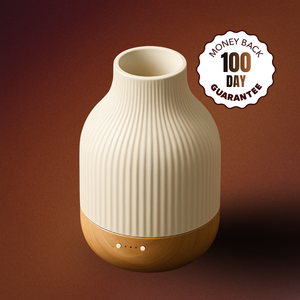
Handcrafted ceramic essential oil diffuser for bedroom and sleep: quieter than a whisper (27.3 dB, lab-test...
Heat Diffuser vs Ultrasonic Diffuser: 9 Key Differences

The nine differences below cover how each diffuser works, what heat can do to the oil, and how each one performs day to day.
Diffusion Method (Heat vs Cool Mist)
Heat diffusers rely on warmth and evaporation; ultrasonic diffusers use vibration to create cool mist.
A heat diffuser raises the temperature of the scented material so volatile compounds evaporate more quickly.
An ultrasonic diffuser mechanically disperses water and essential oil without deliberately heating the mixture.
Effect on Essential Oil Chemical Composition
Ultrasonic diffusion removes deliberate heat as a variable, while heat can affect how some volatile aroma compounds evaporate or change.
Essential oils contain many different molecules, and they do not all respond to heat in the same way.
Research has identified a number of thermolabile aroma compounds that can undergo degradation processes such as oxidation, rearrangement, or bond cleavage under thermal conditions.
That does not mean a heat diffuser instantly “destroys” an essential oil. A more accurate conclusion is that temperature and exposure time can influence its chemical and sensory profile.
Scent Strength and Aroma Quality
Heat diffusers usually create more localized scent, while ultrasonic diffusers spread a softer aroma across the room.
Heat increases evaporation, so the aroma can become noticeable quickly near the device. Different compounds may also evaporate at different rates during the session.
Ultrasonic mist carries diluted essential oil farther from the machine, producing a gentler and often more even scent experience.
If you want substantially stronger fragrance without water, a waterless cold-air diffuser is another option; our guide to cold air diffuser vs ultrasonic diffuser compares the two.
Essential Oil Consumption
Ultrasonic diffusers generally make a small amount of essential oil last longer.
Only a small number of drops is added to a reservoir of water. The exact amount depends on tank size and desired intensity. For Scentreat's 180 ml Ceramic Diffuser, for example, current guidance ranges from approximately 6–8 drops for a lighter scent to 12–15 for a stronger one.
Heat-diffuser consumption is harder to generalize because candle burners, lamp rings, and electric warmers use different reservoir designs.
Coverage Area
Ultrasonic diffusers generally provide more predictable full-room coverage than small heat diffusers.
Heat diffusion relies largely on evaporation and natural room airflow. Ultrasonic mist is actively dispersed away from the machine, making it easier to scent a bedroom, home office, or living area.
Coverage still depends on the specific model and room layout.
Humidity Output
Ultrasonic diffusers add a small amount of moisture to the air; heat diffusers generally do not.
Because ultrasonic diffusers create a water-based mist, some moisture enters the surrounding air. However, an ultrasonic diffuser is designed primarily for scenting and should not be treated as a replacement for a dedicated humidifier.
If you want fragrance without a water-based mist, a heat diffuser or waterless cold-air diffuser may make more sense.
Noise Level
Heat diffusers are usually silent, while ultrasonic diffusers are typically very quiet rather than completely silent.
A candle oil burner has no motor or vibrating plate. Ultrasonic models may produce a faint hum or water sound. Scentreat's current Ceramic and Wood ultrasonic diffusers, for example, are rated at 27.3 dB(A) at 1 meter.
Run Time and Auto Shut-Off
Ultrasonic diffusers generally offer better runtime control.
Many provide:
- Continuous mist
- Intermittent mist
- Timers
- Automatic shut-off when water runs low
Scentreat's current Ceramic and Wood models run approximately 4–5 hours continuously or 8–10 hours intermittently per fill.
Heat diffusers vary much more. Some electric models include timers, but a traditional candle burner has no automatic shut-off and should never be left burning unattended.
Price and Energy Use
Heat diffusers usually have a lower upfront cost, while ultrasonic diffusers provide more controls and features.
A basic oil burner requires very few components. Ultrasonic diffusers add a water reservoir, vibration plate, controls, timers, lights, and automatic shut-off.
Both electric formats generally use relatively little power compared with major household appliances, so purchase price and oil consumption are often more meaningful differences than electricity cost.
Pros and Cons of Heat Diffusers

Pros of Heat Diffusers
Heat diffusers are appealing because they are simple and require very little technology.
Pros include:
- Usually inexpensive
- Silent operation
- Simple setup
- Compact size
- No ultrasonic plate
- No traditional water tank on many designs
- Candle versions require no electricity
- Candle models add warm visual ambiance
Cons of Heat Diffusers
The main limitations are heat exposure, smaller coverage, fewer controls, and additional safety considerations with candle models.
Cons include:
- Heat can affect the evaporation profile of aromatic compounds
- Scent is usually more localized
- Runtime control is often limited
- Fewer automatic shut-off features
- Hot surfaces can cause burns
- Candle versions use an open flame
- Candle burners require active supervision
Pros and Cons of Ultrasonic Diffusers

Pros of Ultrasonic Diffusers
Ultrasonic diffusers combine heat-free mist with relatively low oil consumption and useful everyday controls.
Pros include:
- No open flame
- No deliberate heating of the oil
- Uses relatively little essential oil
- Quiet operation
- Better full-room distribution
- Timers and mist modes
- Automatic shut-off on many models
- Soft cool mist
- Small amount of added moisture
Cons of Ultrasonic Diffusers
The main trade-offs are the need for water, regular tank cleaning, and a softer scent than concentrated waterless diffusion.
Cons include:
- Requires a water reservoir
- Needs regular cleaning
- Water should not be left standing indefinitely
- Scent is less concentrated than waterless diffusion
- Mineral buildup can occur with hard water
- Too much oil may leave residue on the ultrasonic plate
Ultrasonic Diffuser vs Heat Diffuser: Which Diffuser Is Safer?

An ultrasonic diffuser removes the open-flame and hot-bowl risks of candle-powered heat diffusers, but that does not make every ultrasonic setup automatically safer in every situation.
The oil itself, concentration, exposure, pets, children, ventilation, and device placement all matter.
Fire and Burn Risks of Heat Diffusers
Candle-powered oil burners introduce both an open flame and a hot surface.
Fire-safety guidance recommends keeping oil burners on stable, non-combustible surfaces, away from anything that can burn, and never leaving them unattended or operating while you sleep.
Electric heat diffusers eliminate the flame but still contain a heated element. Ultrasonic diffusers use neither an open flame nor a hot oil dish.
Safety Around Pets
Neither diffuser technology should automatically be described as pet-safe.
Veterinary guidance distinguishes between passive systems such as candle or reed diffusion and active systems such as ultrasonic diffusers.
Ultrasonic models release tiny oil-containing droplets into the air. Those droplets may settle on fur or feathers and create additional exposure, particularly for cats and birds.
Heat diffusers do not generally produce the same airborne droplets, but the aroma can still cause respiratory irritation, while candle burners add spill and fire risks.
When pets are present, keep concentrated oils out of reach, ventilate the area, keep sessions conservative, and allow animals to leave the room.
Safety Around Babies and Children
Avoid assuming that heat-free automatically means appropriate for every child.
Ultrasonic diffusers remove the flame and hot surface, but essential oils themselves are highly concentrated.
Johns Hopkins advises using essential oils carefully with children, avoiding overuse, storing oils securely, and consulting a healthcare professional when there is uncertainty about a particular oil or child.
Keep both the diffuser and oil bottles out of reach and avoid directing mist toward a child's face or crib.
Safe Use Tips for Both Diffuser Types
For either diffuser type:
- Follow the manufacturer's instructions
- Use only oils or formulations approved for that device
- Keep concentrated oils away from children and pets
- Use the diffuser in a ventilated space
- Keep it on a stable surface
- Stop use if anyone develops irritation or breathing discomfort
- Clean the device as recommended
For candle-powered heat diffusers:
- Keep combustible materials away
- Never leave the flame unattended
- Extinguish it before leaving the room or going to sleep
Heat Diffuser vs Ultrasonic Diffuser: Which Is Better for You?

For most regular home use, an ultrasonic diffuser is the more versatile choice. Heat diffusers make more sense when simplicity, silence, low upfront cost, or candle ambiance is the priority.
Choose a heat diffuser if you:
- Want occasional fragrance
- Need only a small scenting area
- Prefer completely silent operation
- Want a simple, inexpensive design
- Enjoy candle ambiance and can supervise it
Choose an ultrasonic diffuser if you:
- Want heat-free diffusion
- Use essential oils regularly
- Prefer lower oil consumption
- Want broader room coverage
- Need timers or automatic shut-off
- Prefer a flame-free device
- Want a diffuser for a bedroom or everyday routine
| Your Priority | Better Fit |
|---|---|
| Lowest upfront cost | Heat |
| Silent operation | Heat |
| Candle ambiance | Heat |
| No open flame | Ultrasonic |
| Heat-free diffusion | Ultrasonic |
| Long controlled sessions | Ultrasonic |
| Lower oil use | Ultrasonic |
| Bedroom use | Ultrasonic |
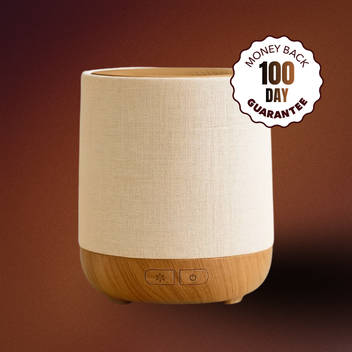
Wood essential oil diffuser that runs up to 10 hours on one 200 ml fill. Quieter than a whisper (27.3 dB, l...
Are There Better Alternatives to Heat Diffusers?

Yes. Ultrasonic and waterless diffusers are the two main heat-free alternatives.
An ultrasonic diffuser uses water and a small amount of essential oil to create a gentle cool mist. It works well for bedrooms, offices, and everyday home routines.
A waterless diffuser skips the traditional water tank and disperses pure essential oil directly. Waterless cold-air models typically provide a stronger scent and are useful when room coverage matters more than minimizing oil use. For a side-by-side breakdown, see our waterless diffuser vs ultrasonic diffuser comparison.
| Type | Best For |
|---|---|
| Ultrasonic | Gentle scent, lower oil use |
| Waterless cold-air | Stronger scent, no water tank |
Both remove the open flame associated with candle-powered heat diffusion.
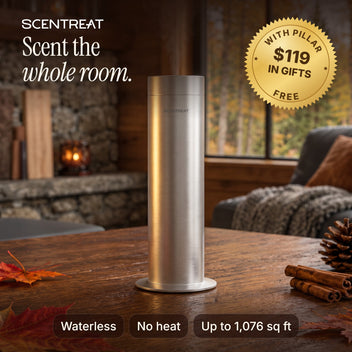
Waterless cold-air diffuser in aluminum: 150 ml oil bottle, covers up to 1,500 sq ft, under 30 dB, app time...
Scentreat Ultrasonic and Waterless Diffusers: Safer, Flame-Free Alternatives to Heat Diffusers

Scentreat offers both ultrasonic and waterless essential-oil diffusers for people who prefer heat-free scenting.
The range covers gentle bedroom mist, larger living spaces, bedside waterless diffusion, and portable car use. Current diffuser support information also lists a 1-year limited warranty and 100-day money-back guarantee.
Scentreat Ultrasonic Diffuser

Scentreat's ultrasonic range includes several designs, and two core options for everyday home use are the Ceramic & Rubber Wood Diffuser and the Minimalist Wood Diffuser.
Both use water plus pure essential oil to create cool mist, are rated at 27.3 dB(A) at 1 meter, and automatically shut off when the water runs low.
The Ceramic model is better suited to smaller rooms and décor-focused spaces, while the Wood model adds a slightly larger tank and wider room coverage.
Key Features and Specifications
Ceramic & Rubber Wood Diffuser
| Feature | Details |
|---|---|
| Type | Ultrasonic cool mist |
| Tank | 180 ml |
| Coverage | Up to 320 sq ft |
| Runtime | 4–5 h continuous / 8–10 h intermittent |
| Noise | 27.3 dB(A) at 1 m |
| Timer | 1 / 3 / 8 h + continuous |
| Auto shut-off | Yes |
| Materials | Porcelain + rubber wood |
Shop the Scentreat Ceramic Diffuser
Minimalist Wood Diffuser
| Feature | Details |
|---|---|
| Type | Ultrasonic cool mist |
| Tank | 200 ml |
| Coverage | Up to 375 sq ft |
| Runtime | 4–5 h continuous / 8–10 h intermittent |
| Noise | 27.3 dB(A) at 1 m |
| Mist modes | Continuous + intermittent |
| Auto shut-off | Yes |
| Design | Fabric cover + wood base |
Shop the Scentreat Wood Diffuser
Best For
The Ceramic Diffuser is best for:
- Bedrooms
- Bedside use
- Home offices
- Reading areas
- Décor-focused spaces
The Wood Diffuser is better for:
- Larger bedrooms
- Living rooms
- Longer evening routines
- Anyone who prefers a larger 200 ml tank
Scentreat Waterless Diffuser

If you want stronger scent without filling a traditional water tank, Scentreat also offers waterless and cold-air options for different room sizes.
The current range includes Pillar for large open spaces, the Night Light Diffuser for the bedside, and CalmRide for cars and portable use.
Key Features and Specifications
| Model | Key Specifications |
|---|---|
| Pillar | 150 ml oil bottle · up to 1,500 sq ft · under 30 dB · Bluetooth app · plug-in |
| Night Light | 5/10/15 ml bottle-fed waterless mode · up to 40 h · optional 120 ml water mode · 325–430 sq ft · USB-C |
| CalmRide | 10–20 ml oil bottles · up to 60 h/charge · 3 mist levels · 1/2/3 h timers · 108–215 sq ft · under 35 dB |
Pillar is a waterless cold-air diffuser, not a traditional glass nebulizer. Its current product page lists a 150 ml oil bottle, no water or heat, coverage up to 1,500 sq ft, and noise below 30 dB.
The Night Light combines bottle-fed waterless diffusion with an optional 120 ml water mode and warm bedside light. CalmRide is a smaller rechargeable option designed around cars, desks, hotel rooms, and similar personal spaces.
Best For
Pillar: large living rooms, open-plan spaces, kitchen-diners, and larger offices.
Night Light Diffuser: bedside tables, bedrooms, reading corners, and anyone who wants a cordless diffuser plus warm light.
CalmRide: cars, desks, travel, hotel rooms, and small personal spaces.
Pair Your Scentreat Diffuser with Scentreat's 100% Pure Essential Oils

A diffuser works best when the oil matches the machine and your preferred scent strength.
Scentreat currently offers 36 single essential oils, giving you botanical options across citrus, floral, herbal, minty, woody, and resinous scent families. Choose one oil on its own or combine complementary oils to build your own diffuser blend.
Popular starting points include Lavender, Peppermint, Lemon, Eucalyptus, Frankincense, Cedarwood, and Sandalwood.
Explore Scentreat's 100% Pure Essential Oils
Conclusion

Heat diffusers are simple, quiet, and inexpensive, while ultrasonic diffusers provide heat-free mist, lower oil use, and more control for regular home use. If you also want to remove the water tank, a waterless cold-air diffuser is another option to consider.
For flame-free scent at home, the Scentreat Ceramic and Wood ultrasonic diffusers suit bedrooms and living rooms, while Pillar, the Night Light Diffuser, and CalmRide cover waterless scenting from large rooms to the car. Choose the diffuser that fits your room, preferred scent strength, and routine, then follow the oil and safety guidance for that specific device.
Stay tuned to the Scentreat Journal and follow us on Facebook and Instagram for essential-oil tips, diffuser guides, and product updates. If you have any questions, contact us at support@scentreat.com.
Frequently Asked Questions
Does Heat Destroy Essential Oil Benefits?
Not completely. Heat can change how some volatile compounds evaporate or degrade, especially with higher temperatures or longer exposure.
Is a Heat Diffuser or Ultrasonic Diffuser Better for Sleep?
An ultrasonic diffuser is usually more practical because it has no open flame and commonly includes timers and automatic shut-off. Choose a quiet model and use scent conservatively.
Can I Use Any Essential Oil in a Heat Diffuser?
Not automatically. Follow the diffuser manufacturer's instructions and check whether the specific oil or formulation is suitable for that device.
Which Uses Less Oil, Heat or Ultrasonic?
Ultrasonic diffusers generally use less essential oil per session because a small number of drops is dispersed through a larger volume of water.
Are Waterless Diffusers Better Than Heat Diffusers?
They can be if you want stronger scent without water, heat, or an open flame. The trade-off is that waterless diffusion generally uses concentrated essential oil more quickly.

