

The best essential oil brands for diffuser use are the ones whose testing, sourcing and scent range match how you actually diffuse. Established names such as doTERRA and Plant Therapy, newer brands like Scentreat, and specialists in organic sourcing or ready-made blends each take a different approach. These ten brands are compared on the points that decide which oils end up in your tank.
In this article
How We Judged These Essential Oil Brands

There is no single characteristic that determines the best essential oil brands for diffuser use. Some shoppers care most about laboratory testing; others prioritize organic certification, price, availability, sourcing, blends, or simply finding scents they enjoy using regularly.
This comparison is based on published company information and product pages rather than laboratory testing of our own. We looked at the factors that matter once the oil is in the tank.
Quality and Testing Transparency
Laboratory testing provides useful information about the identity and chemical composition of an essential oil. GC/MS testing, for example, identifies the constituents present and can flag inconsistencies or potential adulteration.
Testing is one part of the picture, not the whole of it. Companies run different programs, and a test report should not be read as a guarantee of overall quality or of how an oil will smell in your room.
Purity and Ingredient Information
Clear labeling makes it easier to understand what you are buying: the common name, the botanical name, whether the oil is diluted, and whether any additional fragrance ingredients are included.
Sourcing
Sourcing information adds context about where the botanical material comes from and how it is produced. Evaluate specific claims on what the company actually publishes rather than on assumptions about a particular country or growing region.
Product Selection
A useful collection gives you enough variety to explore different scent profiles. Some brands specialize in single oils; others build out blends, organic lines, or ranges designed around particular routines.
Diffuser Compatibility
This guide focuses on oils commonly used in diffusers. Diffuser designs differ — ultrasonic models combine water with a few drops of oil, while waterless models run neat oil — so always follow the instructions for your own device.
Value and Availability
Price, bottle size, availability and ease of reordering all shape the experience of building a collection. The most expensive option is not automatically the best value, and a lower-priced oil is not automatically inferior.
The Brands at a Glance

| Brand | Best for | Key strength |
|---|---|---|
| doTERRA | Quality testing & transparency | Multi-step quality testing approach |
| Plant Therapy | Batch testing | Third-party batch-specific GC/MS information |
| Scentreat | Everyday diffuser use | Pure, undiluted oils and a diffuser-focused selection |
| Edens Garden | Best value | Broad selection and testing transparency |
| Rocky Mountain Oils | Lab transparency | Accessible GC/MS information |
| Mountain Rose Herbs | Best organic | Certified organic selection and quality control |
| Aura Cacia | Traditional aromatherapy | Established aromatherapy focus and testing |
| NOW Foods | Widely available | Broad retail availability |
| REVIVE | Essential oil blends | Wide range of ready-made blends |
| Simply Earth | Subscription | Recurring essential oil experience |
These categories are not a numerical ranking. Each brand is here because it has a particular strength that suits a different kind of diffuser user.
doTERRA — Best for Quality Testing & Transparency
doTERRA is one of the most established names in the essential oil market, and much of its quality messaging is built around its CPTG testing protocol.
According to doTERRA, its quality-control process includes several types of testing: organoleptic testing, microbial testing, gas chromatography, mass spectrometry, FTIR, chirality testing, isotope analysis and heavy-metal testing. The company states that its oils undergo third-party testing and that testing information for single oils can be accessed through its quality resources.
Best for: readers who want the most published testing detail before they buy.
- Extensive quality-testing information
- A large catalogue of single oils and blends
- Product education resources
One distinction is worth keeping clear: CPTG is doTERRA's own trademarked quality protocol, not a government or industry-wide certification for essential oils. For shoppers who weigh testing methodology heavily, it is still one of the more developed frameworks published by a brand.
Plant Therapy — Best for Batch Testing
Plant Therapy is another major name to consider when comparing the best brand of essential oils for diffuser use.
Its clearest differentiator is batch-specific testing. Plant Therapy states that its essential oils are tested by independent laboratories using GC/MS, and that customers can look up testing information using the batch code printed on the bottle. Alongside that, it offers a broad selection of single oils, blends and organic options.
Best for: checking the exact bottle in your hand against its own lab report.
- Third-party GC/MS reports you can look up by batch code
- A broad range of single oils, blends and organic options
If you want documentation tied to the exact bottle in your hand rather than a general statement about testing, that is the practical difference.
Scentreat — Best for Everyday Diffuser Use

Scentreat takes a narrower approach: a growing collection built around everyday aromatherapy and diffuser routines rather than a catalog that covers every botanical.
Its oils are 100% pure and undiluted, with no fillers or synthetic fragrance, and the range is organized by the kind of atmosphere you want rather than by botanical name. That makes it easy to start from a scent family you already like and build outward.
The oils sit in four collections named after the mood they suit, so you can start from a feeling rather than a botanical name. Every collection holds single oils you can diffuse on their own or combine.
| Collection | Suits | Examples from the range |
|---|---|---|
| Sleep & Relax | Evenings and the hour before bed | Lavender, Sandalwood, Vetiver |
| Calm & Balance | An unhurried room at any hour | Ylang Ylang, Frankincense, Patchouli |
| Fresh & Clean | Kitchens, bathrooms, after cooking | Eucalyptus, Tangerine, Tea Tree |
| Focus & Energy | Desks and daytime work | Bergamot, Peppermint, Lemon |
Within a collection the oils still behave differently. Lavender is soft, floral and herbaceous, Sandalwood is warm and creamy-woody, and Vetiver is deeper and distinctly earthy. On the brighter side, Bergamot and Tangerine lift a room quickly, while Eucalyptus is sharper and carries further than either.
Best for: building a small diffuser shelf without learning botanical names first.
- 100% pure, undiluted oils with no fillers or synthetic fragrance
- A diffuser-focused range grouped by mood rather than species
- Single oils you can blend yourself
The appeal is less about having the largest possible catalog and more about making it easy to choose oils based on the scents you naturally enjoy. Browse the full Scentreat essential oil collection to see how the categories are arranged.
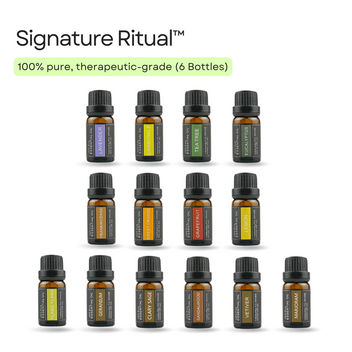
The Signature Ritual™ is our complete 14-oil collection — the full Scentreat library for every mood and rit...
Edens Garden — Best Value
Edens Garden offers a broad collection of single oils and blends, which makes it useful when you want variety without every bottle being a premium purchase.
The company also publishes information about its testing practices and states that its essential oils undergo third-party GC/MS testing.
Best for: covering a lot of scents without paying a premium for each bottle.
- Value-oriented pricing across a wide catalogue
- Testing information published alongside the range
The combination of range and documentation is what makes it practical for building a larger collection by trial and error.
Rocky Mountain Oils — Best for Lab Transparency
Rocky Mountain Oils puts a strong emphasis on laboratory transparency.
The company provides access to GC/MS information associated with its essential oils, so you can look at laboratory results rather than relying only on general marketing descriptions.
Best for: anyone who reads the lab sheet before the label.
- Batch-level GC/MS documentation
- Single oils and blends with detailed product pages
Worth remembering: a GC/MS report describes chemical composition. It does not establish that one oil will suit your diffuser or your preference better than another.
Mountain Rose Herbs — Best Organic
Mountain Rose Herbs has a long-standing focus on organic and natural botanical products, and it is the obvious starting point if certified organic essential oils are a firm requirement.
The company offers certified organic oils and publishes detailed information about its certification and quality-control practices, including identity testing and other laboratory analysis across its botanical range.
Best for: an organic-certified shelf rather than a diffuser-only one.
- Certified organic oils alongside wider botanical products
- Sourcing and quality-control documentation
Organic certification and laboratory testing answer different questions — how a crop was grown, versus what ended up in the bottle. Neither replaces the other.
Aura Cacia — Best for Traditional Aromatherapy
Aura Cacia is an established essential oil brand with a long history in aromatherapy and botanical products.
The company states that essential oil shipments are tested when they arrive at its facilities, with GC/MS analysis used as part of its quality-control process.
Best for: a long-established aromatherapy range you can find in ordinary shops.
- An established aromatherapy name with a broad collection
- Botanical and quality-control information on the label
Its long focus on aromatherapy specifically — rather than wellness products generally — is what makes it a familiar name to people who have been diffusing for years.
NOW Foods — Widely Available
NOW Foods offers a practical advantage the specialist brands cannot match: you can actually find it.
Its essential oils are sold through a broad retail and online network, which makes popular oils easy to buy and, more importantly, easy to reorder. NOW also publishes information about its essential oil quality program, including identity and purity testing.
Best for: restocking without making a special trip for it.
- Wide retail availability and easy reordering
- Familiar oils inside a broad wellness catalogue
If you would rather not depend on specialty aromatherapy websites, that convenience is the whole point.
REVIVE — Best Essential Oil Blends
REVIVE puts its emphasis on blends, which suits anyone who would rather buy a finished scent than compose one.
Building a blend from single oils takes trial, error and a few bottles you end up not using. A ready-made blend skips that and gives you a specific profile straight away.
Best for: skipping the blending step altogether.
- Ready-made blends across many scent combinations
- Single oils alongside the blends
Blends are especially convenient once you already know the kinds of scents you return to.
Simply Earth — Best Subscription
Simply Earth is built around a subscription model rather than one-off purchases.
It suits people who enjoy receiving oils and related products regularly, and who like the discovery element of trying something they would not have picked themselves.
Best for: being sent something new to try each month.
- A subscription of kits and blends
- A guided route into oils you would not have picked yourself
If you run the same two or three oils most evenings, buying individual bottles as they run out is simpler and usually cheaper.
Why Should You Choose Scentreat Oils?

The best brand essential oils for diffuser use depend on what you want from your collection.
If testing documentation is your highest priority, doTERRA and Plant Therapy publish the most about their programs. If organic certification matters most, Mountain Rose Herbs is the reference. If availability decides it, NOW Foods is the easiest to find, while REVIVE concentrates on ready-made blends. Scentreat takes a simpler, diffuser-focused approach.
100% Pure and Undiluted
Scentreat essential oils are 100% pure and undiluted, with no fillers or synthetic fragrance — a straightforward starting point when you are choosing single oils for a diffuser rather than assembling a reference collection.
Easy Scent Categories
The range is browsable by the kind of aroma you want rather than by botanical name — the four collections in the table above are the entry points.
Collections such as Sleep & Relax, Calm & Balance, Fresh & Clean and Focus & Energy group the oils the same way, so you can build around the profiles you actually enjoy.
Easy to Create Your Own Blends
You do not need a large collection to experiment. Starting with versatile oils such as Lavender, Frankincense, Sandalwood, Bergamot or Tangerine already gives you several directions to explore — our guide to blending oils for a diffuser covers the ratios.
Which Essential Oil Brands to Avoid?
Rather than a blacklist, it is more useful to recognize the warning signs that make an essential oil difficult to evaluate.
Be cautious with products that have:
- Vague ingredient information
- No clear indication of whether the oil is diluted
- Undisclosed fragrance ingredients
- Unsupported purity claims
- Very little product information
- Confusing labeling
- Marketing claims that are difficult to verify
What About "Therapeutic Grade"?
The term "therapeutic grade" should not be treated as a universal certification or automatic proof of quality. There is no single government-established grading system that makes an essential oil superior simply because it carries the label.
The same principle applies to testing. A brand does not become unreliable simply because it does not publish a particular type of laboratory report publicly. Consider the complete picture instead: labeling, ingredient information, sourcing, testing practices where available, and whether the company's claims are clear and supportable.
What to Look for in an Essential Oil Brand for Diffuser Use

When comparing the best essential oil brands for diffuser use, focus on the information that actually changes your decision.
Clear Botanical Information
Look for the common name and, where available, the botanical name. That is what distinguishes species and varieties sold under similar common names.
Purity and Dilution
Check whether the bottle holds pure essential oil or a diluted preparation. The two are different products, and a diluted oil behaves differently in a diffuser — some waterless models are not designed for carrier oils at all.
Testing Transparency
If laboratory information matters to you, look at how the company tests and at what level. GC/MS describes chemical composition; other methods cover identity, contamination and related quality checks.
Sourcing
Sourcing detail adds context about where the plant material comes from. Country of origin alone is not proof of higher or lower quality — growing conditions and the distiller matter more.
Scent Profile
For diffuser use, you have to actually enjoy the aroma. Decide which families you prefer:
- Floral
- Citrus
- Woody
- Earthy
- Minty
- Herbaceous
- Resinous
- Fresh
Bottle and Dispensing
A good orifice reducer lets you add oil one drop at a time. Since essential oils are concentrated, controlled dispensing is how you adjust scent strength without wasting the bottle.
Diffuser Compatibility
Always check your diffuser's instructions first. Ultrasonic diffusers use water plus a few drops of oil, while waterless models diffuse neat oil — see our guide to ultrasonic diffusers for how the formats differ.
Price Per Milliliter
Compare bottle size as well as the listed price. A larger bottle often costs more upfront and less per milliliter, which is the number that matters for an oil you use nightly.
Which Oils Work Best in an Ultrasonic Diffuser?

Ultrasonic diffusers combine water with a small amount of essential oil and use ultrasonic vibration to disperse a cool, fine mist. They add a little moisture to the air, but they are not humidifiers.
There is no oil that is universally best. The right choice depends on your preferred scent profile and the atmosphere you want.
| Essential oil | Scent profile | Often suited to |
|---|---|---|
| Lavender | Soft, floral, herbaceous | Evening routines |
| Lemon | Bright, citrus | Fresh daytime atmosphere |
| Sweet Orange | Sweet, citrus | Warm, cheerful spaces |
| Peppermint | Cool, minty | Fresh-feeling spaces |
| Eucalyptus | Fresh, camphoraceous | Crisp aromatic environments |
| Frankincense | Warm, resinous | Grounded atmosphere |
| Sandalwood | Warm, woody | Cozy evening spaces |
| Bergamot | Citrus-floral | Light, fresh routines |
Lavender
Soft, floral and herbaceous, and the most versatile option for an evening diffuser routine. See Lavender essential oil.
Lemon
A bright citrus aroma that suits a kitchen or a workspace when you want the room to feel fresher. See Lemon essential oil.
Sweet Orange
Naturally sweet citrus, and the oil most likely to suit a room several people share. See Sweet Orange essential oil.
Peppermint
Crisp and cooling, and noticeable in small amounts — start low and adjust to your diffuser and your preference. See Peppermint essential oil.
Eucalyptus
Distinctly fresh and camphoraceous, and stronger than softer floral oils. See Eucalyptus essential oil.
Frankincense
Warm and resinous, with the depth that citrus blends usually lack. See Frankincense essential oil.
Sandalwood
Smooth, warm and woody — the choice for grounded evening aromas. See Sandalwood essential oil.
Bergamot
Citrus with a floral edge, which makes it versatile in lighter blends. See Bergamot essential oil.
If you are not sure how much to use, our guide on how many drops to add covers it by tank size.
Conclusion

Finding the best essential oil brand for diffuser use starts with knowing what matters most to you. Testing transparency, organic certification, sourcing, price, availability, blends and scent preference are all reasonable priorities — they simply do not carry equal weight for every shopper.
doTERRA and Plant Therapy stand out for their detailed testing approaches, with Edens Garden and Rocky Mountain Oils offering strong testing-focused options too. Mountain Rose Herbs and Aura Cacia bring established botanical and aromatherapy credentials, NOW Foods leads on accessibility, and REVIVE and Simply Earth take their own routes through blends and subscriptions.
Scentreat is the focused option for shoppers who want 100% pure, undiluted essential oils for everyday diffuser routines. Start with the essential oil collection, pair it with a diffuser from the diffuser range, and find more practical guides in the Scentreat Journal — or follow along on Facebook and Instagram.
Frequently Asked Questions
What is the best essential oil brand for diffuser use?
There is no single brand that is best for every diffuser user. doTERRA and Plant Therapy are notable for their testing approaches, while Scentreat focuses on everyday diffuser use, Mountain Rose Herbs on organic options, REVIVE on blends, and NOW Foods on broad availability.
What is the best brand of essential oils for diffuser?
It depends on your priorities. Weigh testing information, ingredient labeling, sourcing, product range, price and availability — then check that the brand actually stocks the scent profiles you enjoy using.
Is doTERRA better than Plant Therapy?
Both place significant emphasis on quality and testing, but they take different approaches. doTERRA highlights its CPTG multi-step protocol, which is its own trademarked standard, while Plant Therapy highlights third-party batch-specific GC/MS testing you can look up by batch code.
Does Plant Therapy test its essential oils?
Plant Therapy states that its essential oils are tested by independent laboratories using GC/MS, and that customers can access the testing information associated with the batch code on their bottle.
Does "therapeutic grade" mean an essential oil is better?
Not necessarily. "Therapeutic grade" is not a universally standardized government or industry certification, so the term on its own does not establish that one essential oil is superior to another. Look at the labeling, sourcing and testing practices instead.
Do essential oils need to be GC/MS tested?
GC/MS testing gives useful information about an oil's chemical composition and identity. It is one part of evaluating a product, though, and the absence of a public report does not by itself prove that an oil is poor quality.
Which essential oils work best in an ultrasonic diffuser?
Popular options include Lavender, Lemon, Sweet Orange, Peppermint, Eucalyptus, Frankincense, Sandalwood and Bergamot. The right one depends mainly on the scent profile and the atmosphere you want in the room.
Can I use any essential oil in any diffuser?
Not necessarily. Ultrasonic diffusers take a few drops of pure oil in water, waterless models run neat oil from a compatible bottle, and cartridge systems accept only their own refills. Follow the manufacturer's instructions, especially when switching between formats.
How do I choose a trustworthy essential oil brand?
Look for clear labeling, botanical names, explicit dilution information, useful sourcing detail and transparent quality-control practices. It also helps to choose a brand whose scent selection matches how you actually use your diffuser.

